Is it necessary to use a different function name in the chain rule?

Click For Summary

Discussion Overview

The discussion revolves around the application of the chain rule in calculus, particularly regarding whether it is necessary to use different function names when substituting variables in composite functions. Participants explore the implications of naming conventions and the potential for ambiguity in notation, using specific examples involving functions of multiple variables.

Discussion Character

  • Debate/contested
  • Mathematical reasoning

Main Points Raised

  • Some participants propose that when defining a function ##g## in terms of another function ##f##, the chain rule can be expressed as ##\frac{\partial g}{\partial u_j}=\sum_{i=1}^n\frac{\partial f}{\partial x_i}\frac{\partial x_i}{\partial u_j##.
  • There is a question about the naming of a function after substituting a variable, with some suggesting it should be renamed to avoid confusion, while others argue it can retain its original name.
  • Some participants assert that using the same function name for different variable dependencies can lead to ambiguity, particularly when evaluating the function at specific points.
  • Others argue that the context should clarify which variable is being referenced, and that function composition is a valid approach without needing to rename the function.
  • There is a contention regarding the use of partial derivatives versus ordinary derivatives in the context of the chain rule, with some advocating for the latter in cases of single-variable functions.

Areas of Agreement / Disagreement

Participants express differing views on whether it is necessary to rename functions when changing variables. While some agree that renaming can reduce ambiguity, others maintain that context is sufficient to clarify meaning. The discussion remains unresolved regarding the best approach to naming conventions and the use of derivatives.

Contextual Notes

Participants highlight potential ambiguities in notation when using the same function name for different variable dependencies, but do not reach a consensus on a universally accepted notation. The discussion also reflects varying interpretations of the chain rule and its application in different contexts.

Happiness
Messages
686
Reaction score
30
Is the chain rule below wrong?
Screen Shot 2016-06-19 at 12.03.26 am.png


What I propose is as follows:

Given that ##x_i=x_i(u_1, u_2, ..., u_m)##. If we define the function ##g## such that ##g(u_1, u_2, ..., u_m)=f(x_1, x_2, ..., x_n)##, then

##\frac{\partial g}{\partial u_j}=\sum_{i=1}^n\frac{\partial f}{\partial x_i}\frac{\partial x_i}{\partial u_j}##.

This version of chain rule is what is being used, it seems, in the example below when the answer given replaces ##f## with ##g## in the last line.

A related question is as follows:

Consider the function ##V(r)=\frac{1}{3}\pi r^2h##, where ##h## is a constant. Suppose ##r## is a function of ##t## such that ##r(t)=at^2##, where ##a## is a constant.

What do we call the function after substituting ##r## with ##at^2##, which gives ##\frac{1}{3}\pi a^2t^4h##?

I guess we have to give it a different name: ##W(t)=\frac{1}{3}\pi a^2t^4h##, because ##V(t)## would give ##V(t)=\frac{1}{3}\pi t^2h##. Then ##\frac{\partial V(t)}{\partial t}=\frac{\partial V(r)}{\partial r}##. Am I right?

If we still call it ##V## as follows: ##V(t) = \frac 1 3 \pi a^2 t^4 h##, we will run into a problem.

Since ##V(r)=\frac{1}{3}\pi r^2h##, when ##r=2##, we would write ##V(2)=\frac{1}{3}\pi\,2^2\,h##. But if we write ##V(t)=\frac{1}{3}\pi a^2t^4h##, when ##t=2##, we have ##V(2)=\frac{1}{3}\pi a^2\,2^4\,h##. Then ##V(2)\neq V(2)##.
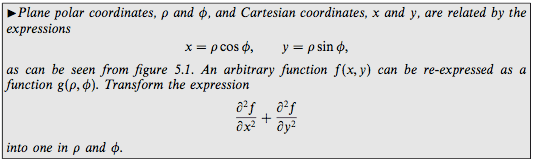
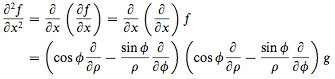
Screen Shot 2016-06-19 at 12.04.05 am.png


Screen Shot 2016-06-19 at 12.04.19 am.png
 
Last edited:
Physics news on Phys.org
About the first question I think the answer is that it is correct (the formula 5.17), but about
Happiness said:
. Am I right?
The correct answer is the same, this one
##\frac{\partial V(t)}{\partial t}=\frac{\partial V(r)}{\partial r}\frac{\partial r}{\partial t}##
I did not check the last equation but I think it is not too difficult
 
Happiness said:
Is the chain rule below wrong?
View attachment 102183

What I propose is as follows:

Given that ##x_i=x_i(u_1, u_2, ..., u_m)##. If we define the function ##g## such that ##g(u_1, u_2, ..., u_m)=f(x_1, x_2, ..., x_n)##, then

##\frac{\partial g}{\partial u_j}=\sum_{i=1}^n\frac{\partial f}{\partial x_i}\frac{\partial x_i}{\partial u_j}##.

This version of chain rule is what is being used, it seems, in the example below when the answer given replaces ##f## with ##g## in the last line.

A related question is as follows:

Consider the function ##V(r)=\frac{1}{3}\pi r^2h##, where ##h## is a constant. Suppose ##r## is a function of ##t## such that ##r(t)=at^2##, where ##a## is a constant.

What do we call the function after substituting ##r## with ##at^2##, which gives ##\frac{1}{3}\pi a^2t^4h##?
You still call it V, but now instead of V being a function of r, it's a function of t. You could refer to it as ##V(t) = \frac 1 3 \pi a^2 t^4 h##, or you could refer to it as ##V(r(t))##
Partials really don't have a place here. The first definition of V has it as a function of r alone (h is a constant, you said), so writing ##\frac{\partial V(r)}{\partial r}## is an overcomplication. ##\frac{d V(r)}{dr}## is appropriate.

Now, since r is a function of t alone, then you can refer to ##\frac{d V}{dt}##, and can calculate it using the chain rule for functions of a single variable.
Happiness said:
I guess we have to give it a different name: ##W(t)=\frac{1}{3}\pi a^2t^4h##, because ##V(t)## would give ##V(t)=\frac{1}{3}\pi t^2h##. Then ##\frac{\partial V(t)}{\partial t}=\frac{\partial V(r)}{\partial r}##. Am I right?
 
Mark44 said:
You still call it V, but now instead of V being a function of r, it's a function of t. You could refer to it as ##V(t) = \frac 1 3 \pi a^2 t^4 h##.

Since ##V(r)=\frac{1}{3}\pi r^2h##, when ##r=2##, we would write ##V(2)=\frac{1}{3}\pi\,2^2\,h##. But if we write ##V(t)=\frac{1}{3}\pi a^2t^4h##, when ##t=2##, we have ##V(2)=\frac{1}{3}\pi a^2\,2^4\,h##. Then ##V(2)\neq V(2)##.
 
Happiness said:
Given that ##x_{i}=x_{i}(u_1,u_2,...,u_m)x_i=x_i(u_1, u_2, ..., u_m)##. If we define the function ##g## such that ##g(u_1,u_2,...,u_m)=f(x_1,x_2,...,x_n)##, then

I think it is understood also that you can express ##u_i=u_i(x_{1},\ldots,x_{n})##...
 
Happiness said:
Since ##V(r)=\frac{1}{3}\pi r^2h##, when ##r=2##, we would write ##V(2)=\frac{1}{3}\pi\,2^2\,h##. But if we write ##V(t)=\frac{1}{3}\pi a^2t^4h##, when ##t=2##, we have ##V(2)=\frac{1}{3}\pi a^2\,2^4\,h##. Then ##V(2)\neq V(2)##.
No, that's not right. You're comparing apples and oranges. If r = 2, then V(2) = ##\frac{1}{3}\pi r^2h = \frac{1}{3}\pi 2^2h = \frac{4}{3}\pi h##. It's understood here that V(2) means that you evaluate things for r = 2.
V(r(2)) = V(2), but when r = 2 you're going to get a different value of V than for t = 2.

If r = 2, then ##t = \pm \sqrt{\frac 2 a}##, so V(r = 2) using the first formula is exactly equal to V(##t = \pm \sqrt{\frac 2 a}##) using the second formula.

This is basic function composition.
 
Mark44 said:
No, that's not right. You're comparing apples and oranges. If r = 2, then V(2) = ##\frac{1}{3}\pi r^2h = \frac{1}{3}\pi 2^2h = \frac{4}{3}\pi h##. It's understood here that V(2) means that you evaluate things for r = 2.
V(r(2)) = V(2), but when r = 2 you're going to get a different value of V than for t = 2.

If r = 2, then ##t = \pm \sqrt{\frac 2 a}##, so V(r = 2) using the first formula is exactly equal to V(##t = \pm \sqrt{\frac 2 a}##) using the second formula.

This is basic function composition.

So ##V(2)## could either mean ##V(r=2)## or ##V(t=2)##? And there is no universally accepted notation? It seems like this ambiguity can be avoided if we use good notations.

( ##V(r=2)## and ##V(t=2)## are themselves not good notations.)
 
Last edited:
Happiness said:
So ##V(2)## could either mean ##V(r=2)## or ##V(t=2)##?
It should be clear from the context in which this is written.
Happiness said:
And there is no universally accepted notation? It seems like this ambiguity can be avoided if we use good notations.
Yes, of course.
If you write ##V(r) = \frac{1}{3}\pi r^2h##, and then also write ##V(t) = \frac{1}{3}\pi (at^2)^2h## (as you have done here), then writing V(2) is ambiguous. Does 2 represent a value of r or is it a value of t?

The first formulation of V above could be written as ##V(r(t)) = \frac{1}{3}\pi (r(t))^2h##, where ##r(t) = at^2##. That would clear up any ambiguity.
 
Mark44 said:
If you write ##V(r) = \frac{1}{3}\pi r^2h##, and then also write ##V(t) = \frac{1}{3}\pi (at^2)^2h## (as you have done here), then writing V(2) is ambiguous. Does 2 represent a value of r or is it a value of t?

If ##V## is a function that maps ##r## to ##\frac{1}{3}\pi r^2h##, then shouldn't it map ##t## to ##\frac{1}{3}\pi t^2h##? Then isn't ##V(t)=\frac{1}{3}\pi t^2h##?

This is the main reason why I believe we shouldn't write ##V(r(t))## as ##V(t)##. We should name it differently, for example, as ##W(t)##. Then ##V(2)## means ##r=2## and ##W(2)## means ##t=2##.
 
  • #10
Happiness said:
If ##V## is a function that maps ##r## to ##\frac{1}{3}\pi r^2h##, then shouldn't it map ##t## to ##\frac{1}{3}\pi t^2h##?
Yes, and V maps x to ##\frac{1}{3}\pi x^2h##, and it maps z to ##\frac{1}{3}\pi z^2h##, but so what?

What you seem to be forgetting is that there is a function composition going on, with V being a function of r, and r being a function of t. In an abuse of notation, we have V = V(r(t))
For a given value of t, find r(t), and then find V(r(t)). So if t = 2, r(2) = 4a, and V(r(2)) = ##\frac 4 3 \pi h##
Happiness said:
Then isn't ##V(t)=\frac{1}{3}\pi t^2h##?

This is the main reason why I believe we shouldn't write ##V(r(t))## as ##V(t)##. We should name it differently, for example, as ##W(t)##. Then ##V(2)## means ##r=2## and ##W(2)## means ##t=2##.
There's no need to give it a different name if you understand function composition.
 
  • #11
Happiness said:
I guess we have to give it a different name: ##W(t)=\frac{1}{3}\pi a^2t^4h##, because ##V(t)## would give ##V(t)=\frac{1}{3}\pi t^2h##. Then ##\frac{\partial V(t)}{\partial t}=\frac{\partial V(r)}{\partial r}##.
I don't know why you're using partial derivatives. As this thread is about the chain rule, and your example is the composition of two functions of one variable, ordinary derivatives suffice. Given V in terms of r and r in terms of t, ##V'(t_0) = V'(r(t_0))*r'(t_0)##, or ##V'(t_0) = \left.\frac{dV}{dr}\right |_{r(t_0)} \left.\frac{dr}{dt} \right|_{t_0}##
 
  • #12
Consider ##z## to be a function of ##y##, which is itself a function of ##x##. The chain rule may be written as ##\frac{dz}{dx}=\frac{dz}{dy}\frac{dy}{dx}##.

The ##z## on the LHS means ##z(y(x))##, which is equivalent to ##(z\circ y)(x)##, whereas the ##z## on the RHS means ##z(y)##. So strictly speaking, they are not the same, right? ##(z\circ y\neq z)##
 
  • #13
Happiness said:
Consider ##z## to be a function of ##y##, which is itself a function of ##x##. The chain rule may be written as ##\frac{dz}{dx}=\frac{dz}{dy}\frac{dy}{dx}##.
Sure. Here the context is that on the left side, we're talking about a map from x value to z values, and on the right side, the left derivative refers to a map from y values to z values. Certainly the two map formulas are different.
Happiness said:
The ##z## on the LHS means ##z(y(x))##, which is equivalent to ##(z\circ y)(x)##, whereas the ##z## on the RHS means ##z(y)##. So strictly speaking, they are not the same, right? ##(z\circ y\neq z)##

Some textbooks use a different function name. If x = g(t), and y = f(x), then they will define z = h(t) = f(g(t)). My point was that, as long as the context was understood, it wasn't necessary to introduce another function. If you have defined V in terms of r, then it's understood that V(2) means to evaluate V at r = 2. But if there is uncertainty whether you mean V as a function r or V as a function of t (with different formulas), then it's not clear what V(2) is supposed to mean.
 

Similar threads

  • · Replies 3 ·
Replies
3
Views
3K
  • · Replies 5 ·
Replies
5
Views
2K
  • · Replies 5 ·
Replies
5
Views
2K
  • · Replies 16 ·
Replies
16
Views
3K
  • · Replies 5 ·
Replies
5
Views
3K
  • · Replies 8 ·
Replies
8
Views
2K
  • · Replies 1 ·
Replies
1
Views
3K
  • · Replies 9 ·
Replies
9
Views
3K
  • · Replies 4 ·
Replies
4
Views
4K
  • · Replies 3 ·
Replies
3
Views
2K
