Is it possible to create a higher energy photon from two lower ones?

  • Context: Graduate 
  • Thread starter Thread starter zrek
  • Start date Start date
  • Tags Tags
    Energy Photon
Click For Summary

Discussion Overview

The discussion centers on the possibility of two lower energy photons combining to form a single higher energy photon, exploring theoretical implications, conservation laws, and the role of mediums in such processes. It includes considerations of angular momentum conservation, the photoelectric effect, and the behavior of photons in different contexts.

Discussion Character

  • Debate/contested
  • Technical explanation
  • Conceptual clarification

Main Points Raised

  • Some participants propose that two photons could theoretically combine their energies under specific conditions, while others argue that this is not possible due to conservation of angular momentum.
  • One participant questions the implications of photon splitting and whether it is an irreversible process.
  • Another participant mentions Furry's Theorem, suggesting that a single photon cannot downshift to two photons, and discusses the implications of odd and even numbers of photons on spin-statistics.
  • Some participants note that while the process may not be possible in a vacuum, it could be feasible in a medium, such as a nonlinear crystal, which can account for the missing angular momentum.
  • There is a discussion about whether a lonely atom can be considered a medium and how it might interact with the photons.
  • Concerns are raised regarding the interpretation of the state of the medium during photon interactions, particularly in relation to the conservation of angular momentum.
  • One participant speculates that changes in electron spin within the medium may contribute to the conservation of angular momentum, while questioning the assertion that the state of the crystal remains unchanged.

Areas of Agreement / Disagreement

Participants express multiple competing views regarding the feasibility of combining photons and the role of mediums, with no consensus reached on the core question of whether higher energy photons can be created from lower energy ones.

Contextual Notes

Discussions involve complex interactions of photons and conservation laws, with limitations including assumptions about the nature of mediums and the specifics of photon behavior in different contexts. The implications of Furry's Theorem and the role of spin-statistics are also noted as significant factors in the discussion.

zrek
Messages
115
Reaction score
0
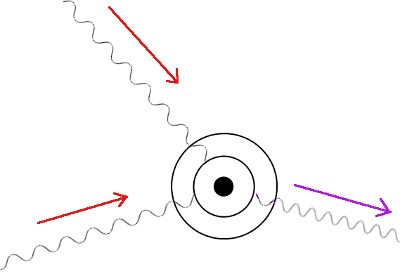
Is it possible for two photons to join their energy to structure a one photon of higher frequency?
join.png

Let's assume that the two incoming (IR) photons are prepared specially: coming in the same time, same wavelength, phase, appropriate (complementer) spins and angle, etc. They arrive the appropriate atom and giving the energy at the same time. The atom gets energized and releases one single photon (UV) with the double energy.

1. This is possible... OK, but why this is not happening in case of the photoelectric effect?
2. This is not possible, because of ... (the energy-time uncertainty?).

What do you think?
Thanks for the anwsers in advance.
 
Physics news on Phys.org
No, it's not possible by conservation of angular momentum. The photon is spin-1, which ordinarily means that possible values for the spin along some axis (say, the z-axis) are +1, 0, and -1. Because it's massless, the longitudinal polarization state is forbidden and the z-component can only be +1 or -1. Hence, for two photons, the total z-component of angular momentum will be +2, 0, or -2. However, the outgoing photon will be +1 or -1. Hence, conservation of angular momentum would be violated by this process.
 
LastOneStanding said:
No, it's not possible by conservation of angular momentum [...]

OK, and what is the difference if we are using a twophoton?

splitandjoin.png


I mean let's imagine an experiment when we split an IR photon to a twophoton and then we try to join them? Or it is also not possible? Is the photon splitting an irreversible process?
 
fluidistic said:

Thank you, I have found this in the thread:
Vanadium 50 said:
A single photon cannot downshift to 2 because of something called Furry's Theorem. proved by Wendell Furry. This generalizes to any even number of photons.

If you have an odd number of photons, you will discover that spin-statistics sets all the amplitudes to zero: you end up with terms like the momentum of one photon dotted into the difference of the other two, which spin-statistics will force to be zero.

In matter, the premises of these arguments are no longer strictly true, and non-linear effects can produce them.

Am I understand well that if a special matter contributed, LastOneStanding's explanation about the spins is not always prevents the join?
 
Due to angular momentum conservation the mentioned process is not possible in vacuum, but is probably possible in a medium.
 
Demystifier said:
Due to angular momentum conservation the mentioned process is not possible in vacuum, but is probably possible in a medium.

Great, thank you. Please make it clear for me: if there is a lonely atom involved in the effect (like the case on the figure) is it count as a medium?
Would you be so kind and explain a little more how the spin problem is solved by a medium?
Thank you in advance.
 
zrek said:
Great, thank you. Please make it clear for me: if there is a lonely atom involved in the effect (like the case on the figure) is it count as a medium?
In principle, yes.

zrek said:
Would you be so kind and explain a little more how the spin problem is solved by a medium?
The medium can take the missing angular momentum, so that the total angular momentum is conserved.

The process has still a very low probability (essentially because it typically requires a decrease of total entropy), but the time-inverted process - parametric down-conversion - is often produced in laboratories.
http://en.wikipedia.org/wiki/Parametric_down-conversion
In this case the medium is a nonlinear crystal.
 
Very good, this is exactly what I was thinking about the problem, but I was uncertain.

Thank you very much!
 
  • #10
Demystifier said:
The medium can take the missing angular momentum, so that the total angular momentum is conserved.

The process has still a very low probability (essentially because it typically requires a decrease of total entropy), but the time-inverted process - parametric down-conversion - is often produced in laboratories.
http://en.wikipedia.org/wiki/Parametric_down-conversion
In this case the medium is a nonlinear crystal.

From the Wiki article: "A nonlinear crystal is used to split photons into pairs of photons that, in accordance with the law of conservation of energy, have combined energies and momenta equal to the energy and momentum of the original photon, are phase-matched in the frequency domain, and have correlated polarizations. (The state of the crystal is unchanged by the process.)"

Is this a mistake? How can the state of the crystal be unchanged when it needs to pick up the difference in angular momenta from the incoming and outgoing photons? I agree it must do—and obviously such processes due occur since down conversion with non-linear media is done regularly—but this seems at odds with the article. The citation for that paragraph is a book I don't have access to.
 
  • #11
I have an idea about it. Maybe one of the electrons in the shell of the medium atom changes its spin. The crystal (structure) itself remains unchanged (in avarage at least). Please correct me if I'm wrong.
 
  • #12
zrek said:
I have an idea about it. Maybe one of the electrons in the shell of the medium atom changes its spin. The crystal (structure) itself remains unchanged (in avarage at least). Please correct me if I'm wrong.

Well, that's what I assumed happens but then I would strongly dispute the wording that "The state of the crystal is unchanged by the process." The overall state of the crystal includes the spin states of its electrons.
 

Similar threads

  • · Replies 5 ·
Replies
5
Views
2K
  • · Replies 8 ·
Replies
8
Views
2K
  • · Replies 0 ·
Replies
0
Views
916
  • · Replies 23 ·
Replies
23
Views
4K
  • · Replies 29 ·
Replies
29
Views
4K
  • · Replies 3 ·
Replies
3
Views
3K
  • · Replies 21 ·
Replies
21
Views
5K
  • · Replies 3 ·
Replies
3
Views
2K
  • · Replies 76 ·
3
Replies
76
Views
7K
  • · Replies 3 ·
Replies
3
Views
3K