Is My Calculation of Centripetal Acceleration and Tangential Velocity Correct?

Click For Summary

Homework Help Overview

The discussion revolves around calculating centripetal acceleration and tangential velocity for a system involving two turntables, one rotating around its own axis while also revolving around the center of the larger turntable. The original poster presents their calculations and seeks validation of their logic and results.

Discussion Character

  • Exploratory, Assumption checking, Mathematical reasoning

Approaches and Questions Raised

  • The original poster attempts to calculate tangential velocity and centripetal acceleration at a specific point, considering both rotational and revolutionary motions. Some participants question the accuracy of the calculations and the underlying assumptions, particularly when considering special cases such as when one of the angular velocities is zero.

Discussion Status

Participants are actively engaging with the original poster's calculations, providing feedback and prompting further reflection on the assumptions made. There is an exploration of specific cases to test the validity of the original approach, but no explicit consensus has been reached regarding the correctness of the calculations.

Contextual Notes

There is a focus on the implications of different angular velocities and their effects on the calculated values. The discussion highlights the need for clarity on the orbital paths and the conditions under which the calculations hold true.

user079622
Messages
449
Reaction score
29
Homework Statement
I must find centripetal acceleration and tangential velocity, I post this to check my results.
Relevant Equations
vt = ω r
ac = ω2 r
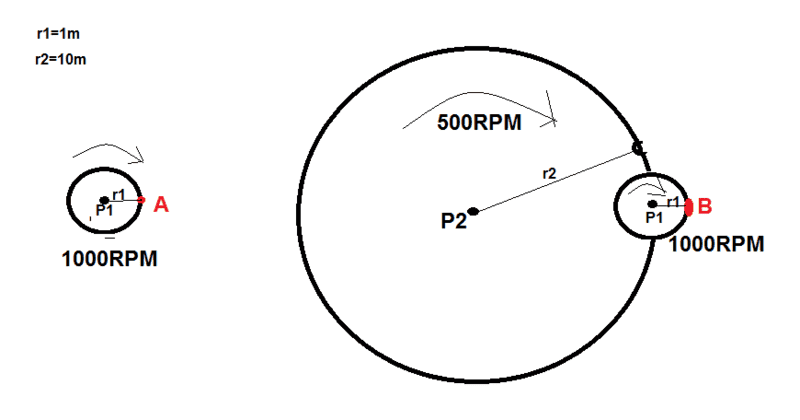
Right picture is two turn tables on of top of the other, smaller turn table is connected with shaft to bigger one so it rotate around itself and in same time "revolve" around center of bigger one which is also rotate about itself. They both rotate clockwise.

I observe case from inertial frame of reference, earth. I must find centripetal acceleration and tangential velocity in point B.

r1=1m ω1=1000RPM
r2=10 ω2=500RPM

Tangential velocity in point B = tangen. velocity in point P1(right picture) + tangen. velocity in point A
vt = ω r
A= 104.72 m/s
P1=523.6 m/s

They are two parallel velocity vectors pointing in same direction so I add them to get tangential velocity in point B=628.32 m/s

Centripetal acceleration in point B = cent. acceleration in point P1(right picture) + cent. acceleration in point A

ac = ω2 r
P1= 27416 m/s2
A= 10966 m/s2

They are two vectors that point in same direction,(toward left at my graph), I add them to get centripetal acceleration in point B= 38382 m/s2

Is my logic and results correct?
Point A show case where smaller turn table rotate just around itself, revolution is zero)
fff.png
 
Last edited:
Physics news on Phys.org
Looks fine to me.
 
haruspex said:
Looks fine to me.
Do you maybe have any doubts about the way how I calculated centripetal acceleration?
 
user079622 said:
Do you maybe have any doubts about the way how I calculated centripetal acceleration?
Let me think on it some more…
A sanity check: consider ##\omega_1=\omega_2##.
Now B is always at ##r_1+r_2## from ##P_2##, so its acceleration is clearly ##(r_1+r_2)\omega^2##. Your method gives ##r_1\omega^2+r_2\omega^2##, which is the same.
Try ##\omega_1=0##.
 
haruspex said:
Let me think on it some more…
A sanity check: consider ##\omega_1=\omega_2##.
In this case is easy and clear.
 
Last edited:
So are you reassured?
 
haruspex said:
So are you reassured?
If ω1=ω2 then vt=576 m/s and acc=30159 m/s2
This is moon case, like small table is locked so it cant rotate in relation to big one.
 
Last edited:
user079622 said:
If ω1=ω2 then vt=576 m/s and acc=30159 m/s2
This is moon case, like small table is locked so it cant rotate in relation to big one.
Yes, but the point of considering such special cases is to see whether your approach in post #1 works. Don't plug in any numbers. I showed in post #4 that your method gives the right formula for that case. Can you do the same for ##\omega_1=0##?
 
haruspex said:
Yes, but the point of considering such special cases is to see whether your approach in post #1 works. Don't plug in any numbers. I showed in post #4 that your method gives the right formula for that case. Can you do the same for ##\omega_1=0##?
Formula for my case is r1 (ω1)2 + r2 ( ω2)2

I must think...
If ω1=0, that mean small table not rotate from earth frame,so point B always point toward right side
If is not rotate then acc=0 from rotation, so it has only acceleration from "revolution" around point P2, that is equal
(r1+r2 ) (ω2)2

But small table then rotate in relation to big table at -500RPM.
Am I correct?
 
  • #10
user079622 said:
If is not rotate then acc=0 from rotation, so it has only acceleration from "revolution" around point P2, that is equal
(r1+r2 ) (ω2)2
That would conflict with your general solution. Plugging ##\omega_1=0## into ##r_1\omega_1^2+r_2\omega_2^2## gives ##r_2\omega_2^2##, not ##(r_1+r_2)\omega_2^2##.
But fortunately your reasoning in post #9 is wrong. If ##\omega_1=0##, what point is B orbiting?
 
  • #11
haruspex said:
That would conflict with your general solution. Plugging ##\omega_1=0## into ##r_1\omega_1^2+r_2\omega_2^2## gives ##r_2\omega_2^2##, not ##(r_1+r_2)\omega_2^2##.
But fortunately your reasoning in post #9 is wrong. If ##\omega_1=0##, what point is B orbiting?
Yes I miss orbit path
B orbit around point P2+r1
so acc= r2 (ω2)2
 
Last edited:
  • #12
user079622 said:
Yes I miss orbit path
B orbit around point P2+r1
so acc= r2 (ω2)2
Right. So your solution in post #1 looks to be good.
 
  • #13
haruspex said:
Right. So your solution in post #1 looks to be good.
Thanks for help.
 

Similar threads

  • · Replies 17 ·
Replies
17
Views
2K
  • · Replies 1 ·
Replies
1
Views
3K
  • · Replies 2 ·
Replies
2
Views
2K
  • · Replies 3 ·
Replies
3
Views
3K
Replies
1
Views
2K
  • · Replies 1 ·
Replies
1
Views
3K
  • · Replies 2 ·
Replies
2
Views
3K
  • · Replies 35 ·
2
Replies
35
Views
5K
Replies
8
Views
1K
  • · Replies 15 ·
Replies
15
Views
2K