Is My Calculation of Travel Time on a Frictionless Surface Correct?

  • Context: Undergrad 
  • Thread starter Thread starter hunter45
  • Start date Start date
  • Tags Tags
    Time
Click For Summary

Discussion Overview

The discussion revolves around the calculation of travel time for a trolley on a frictionless surface, focusing on the application of physics principles such as force, work, and energy. Participants evaluate the correctness of a proposed method and explore alternative approaches to the problem.

Discussion Character

  • Technical explanation
  • Debate/contested
  • Mathematical reasoning

Main Points Raised

  • One participant calculates the force acting on the system as 14.7 N, but others challenge this by stating that only the weight of the 1 kg block contributes to the acceleration, while the weight of the 0.5 kg block is countered by the reaction force of the table.
  • There is a discussion about the correct application of energy principles, with some participants noting that equating final velocity with average velocity is incorrect due to the system's acceleration.
  • Alternative calculations using equations of motion are proposed, with one participant suggesting that the acceleration can be calculated as 6.53 m/s², leading to a different time calculation of 0.55 s.
  • Another participant provides an energy-based approach, stating that the work done is 9.8 J, leading to a final velocity of 3.61 m/s and an average velocity of 1.81 m/s, resulting in a time of 0.55 s.

Areas of Agreement / Disagreement

Participants express disagreement regarding the initial force calculation and the method of determining travel time. Multiple competing views are presented, particularly between energy-based and motion-based approaches, and the discussion remains unresolved regarding the best method to use.

Contextual Notes

Participants note limitations in the initial calculations, particularly regarding the assumptions made about forces acting on the system and the treatment of average versus final velocity. There is also a recognition that the two blocks can be treated together due to their connected motion.

hunter45
Messages
7
Reaction score
0
I have this question from another site where a member asked this. I attempted to answer it and they think it is incorrect. I would therefore like someone who knows what they are talking about to answer this question if it is incorrect and explain where I am going wrong. Thank you.
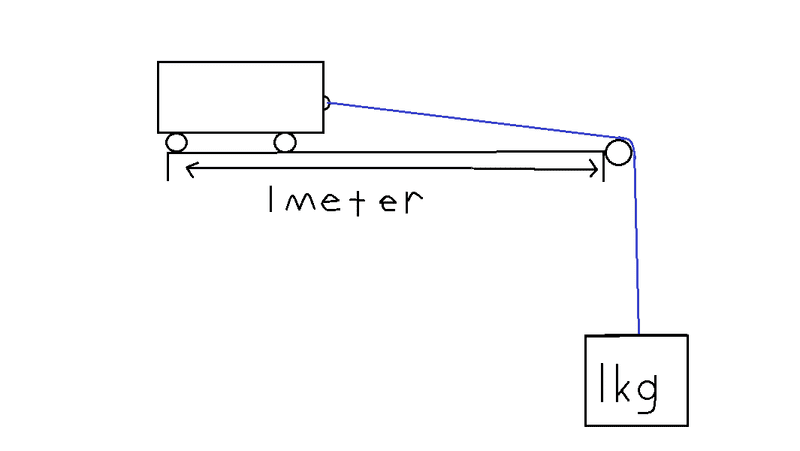
2j10olh.png


Question : How long will it take to travel that 1 metre?
NOTE: The surface is a frictionless surface. The mass of the trolley is 0.5kg

My method:

F = ma , F = (0.5+1) X 9.8 = 14.7N
W= Fd , W = 14.7 X 1 = 14.7J

Ek = 1/2mv^2
14.7 = 0.5 X 1.5 X v^2
v^2 = 19.6, v = 4.427 m/s

v = d/t
t = d/s
t = 1/4.427
t = 0.226s
 
Physics news on Phys.org
In the first step you're incorrect to say the force is 14.7 N because only the weight of the 1kg block is acting to accelerate the apparatus. The weight of the 0.5 kg block is being canceled by the reaction force of the table. In essence you have a 1.5 kg block being accelerated by a 9.8 N force.

In your next step you're correct to equate work done with final kinetic energy, but incorrect to equate the final velocity with the average velocity of the apparatus, since the apparatus is accelerating.

Energy balance is one way to do this but a faster way is to stick with the equations of motion. The acceleration is F/m = 9.8/1.5 = 6.53 m/s^2, the starting velocity is 0 m/s and the distance traveled is 1 m, so your time answer is found using:

s = 0.5*a*t^2 + v*t

this gives you t^2 = 1/(0.5*6.53); t = 0.55 s.
 
MikeyW said:
In the first step you're incorrect to say the force is 14.7 N because only the weight of the 1kg block is acting to accelerate the apparatus. The weight of the 0.5 kg block is being canceled by the reaction force of the table. In essence you have a 1.5 kg block being accelerated by a 9.8 N force.

In your next step you're correct to equate work done with final kinetic energy, but incorrect to equate the final velocity with the average velocity of the apparatus, since the apparatus is accelerating.

Energy balance is one way to do this but a faster way is to stick with the equations of motion. The acceleration is F/m = 9.8/1.5 = 6.53 m/s^2, the starting velocity is 0 m/s and the distance traveled is 1 m, so your time answer is found using:

s = 0.5*a*t^2 + v*t

this gives you t^2 = 1/(0.5*6.53); t = 0.55 s.
Thank you for a detailed, explained and very easy to understand explanation. I understand where I went wrong and why.

EDIT: If i was to use energy to calculate this problem, how would I do it?
 
Last edited:
No problem!

Using energy, the work done in moving the apparatus 1 m under a force of 9.8 N is 9.8 J, which equates to a final velocity of 3.61 m/s. Since the acceleration is constant, the average velocity is equal to half the sum of the initial and final velocities, (0 + 3.61)/2 = 1.81 m/s. Then the time taken is just 1/1.81 = 0.55 s.

The two blocks can be treated together only because the chord keeps their velocities equal and their displacements are always in the same direction as the net force acting on them.
 
MikeyW said:
No problem!

Using energy, the work done in moving the apparatus 1 m under a force of 9.8 N is 9.8 J, which equates to a final velocity of 3.61 m/s. Since the acceleration is constant, the average velocity is equal to half the sum of the initial and final velocities, (0 + 3.61)/2 = 1.81 m/s. Then the time taken is just 1/1.81 = 0.55 s.

The two blocks can be treated together only because the chord keeps their velocities equal and their displacements are always in the same direction as the net force acting on them.
Once again, you have provided a very well explained answer. Thank you Sir.
 

Similar threads

  • · Replies 2 ·
Replies
2
Views
2K
  • · Replies 13 ·
Replies
13
Views
2K
  • · Replies 1 ·
Replies
1
Views
2K
  • · Replies 17 ·
Replies
17
Views
3K
  • · Replies 3 ·
Replies
3
Views
1K
  • · Replies 2 ·
Replies
2
Views
2K
  • · Replies 8 ·
Replies
8
Views
2K
  • · Replies 6 ·
Replies
6
Views
12K
  • · Replies 2 ·
Replies
2
Views
3K