Is My Super Capacitor Power Bank Circuit Safe?

Click For Summary
SUMMARY

The discussion centers on the safety and functionality of a power bank circuit utilizing a 2.7V, 600F supercapacitor. The circuit specifications include a maximum charging current of 1A and an output current of 2.1A at 5V DC. Concerns were raised about the potential for dielectric breakdown if the voltage exceeds the capacitor's rating. Recommendations included using balancing resistors for series configurations and ensuring proper initial charging of the supercapacitors before utilizing the charging board (model 864-KC v1.0).

PREREQUISITES
  • Understanding of supercapacitor specifications and ratings
  • Familiarity with circuit design for power banks
  • Knowledge of balancing techniques for capacitors in series
  • Experience with charging circuits, particularly for supercapacitors
NEXT STEPS
  • Research "supercapacitor balancing techniques" for series configurations
  • Learn about "charging circuits for supercapacitors" and their requirements
  • Explore "safety measures for capacitor banks" to prevent dielectric breakdown
  • Investigate "power bank circuit design" for optimal performance and safety
USEFUL FOR

Electronics enthusiasts, power bank designers, and engineers working with supercapacitors who seek to ensure safety and efficiency in their designs.

emtae55
Messages
24
Reaction score
0
TL;DR
I'll make a power bank with capacitors and I made circuit of it. But I'm worrying about whether the circuit is safe, because it's dangerous to use capacitor.
So, can you check the circuit i made??
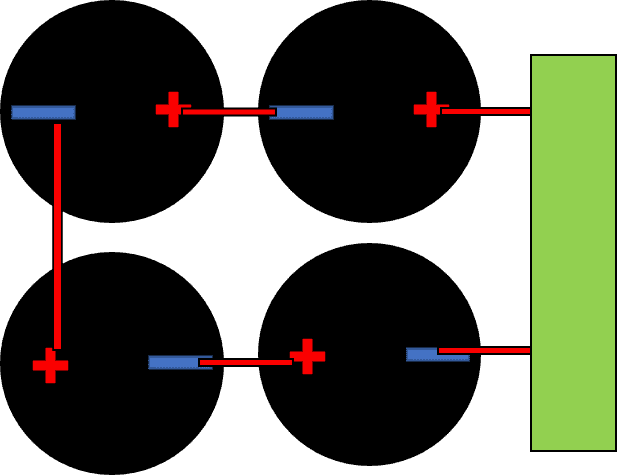
pic2.png

My capacitor is 2.7V, 600F and the power bank circuit has "Charging current : 1A maximum, output current : 2.1A(5V) maximum, ouput voltage : 5V DC","http://www.11st.co.kr/product/Selle...%DB_PC_S_%BC%EE%C7%CE&utm_medium=%B0%CB%BB%F6"
I wonder if you understand this site because it's korean :(
Thanks. :)
 
Engineering news on Phys.org
Web site in Korean is useless here and I have no idea what it is that you think is unsafe. You seem to be working with very low voltage and very low current capability. What do you think is unsafe?
 
phinds said:
Web site in Korean is useless here and I have no idea what it is that you think is unsafe. You seem to be working with very low voltage and very low current capability. What do you think is unsafe?
I thought whether the power bank circuit gives voltage to the capacitor that greater than 2.7V. Isn't it?
 
emtae55 said:
I thought whether the power bank circuit gives voltage to the capacitor that greater than 2.7V. Isn't it?
Well, yes, if you are using a capacitor that is rated too low for the voltage you are using that could make the capacitor have dialectic breakdown. Why would you do that?
 
emtae55 said:
I'll make a power bank with capacitors and I made circuit of it. But I'm worrying about whether the circuit is safe, because it's dangerous to use capacitor.
I'm not familiar with placing large value supercaps in series, but for more normal size capacitors in series, we generally would put large resistance value resistors in parallel with each capacitor, to help to equalize the voltage on each. But with such large value capacitors (600F !), I'm not sure that technique works...
 
DOH_small.jpg


I clearly was not paying attention. Thought the caps were in parallel. @emtae55 you should be OK since each cap only gets 1/4th of the voltage, so about 1.25V per cap. Still, you should check equalization, as @berkeman pointed out.
 
Last edited:
  • Like
Likes   Reactions: berkeman
Although I have not worked with super caps we do need to keep in mind what a capacitor is able to do. And that is accumulate a large quantity of charge from a harmless low current source. It may take many hours to charge a super cap or bank of super caps but by definition a capacitor can dump it's charge very quickly. This will depend on equivalent series resistance (ESR) but when it comes to safety I would assume the capacitor bank can dump its charge with NO ESR.
 
emtae55 said:
I wonder if you understand this site because it's korean :(

If the translate got it right then this thing is for Li-Ion batteries. Current seems to be OK, but I'm not sure if it's for single or for double cell?
Quite wasteful to use that suparcap bank this way, but it's expected to be safe.

Though I would put a small fuse in series somewhere.

Ps.: wait, your circuit is actually four supercap in series :woot: Are you sure about that? It's safe up to 10.8V or so, but ... erm...
 
Last edited:
  • #10
We're getting a number of similar questions recently. There may be some articles driving it. I imagine the application is mobile recharging of batteries for drones, scooters, hoverboards and the like. The advantage would be that the mobile charger could itself be recharged in a very short time from AC mains.

If any of our EE members know of a good tutorial article on mobile power banks, that would be welcome. As always, if you would like to write an Insights article on the topic that too would be welcome. What I would like to see most is a schematic for a commercial mobile power bank using supercaps.
 
  • #11
berkeman said:
I'm not familiar with placing large value supercaps in series, but for more normal size capacitors in series, we generally would put large resistance value resistors in parallel with each capacitor, to help to equalize the voltage on each. But with such large value capacitors (600F !), I'm not sure that technique works...
Passive balancing technique with resistors or ZDs is widely used and protection circuits are similar to circuits for series connection of Li-ion batteries . A colleague has written a paper with simuls included:
https://bib.irb.hr/datoteka/942041....balancing_using_resistors_T.Bari_pp_15-22.pdf
 
  • Informative
Likes   Reactions: berkeman
  • #12
Um, guys, I tried to make a batteries, but it doesn't work. I used DMM but it displayed 0V when i measured the charging part.(The charging board's 'B+' and 'B-') I think it is because of the board, so i want to find another one.
The board's name is '864-KC v1.0'. Google it! and the circuit was like this. Thanks
2.png
 
  • #13
Any half-decent Li-charger board would need a bunch of different kind of protection circuits: likely against charging non-healthy (under-depleted, 0V) cells too.

I think you have to supply the initial charge of supercaps yourself, before the charger can kick in.
 
  • Like
Likes   Reactions: Tom.G
  • #14
Rive said:
Any half-decent Li-charger board would need a bunch of different kind of protection circuits: likely against charging non-healthy (under-depleted, 0V) cells too.

I think you have to supply the initial charge of supercaps yourself, before the charger can kick in.
I tried it, but it didn't work. I charged the caps and tried to charge with the board, but i couldn't charge them
 
  • #15
emtae55 said:
I tried it, but it didn't work. I charged the caps and tried to charge with the board, but i couldn't charge them
83566975_165308411466635_161139996055568384_n.jpg
83617086_576837356200714_6872001261906952192_n.jpg
83094600_3441058965965106_5784204767316148224_n.jpg
 
  • #16
I'm in a project that make a powerbank with supercapacitor. I made it but it didn't work. Can you confirm it?? My circuit is here. The green one is a board (charging board, 864-kc v1.0). It gives 4.2V DC to capacitor.
2.png
83094600_3441058965965106_5784204767316148224_n.jpg
 
  • #17
emtae55 said:
Summary:: I'll make a power bank with capacitors and I made circuit of it. But I'm worrying about whether the circuit is safe, because it's dangerous to use capacitor.

I'll make a power bank with capacitors and I made circuit of it. But I'm worrying about whether the circuit is safe, because it's dangerous to use capacitor.
So, can you check the circuit i made??

View attachment 255083
My capacitor is 2.7V, 600F and the power bank circuit has "Charging current : 1A maximum, output current : 2.1A(5V) maximum, ouput voltage : 5V DC","http://www.11st.co.kr/product/Selle...%DB_PC_S_%BC%EE%C7%CE&utm_medium=%B0%CB%BB%F6"
I wonder if you understand this site because it's korean :(
Thanks. :)
So far, seems the circuit would work without balancing resistors. Super-capacitors typically have quite uniform Rseries and capacitance to connect them in series without balancing. Take care to equalize temperatures though (make a solid common heat sink) .
 
  • #18
The link you posted is in a language many of us can not read. Can you post a link for the English version?

The photo you show is for a USB power supply that will turn off if more than 1A output is needed (some will work to 2A).

Put a resistor in series with the power supply output for charging. A resistor value of 5 Ohms or more will limit the current to less than 1A. The power rating of the resistor must be 7 Watts or higher, otherwise it will get too hot and burn up.

If the power supply will really supply 2A, then the resistor can be 2.5 Ohms and 15 Watts or higher.

With a 5 Ohm resistor, it will take about 1 Hour to charge the capacitors to 2/3 of full. A full charge will take about 5 Hours. If you want a faster charge you will have to use a higher current supply and a lower value (or no) resistor. To charge in 10 minutes needs a 30A supply. These numbers are not exact but are probably within a factor of 2. (that means it might take twice as long or half as long)

Cheers,
Tom

(p.s. for those that are wondering about the above estimates, the charge time was estimated using the RC time constant. A Constant Current supply would speed things up but those cost more and are harder to find.)