Is the Classical Pendulum Formula Still Accurate for Large Theta Values?

Join the discussion
Ask a follow-up here, or get your own question answered by working scientists, mathematicians and engineers — people, not an autocomplete.
Real named experts · corrections over time · the nuance an AI answer skips
16 replies · 2K views
rehab
Messages
12
Reaction score
0
Post moved from technical forums, so no template
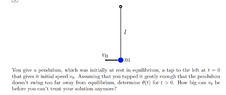
Summary: Hi, I'm trying to solve this problem, if it's not right then please help me with a hint without solving it.

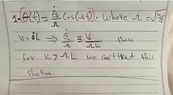
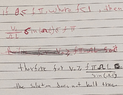
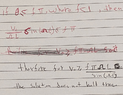
This formula is just an approximation for small values of theta, but if Vo was greater than the denominator this will lead to large values of theta and then this solution is not valid anymore, I'm not sure so I need your
 

Attachments
  • 2022-09-22 (1).png
    2022-09-22 (1).png
    15.3 KB · Views: 172
  • 2022-09-22 (2).png
    2022-09-22 (2).png
    90.5 KB · Views: 170
Physics news on Phys.org
kuruman said:
Your expression for ##\theta(t)## does not match the statement of the problem because ##\theta(0) \neq 0##.
Why?
the problem stated that at first, it was at rest in equilibrium!
 
kuruman said:
What is ##\cos0^o##?
1.
but it doesn't add anything because the solution theta= A cos(theta) 'let's ignore the sin term' at t =0 is
theta = A and from the problem, this is just zero.
Right?
 
rehab said:
1.
but it doesn't add anything because the solution theta= A cos(theta) 'let's ignore the sin term' at t =0 is
theta = A and from the problem, this is just zero.
Right?
I assume you mean ##\theta=A\cos(\omega t)##, but as @kuruman pointed out, that violates ##\theta(0)=0##. So what equation should you write instead?
rehab said:
if Vo was greater than the denominator this will lead to large values of theta
How large, exactly, and how large a value would render the solution invalid?
 
rehab said:
1.
but it doesn't add anything because the solution theta= A cos(theta) 'let's ignore the sin term' at t =0 is
theta = A and from the problem, this is just zero.
Right?
You wrote down
##\theta(t)=\dfrac{\dot{\theta}_0}{\Omega}\cos(\Omega~t).##
At ##t=0##,
##\theta(0)=\dfrac{\dot{\theta}_0}{\Omega}\cos(\Omega*0)=\dfrac{\dot{\theta}_0}{\Omega}\cos(0)=\dfrac{\dot{\theta}_0}{\Omega}*(1) =\dfrac{\dot{\theta}_0}{\Omega}.##

The result is not zero.
 
kuruman said:
You wrote down
##\theta(t)=\dfrac{\dot{\theta}_0}{\Omega}\cos(\Omega~t).##
At ##t=0##,
##\theta(0)=\dfrac{\dot{\theta}_0}{\Omega}\cos(\Omega*0)=\dfrac{\dot{\theta}_0}{\Omega}\cos(0)=\dfrac{\dot{\theta}_0}{\Omega}*(1) =\dfrac{\dot{\theta}_0}{\Omega}.##

The result is not zero.
Oh, yeah I just realized that I inadvertently wrote down the cos function where it should be the sin function instead, is it right now?
And what do think about this expression for Vo?
 

Attachments

  • 2022-09-22 (4).png
    2022-09-22 (4).png
    155 KB · Views: 156
haruspex said:
I assume you mean ##\theta=A\cos(\omega t)##, but as @kuruman pointed out, that violates ##\theta(0)=0##. So what equation should you write instead?

How large, exactly, and how large a value would render the solution invalid?
It should be written with the sic function for some reason I wrote it with the cos function.

for Vo:
 

Attachments

  • 2022-09-22 (4).png
    2022-09-22 (4).png
    155 KB · Views: 166
rehab said:
And what do think about this expression for Vo?
Not much. Your expression has time parameter ##t## in it which doesn't make sense. You should find an expression that one can use in an actual pendulum experiment. In other words, suppose I gave you a real pendulum, with length ##L## that you measure and find it is 1.5 m. How would you proceed to find a numerical answer for ##v_0## in m/s? Show a sample calculation.
 
kuruman said:
Not much. Your expression has time parameter ##t## in it which doesn't make sense. You should find an expression that one can use in an actual pendulum experiment. In other words, suppose I gave you a real pendulum, with length ##L## that you measure and find it is 1.5 m. How would you proceed to find a numerical answer for ##v_0## in m/s? Show a sample calculation.
well, simply measure the initial {\theta} and then {\theta} at some stop time ##t##, then multiply the result with ##L##.
why does having ##t## as a parameter doesn't make sense?
 
haruspex said:
Because you want the range of v0 for which a function of t is valid in general, not for some particular values of t.
So, should I replace ##t## by theta/##L##?
 
kuruman said:
Why would you do that? That relation is incorrect. Elapsed time is not angle divided by pendulum length. I suggest that you start by finding a relation between ##v_0## and the maximum angle reached by the pendulum.
It's 12:11 here and this is time for bed this is clearly the reason for this unforgivable mistake :).
well, I can't think of anything but (f*pi''maximum angle''/2*pi ''the total period'') *L.