Is the Definite Integral of the Function Exactly 1?

Click For Summary

Discussion Overview

The discussion revolves around the evaluation of a definite integral of a specific function from 0 to infinity, with participants questioning whether the result is exactly 1 or if there are rounding errors involved. The conversation includes numerical integration methods and the reliability of computational tools like Wolfram Alpha and Maple.

Discussion Character

  • Exploratory
  • Technical explanation
  • Debate/contested

Main Points Raised

  • One participant seeks verification of the definite integral's value, questioning if it is exactly 1 or if rounding errors are present.
  • Another participant speculates that the original problem creator may have used numerical integration, resulting in a value close to 1 when adjusted by a specific fraction (50,000/98713).
  • A later reply presents a computation using Maple, showing that the integral does not equal exactly 1, yielding a value of approximately 1.97425968165579173304278091386, which when multiplied by the fraction results in a value very close to 1, but not exactly.
  • Concerns are raised about the reliability of Wolfram Alpha, particularly regarding its rounding of results to '1' and the potential limitations of not having Wolfram Alpha Pro for extended computation.

Areas of Agreement / Disagreement

Participants do not reach a consensus on whether the definite integral equals exactly 1. There are multiple competing views regarding the accuracy of numerical methods and the interpretation of results from different computational tools.

Contextual Notes

The discussion highlights limitations related to numerical precision and the potential for rounding errors in computational outputs. There is also an acknowledgment of the dependency on the capabilities of the tools used for evaluation.

Saracen Rue
Messages
150
Reaction score
10
Hi everyone,

I am trying to find the definite integral of a function (see attached image) from 0 to infinity using Wolfram alpha. I'm just looking for some verification on if the integral actual is equal to exactly 1, or if there's some rounding errors going on.

Thank you for your time :)
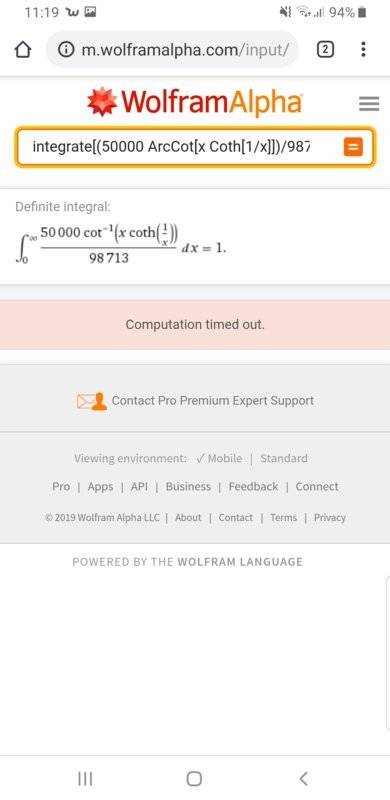
Screenshot_20190331-111946_Chrome.jpg
 
Physics news on Phys.org
This is just a guess on my part, but the person who made up the problem may have done a numerical integration, and found the answer to be such that multiplying by the fraction 50,000/98713 made it very close to 1. Perhaps there is a way to evaluate it in closed form, but it is beyond my capabilities.
 
Charles Link said:
This is just a guess on my part, but the person who made up the problem may have done a numerical integration, and found the answer to be such that multiplying by the fraction 50,000/98713 made it very close to 1. Perhaps there is a way to evaluate it in closed form, but it is beyond my capabilities.
Thanks for your insight :)

The part that's confusing me is that Wolfram Alpha is usually very good with these type of problems and would provide an answer correct to 100+ decimal places. The fact that it seems to just be rounding it to '1' is quite unusal.

Prehapa the problem is that I don't have Wolfram Alpha Pro which allows for extended computation time. If anyone with Pro does read this, please try computing this question for me and let me know if it provides a different answer or not. Thank you :)
 
Saracen Rue said:
Thanks for your insight :)

The part that's confusing me is that Wolfram Alpha is usually very good with these type of problems and would provide an answer correct to 100+ decimal places. The fact that it seems to just be rounding it to '1' is quite unusal.

Prehapa the problem is that I don't have Wolfram Alpha Pro which allows for extended computation time. If anyone with Pro does read this, please try computing this question for me and let me know if it provides a different answer or not. Thank you :)

The result is not exactly 1.0000 ... Here is a computation using Maple, set to 30-digit precision.

restart;
k:=50000/98713;

50000
k := -----
98713

> f0:=arccot(x*coth(1/x));

f0 := arccot(x coth(1/x))

> Digits:=30;

Digits := 30

> evalf(Int(f0,x=0..infinity));

1.97425968165579173304278091386

> J0:=%;

J0 := 1.97425968165579173304278091386

> k*J0;

0.999999838752642373873137739639
 
  • Like
Likes   Reactions: Charles Link

Similar threads

  • · Replies 27 ·
Replies
27
Views
3K
  • · Replies 8 ·
Replies
8
Views
3K
  • · Replies 4 ·
Replies
4
Views
2K
  • · Replies 6 ·
Replies
6
Views
3K
  • · Replies 4 ·
Replies
4
Views
7K
  • · Replies 5 ·
Replies
5
Views
3K
  • · Replies 20 ·
Replies
20
Views
4K
  • · Replies 16 ·
Replies
16
Views
4K
  • · Replies 9 ·
Replies
9
Views
2K
  • · Replies 14 ·
Replies
14
Views
4K