Is the Equilibrium Calculation for HI Correct?

Click For Summary

Discussion Overview

The discussion revolves around the equilibrium calculation for the reaction involving hydrogen iodide (HI), specifically examining the correctness of the equilibrium constant (Kc) and the resulting concentrations and masses of HI. The scope includes mathematical reasoning and technical clarification related to chemical equilibrium and stoichiometry.

Discussion Character

  • Technical explanation
  • Mathematical reasoning
  • Debate/contested

Main Points Raised

  • One participant calculates Kc1 as 6.865 and derives a concentration of HI as 5.52x10^-3 M and a mass of 70.6g, questioning the correctness of these values.
  • Another participant challenges the mass of HI, suggesting that with 45g of I2 available, the maximum mass of HI that can be produced should be considered.
  • A different participant presents an alternative equation for Kc, questioning the validity of their earlier calculations and suggesting a concentration of HI as 5.33x10^-4 M.
  • Several participants discuss the unconventional notation used in the calculations, particularly the inclusion of "100" in the equations, prompting questions about its meaning and necessity.
  • There is a debate about the correct application of volume in the calculations, with suggestions that the volume should be consistently applied in both the numerator and denominator when calculating concentrations.
  • One participant expresses confusion about the treatment of moles versus concentrations in their calculations, indicating uncertainty about how to properly express the amounts reacting.
  • Another participant emphasizes the importance of treating reactants and products consistently, either as moles or concentrations, throughout the calculations.

Areas of Agreement / Disagreement

Participants express differing views on the correctness of the equilibrium calculations, with no consensus reached on the validity of the mass and concentration values derived. The discussion remains unresolved regarding the proper treatment of volume in the calculations and the implications for the equilibrium constant.

Contextual Notes

Participants highlight limitations in the clarity of the calculations, particularly concerning the use of volume in the equations and the distinction between moles and concentrations. There are unresolved questions about the assumptions made in the calculations and the implications of those assumptions on the results.

myvow
Messages
10
Reaction score
0
Member warned about not using the homework template
Kc1 = (5.8*2/5)^2 / (14/5)(1.4/5) = 6.865

6.865 = [HI]^2 / (45/253.8/100)(0.5/2/100)
[HI] = 5.52x10^-3 M
mass no of HI = [HI] x (126.9+1) x 100 = 70.6g
is it correct?
And how to do 3bii
I GOT 3bi Kc2 = [HCl(g)]^2/ / Kc(1) [H2(g)] [Cl2(g)]
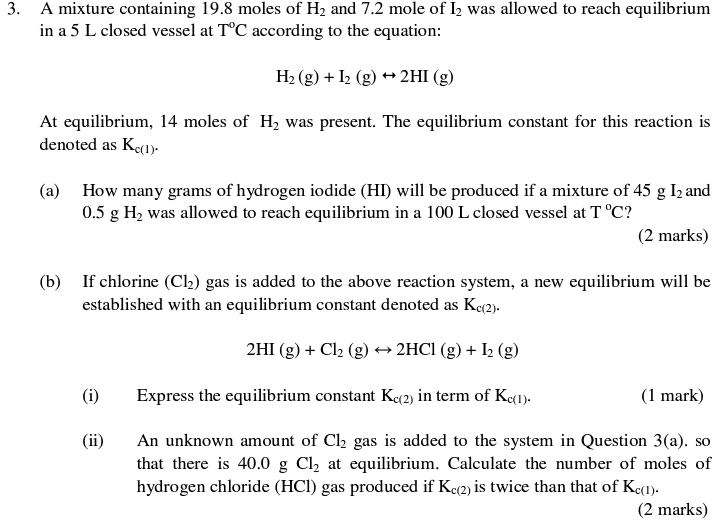
20141228_f511cddd68ca462e6de7NFWjy7I2WqFy.png
 
Physics news on Phys.org
myvow said:
70.6g is it correct?
Think about it --- you've got 45 g I2 to start --- what's the largest mass of HI you can make?
 
6.865 = x^2 / ((45/253.8/100)-0.5x)((0.5/2/100)-0.5x)
This equation is OK?because the mole ratio of H2 to Hi is 1:2
So [HI]=x=5.33*10-4M
HI =6.813g?
 
Last edited:
The 6.865 is okay for an equilibrium constant. The notation you're using for the equation is unconventional. What're the "100s" doing in there?
 
Bystander said:
The 6.865 is okay for an equilibrium constant. The notation you're using for the equation is unconventional. What're the "100s" doing in there?
100L
The volume
 
And the HI is not also occupying that volume?
 
Yes, but molarity = mole/volume
Does not volume is necessary?
 
You're using it in the denominator for hydrogen and iodine concentrations. Don't you think you should be using it in the numerator as well? After all, you did it that way when finding the equilibrium constant.
 
((45/253.8)/100)
??this way??
 
  • #10
myvow said:
((45/253.8)/100)
??this way??
No, the way you did it for the very first step when you solved for the equilibrium constant.
myvow said:
Kc1 = (5.8*2/5)^2 / (14/5)(1.4/5) = 6.865
 
  • #11
You're using it in the denominator for hydrogen and iodine concentrations
What it mean...
 
  • #12
Do you see where you inserted the number "5" for five liters in the very first calculation you did? Do you see it in both numerator, HI, and denominator, H and I?
 
  • #13
Bystander said:
Do you see where you inserted the number "5" for five liters in the very first calculation you did? Do you see it in both numerator, HI, and denominator, H and I?
For example
14 is the mole of h2,so 14/5=2.8 which is concentration of h2, right?
OK then there is 0.5g of h2,
0.5/2=0.25mol
0.25/100=1.25*10^-3M
What wrong with me?
 
  • #14
myvow said:
6.865 =( x^2/1002) / ((45/253.8/100)-0.5x)((0.5/2/100)-0.5x)
So, you will have x moles of HI in 100 liters. Clear?
 
  • #15
Bystander said:
So, you will have x moles of HI in 100 liters. Clear?
Does numerator will not be wrong?
 
  • #16
myvow said:
Does numerator will not be wrong?
If you are using the 100 liter volume in the denominator, you HAVE to include it in the numerator.
 
  • #17
Bystander said:
If you are using the 100 liter volume in the denominator, you HAVE to include it in the numerator.
I know what you mean sir
if I use (x/100)^2, .x will be the mole of HI right?
But in the numerator,did you see((0.5/2/100)-0.5x)
if x =mole, minus 0.5x
this is the mole instead of concentration
 
  • #18
Okay. We are making progress. You also need to be dividing the 0.5x by 100 if you're going to work with concentration. It is your option or choice whether to express x the amount actually reacting subtracted from the amount you begin with as just moles, or to divide by the volume and handle amounts as concentrations. The one thing you do have to do is treat reactants and products and fraction reacted all the same way, either as number of moles, or as concentrations.
 

Similar threads

Replies
6
Views
14K
Replies
1
Views
2K
  • · Replies 1 ·
Replies
1
Views
3K
  • · Replies 1 ·
Replies
1
Views
6K
  • · Replies 1 ·
Replies
1
Views
7K
  • · Replies 3 ·
Replies
3
Views
2K
  • · Replies 5 ·
Replies
5
Views
8K
Replies
10
Views
8K
  • · Replies 1 ·
Replies
1
Views
4K
Replies
3
Views
11K