Is the Integral Zero for Closed Paths in Complex Analysis?

Click For Summary

Homework Help Overview

The discussion revolves around a question in complex analysis regarding the evaluation of an integral over closed paths. Participants are exploring the conditions under which the integral may be zero, particularly focusing on the implications of the properties of the function involved.

Discussion Character

  • Exploratory, Assumption checking, Conceptual clarification

Approaches and Questions Raised

  • Participants discuss the implications of the condition on the magnitude of the function, questioning how to demonstrate that the integral is zero. There is uncertainty about the relationship between being less than zero and being equal to zero, as well as the significance of the closed path in this context.

Discussion Status

Some participants have provided clarifications regarding the properties of the function and the implications of inequalities. There is an ongoing exploration of whether the integral being evaluated can be conclusively shown to be zero based on the conditions given.

Contextual Notes

Participants are navigating the nuances of complex analysis, particularly focusing on the definitions and properties of integrals over closed paths. There is a mention of non-strict inequalities and their implications for the function's behavior.

Gwinterz
Messages
27
Reaction score
0
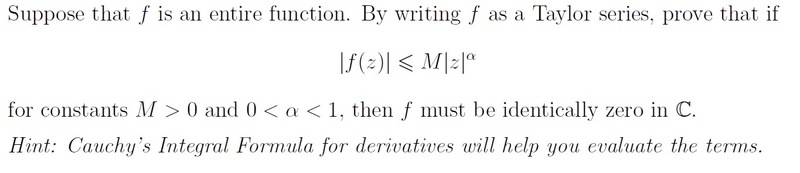
Hey, I have been stuck on this question for a while:
WClcaAN.jpg

I have tried to follow the hint, but I am not sure where to go next to get the result.


Have I started correctly? I am not sure how to show that the integral is zero.

If I can show it is less than zero, I also don't see how that shows it is always zero.

Thanks in advance for any help.
 

Attachments

  • WClcaAN.jpg
    WClcaAN.jpg
    17.6 KB · Views: 682
Physics news on Phys.org
The condition in the premise is on ##\left|f(z)\right|##, not ##f(z)##. If you have in fact shown that ##\left|f(z)\right| \leq 0##, then it must be equal to 0 since it can't be negative.
 
Gwinterz said:
Hey, I have been stuck on this question for a while:

View attachment 232707
I have tried to follow the hint, but I am not sure where to go next to get the result.


Have I started correctly? I am not sure how to show that the integral is zero.

If I can show it is less than zero, I also don't see how that shows it is always zero.

Thanks in advance for any help.

Something cannot be less than zero and equal to zero at the same time. However, since you have non-strict inequalities "##\leq##" there is a chance you can show the thing is ##\leq 0##. Then (being a norm in the complex plane) it must also be ##\geq 0##, hence must ##= 0.##
 
Thanks guys that makes sense.

Is the integral equal to zero because its a closed path?
 

Similar threads

  • · Replies 2 ·
Replies
2
Views
2K
  • · Replies 2 ·
Replies
2
Views
2K
  • · Replies 2 ·
Replies
2
Views
2K
Replies
3
Views
2K
  • · Replies 3 ·
Replies
3
Views
2K
  • · Replies 2 ·
Replies
2
Views
3K
  • · Replies 14 ·
Replies
14
Views
2K
  • · Replies 17 ·
Replies
17
Views
4K
Replies
8
Views
3K
Replies
7
Views
3K