Is the Plane MKPN Possible Inside Pyramid ABCD?

Click For Summary
SUMMARY

The discussion centers on the geometric possibility of a plane MKPN existing within a tetrahedron ABCD, where M, K, P, and N are points on the edges of the tetrahedron. Participants concluded that while it is possible to slice a tetrahedron with a plane, the specific configuration described is impossible due to the positioning of points M, N, and P, which lie on the same face of the tetrahedron, while point K does not. This violates the geometric axiom that states two planes intersect along a straight line, confirming that such a plane cannot exist in the described configuration.

PREREQUISITES
  • Understanding of tetrahedron geometry and properties
  • Familiarity with the axioms of geometry in plane and space
  • Knowledge of collinearity and coplanarity concepts
  • Basic skills in three-dimensional analytic geometry
NEXT STEPS
  • Study the properties of tetrahedrons and their geometric characteristics
  • Learn about the axioms of geometry, particularly regarding planes and intersections
  • Explore the concept of collinearity and its implications in geometric configurations
  • Investigate three-dimensional analytic geometry techniques for visualizing complex shapes
USEFUL FOR

Mathematicians, geometry enthusiasts, educators, and students seeking to deepen their understanding of spatial relationships and geometric proofs.

Lancelot1
Messages
26
Reaction score
0
Good morning (or evening),

I have a geometrical tricky question, which I need your assistance with.

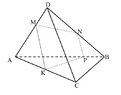
Look at the following sketch:

View attachment 6574

In the sketch you see a pyramid ABCD. Inside the space of ABCD, you see a plane MKPN, where M, K, P and N are points on the pyramid sides.

Using the axioms of geometry in plane and space, I wish to determine if this object is possible or impossible.

I thank you in advance !
 

Attachments

  • geo.JPG
    geo.JPG
    12.8 KB · Views: 160
Mathematics news on Phys.org
Hi Lancelot and welcome to MHB! :D

Certainly possible, as it's possible to slice the tetrahedron with a plane, cutting all four sides.
 
That is not a "pyramid". It is, as greg1313 said, a "tetrahedron". A "pyramid" has a square (or rectangular) base with four edges meeting in one point above the base. So a "pyramid" has one rectangular face and four triangular faces. A "tetrahedron" has four triangular faces but no rectangular face.

But what, exactly are you asking? If you are given four points, K, M, N, and P, on the four edges, they do not necessarily all lie on a single plane. But given any three such points, they exist a unique plane through those points and that plane cuts the remaining sides at some point- so there certainly do exist such points.
 
Last edited by a moderator:
HallsofIvy said:
That is not a "pyramid". It is, as greg1313 said, a "tetrahedron". A "pyramid" has a square (or rectangular) base with four edges meeting in one point above the base. So a "pyramid" has one rectangular face and four triangular faces. A "tetrahedron" has four triangular faces but no rectangular face.

HallsofIvy, I would just like to point out that tetrahedrons are also pyramids, but not every pyramid is a tetrahedron. A pyramid is a polyhedron of which one face can be any polygon (called its base) and all other faces (called lateral) are triangles meeting at a common vertex. A pyramid can be named triangular, quadrangular, etc depending on what the base is: a triangle, quadrilateral, etc. A triangular pyramid can also be called a tetrahedron.
 
My spatial intuition is just short of second rate. So I was definitely unsure about the OP's question. Below is a statement that kind of surprised me. By the way, some people, including me, think a tetrahedron is regular; i.e. one of the Platonic solids.

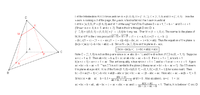
Let ABCD be any "tetrahedron"; i.e. ABCD is a polyhedron with 4 vertices, 4 triangular faces and 6 edges. Let N, P and M be any interiior points of edges AB, AC and BD respectively. Then the plane that contains N, P and M meets edge CD at a point K with K interior to CD. The proof requires some three dimensional analytic geometry, unfortunately not what the OP wanted

I may suppose A=(0,0,0); if necessary translate the tetrahedron. Now B, C and D are linearly independent, so there is an invertible linear transformation T that maps B to (1,0,0), C to (0,1,0) and D to (0,0,1). Such a T maps planes to planes, line segments to line segments and interior points of line segment to interior points of line segments. The upshot is that I can assume the coordinates of B, C and D are as stated. Below is the proof for this case.

View attachment 6583
 

Attachments

  • MHBgeometry26.png
    MHBgeometry26.png
    23.5 KB · Views: 135
Thank you all for your answers. Special thanks to the last answer, the proof is very impressive.

So to sum all your answers, this situation is possible, it is not an impossible object like the Penrose stairs of triangle.

I will need some time to understand the proof johng gave.
 
Something bothers me here.
Doesn't the object violates the axiom that two planes intersect by a straight line ?
 
Lancelot said:
Good morning (or evening),

I have a geometrical tricky question, which I need your assistance with.

Look at the following sketch:

http://www.mathhelpboards.com/attachments/geometry-11/6574d1493615335-pyramid-3d-geo-jpg

In the sketch you see a pyramid ABCD. Inside the space of ABCD, you see a plane MKPN, where M, K, P and N are points on the pyramid sides.

Using the axioms of geometry in plane and space, I wish to determine if this object is possible or impossible.

I thank you in advance !
Lancelot said:
Something bothers me here.
Doesn't the object violates the axiom that two planes intersect by a straight line ?
Something has been bothering me too, ever since I saw this sketch a week ago. The configuration somehow looked impossible, but until now I could not see why.

But now I see what is wrong with it. The three points $M,N,P$ all lie in the same face $ABD$ of the tetrahedron. Those three points are not collinear, and so the plane containing them must be the plane containing the face $ABD$. But the point $K$ does not lie in that plane. Therefore it is impossible for $MKPN$ to be a plane.

Maybe that is what you mean by suggesting that the object violates the axiom that two planes intersect by a straight line? If $ABD$ and $MKPN$ are both planes then their intersection would have to contain the non-collinear points $M,N,P$. It was that suggestion that cleared things up for me.
 
Not only is my intuition suspect, at least for this question I am a poor reader. Somehow, I thought M, N and P were points on edges that share a common vertex. In this case, my previous post is correct, but this was not the question. As stated M, N and P are points on 3 edges that share a common face. So Opal is exactly right, there can be no such configuration.
 

Similar threads

  • · Replies 2 ·
Replies
2
Views
2K
  • · Replies 2 ·
Replies
2
Views
2K
  • · Replies 6 ·
Replies
6
Views
2K
  • · Replies 35 ·
2
Replies
35
Views
7K
  • · Replies 7 ·
Replies
7
Views
2K
  • · Replies 2 ·
Replies
2
Views
3K
  • · Replies 15 ·
Replies
15
Views
6K
  • · Replies 7 ·
Replies
7
Views
3K
  • · Replies 2 ·
Replies
2
Views
2K
  • · Replies 40 ·
2
Replies
40
Views
5K