Is the Proven Condition of ρ=0 Universal or Limited to Specific Limits?

  • Thread starter Thread starter cdux
  • Start date Start date
Click For Summary
SUMMARY

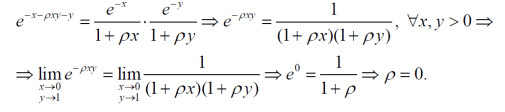
The discussion centers on the proof of the condition that ρ must equal zero for the identity exp(-ρxy) = 1/((1+ρx)(1+ρy)) to hold for all x, y > 0. Participants debate whether the proof is universal or limited to specific limits, emphasizing the importance of continuity and the implications of finding particular values of x and y. It is concluded that while ρ = 0 is a solution, the challenge lies in demonstrating that it is the only solution applicable across all x and y values.

PREREQUISITES
  • Understanding of mathematical identities and proofs
  • Familiarity with limits and continuity in calculus
  • Knowledge of exponential functions and their properties
  • Basic algebraic manipulation skills
NEXT STEPS
  • Study the concept of mathematical identities and their proofs
  • Learn about limits and continuity in calculus
  • Explore the properties of exponential functions in depth
  • Practice algebraic manipulation with complex equations
USEFUL FOR

Mathematicians, students studying calculus or algebra, and anyone interested in understanding the nuances of mathematical proofs and identities.

cdux
Messages
187
Reaction score
0
Teacher wanted to prove that for that condition to be satisfied ρ must be zero, but the limits give the idea that it applies only when those limits are satisfied. By the way, x>0 and y>0. Is it a universal proof or only for those limits?

rDSbDhA.png
 
Physics news on Phys.org
The given condition is that the equality holds for all x, y > 0. If the limits exist and the functions are continuous (e.g. limx → 0 ex = e0) then it must also hold in the limit.
 
  • Like
Likes   Reactions: 1 person
cdux said:
Teacher wanted to prove that for that condition to be satisfied ρ must be zero, but the limits give the idea that it applies only when those limits are satisfied. By the way, x>0 and y>0. Is it a universal proof or only for those limits?

rDSbDhA.png

I don't know what you mean by "universal proof". You have this proposed identity that looks really unlikely to be true unless ##\rho=0##. To refute the identity, all you have to do is find something that implies that ##\rho## must be ##0##. That argument surely works. You could undoubtedly find other arguments that would imply ##\rho=0##.
 
LCKurtz said:
I don't know what you mean by "universal proof". You have this proposed identity that looks really unlikely to be true unless ##\rho=0##. To refute the identity, all you have to do is find something that implies that ##\rho## must be ##0##. That argument surely works. You could undoubtedly find other arguments that would imply ##\rho=0##.

But didn't that use the restriction that x->0 and y->1? How did it prove it in general?
 
haruspex said:
The given condition is that the equality holds for all x, y > 0. If the limits exist and the functions are continuous (e.g. limx → 0 ex = e0) then it must also hold in the limit.

I didn't see this reply at first.

But if it holds for the limit, how does it prove it in general?
 
That \exp(-\rho x y) = 1/((1+\rho x)(1+\rho y)) is true for all x,y in the case that rho=0 is obvious. That this trivial solution for rho is the only solution in the case that one but not both of x or y is zero is also obvious.

And that is all that is needed. The claim is that \exp(-\rho x y) = 1/((1+\rho x)(1+\rho y)) for all x,y>0. Finding any particular x,y that restricts rho to 0 suffices to show that rho must necessarily be zero.
 
D H said:
Finding any particular x,y that restricts rho to 0 suffices to show that rho must necessarily be zero.

I don't get this logic. If you find an x and a y that point to ρ = a then how does that prove ρ must always be a? There is something missing in the explanations in text. I'm sure it's possible that's correct but I don't see it when reading the texts here about it.
 
cdux said:
I don't get this logic. If you find an x and a y that point to ρ = a then how does that prove ρ must always be a? There is something missing in the explanations in text. I'm sure it's possible that's correct but I don't see it when reading the texts here about it.

You have an identity of the form ##F(x,y,\rho) = 0## that must hold for all x and y. For more-or-less arbitrary values of x and y it might not be easy to see what this implies about ##\rho##, but by taking ##x, y \to 0## we can quite easily see that we must have ##\rho = a##. Once we do have ##\rho = a## we can plug that back into F to check that, indeed, ##F(x,y,a) \equiv 0,## as desired.
 
cdux said:
I don't get this logic. If you find an x and a y that point to ρ = a then how does that prove ρ must always be a? There is something missing in the explanations in text. I'm sure it's possible that's correct but I don't see it when reading the texts here about it.
That is not what the conjecture is saying. To the contrary, for any given x,y>0 there are three real solutions (not necessarily distinct) of ρ such that eρxy=(1+ρx)(1+ρy).
 
  • #10
D H said:
That is not what the conjecture is saying. To the contrary, for any given x,y>0 there are three real solutions (not necessarily distinct) of ρ such that eρxy=(1+ρx)(1+ρy).

Hence it's insufficient for the needs of the exercise. It was explicitly asked to prove that "only when p=0" that expression can be true.
 
  • #11
Do you understand the difference between "for all" and "there exists"?
 
  • #12
D H said:
Do you understand the difference between "for all" and "there exists"?

And I'm not convinced it proves it for all. What am I missing?

I keep hearing "If I set x and y tending to those numbers ρ must be 0". Yeah, fine, that's obvious. Why does that restrict ρ to one number?
 
  • #13
cdux said:
Hence it's insufficient for the needs of the exercise. It was explicitly asked to prove that "only when p=0" that expression can be true.

That is NOT what it says. It says that something holds FOR ALL x,y. Of course if ρ ≠ 0 the equation F(x,y,ρ) = 0 has some (x,y) solutions; for any given value of ρ you will get a curve C(ρ) in x-y space so that for all points (x,y) in the curve, the equation is satisfied. However, that means the equation is satisfied on the curve, not on all of x-y space. If you change the value of ρ you will get a different curve. What the result is saying is that for the special value ρ = 0, and for only that value, the "curve" spreads out to become the whole of x-y space!
 
  • #14
I suspect the answer lies closer to the first reply. That it's related to continuity.
 
  • #15
@cdux: You were given a proposed identity. That means it must be true for all x and y. ##\rho## is presumably a constant so it doesn't change. So if it is shown to be zero under any circumstance or argument, it is zero period. Here's a simpler example of the same idea:
$$(x + y)^2=x^2 + cxy+y^2$$Show that ##c## must b ##2##. You could put, for example, ##x=1,~y=1## in both sides to see it. You could try lots of other values to see it too. Nothing but ##c=2## can work. Any other value of ##c## won't work when ##x=1,~y=1##. Your "identity" is a little more complicated, but it's the same idea.
 
  • Like
Likes   Reactions: 1 person
  • #16
LCKurtz said:
ρ is presumably a constant so it doesn't change

That makes perfect sense.

Per the first reply, doesn't continuity play a role?
 
  • #17
cdux said:
That makes perfect sense.

Per the first reply, doesn't continuity play a role?

Yes, it plays a role in the particular argument that was given. But they could have used other arguments. Any logical argument at all that shows that ##\rho=0## would do. Just like in my simpler example, you could have used other values of x and y.

Your original problem could probably be worked by choosing particular x and y also. It's just that you would need a calculator to work it out, where the limit argument they gave is "simpler" that way.
 
  • #18
LCKurtz said:
Your original problem could probably be worked by choosing particular x and y also. It's just that you would need a calculator to work it out, where the limit argument they gave is "simpler" that way.

Actually, why don't you try ##x=1,~y=1## in your problem. See that you can get ##\rho=0## out of that. It's easy.
 
  • #19
LCKurtz said:
So if it is shown to be zero under any circumstance or argument, it is zero period.
That's not quite right. One has to show that ρ=0 is a solution under all circumstances *and* that this is the only solution under all circumstances. The first condition is trivial to prove; just substitute ρ=0 and you get 1=1. The second condition is where the given proof comes into to play. If there is some circumstance where the only solution is the trivial solution ρ=0, then that's all one needs.
 
  • #20
LCKurtz said:
Actually, why don't you try ##x=1,~y=1## in your problem. See that you can get ##\rho=0## out of that. It's easy.
How about ρ ≈ -1.47767 and ρ ≈ 2.51286? Both of are also solutions to eρxy=(1+ρx)(1+ρy) at x=y=1. The problem is that these non-trivial solutions for this specific x,y pair are not valid for all x,y>0. Use some other values of x and y and the equality no longer holds.
 
  • #21
D H said:
That's not quite right. One has to show that ρ=0 is a solution under all circumstances *and* that this is the only solution under all circumstances. The first condition is trivial to prove; just substitute ρ=0 and you get 1=1. The second condition is where the given proof comes into to play. If there is some circumstance where the only solution is the trivial solution ρ=0, then that's all one needs.

D H said:
How about ρ ≈ -1.47767 and ρ ≈ 2.51286? Both of are also solutions to eρxy=(1+ρx)(1+ρy) at x=y=1. The problem is that these non-trivial solutions for this specific x,y pair are not valid for all x,y>0. Use some other values of x and y and the equality no longer holds.

Yes, of course, I know that. My comments were made in the context that the proposed equation is claimed to be an identity (as I mentioned in post #15), not that we are proving it to be an identity. So "if this is an identity, then ##\rho=0##" is all that is being argued. Similarly for my example. And that's all the OP mentioned.
 
  • #22
I had no idea what an identity is but it appears to be one since the relation is formed by combining probability functions that do consider ρ to be distinct for a particular distribution.

It also comes to reason they are continuous which might play a role..

Hands up, I realize I could have revealed that information sooner.
 
  • #23
D H said:
How about ρ ≈ -1.47767 and ρ ≈ 2.51286? Both of are also solutions to eρxy=(1+ρx)(1+ρy) at x=y=1. The problem is that these non-trivial solutions for this specific x,y pair are not valid for all x,y>0. Use some other values of x and y and the equality no longer holds.

Sorry DH, I responded rather quickly this am didn't really address this. Coincidentally I had also made an arithmetic mistake so I only got ##\rho=0##. Your point is well taken.
 

Similar threads

  • · Replies 4 ·
Replies
4
Views
2K
  • · Replies 3 ·
Replies
3
Views
2K
  • · Replies 1 ·
Replies
1
Views
2K
  • · Replies 5 ·
Replies
5
Views
2K
  • · Replies 3 ·
Replies
3
Views
2K
  • · Replies 1 ·
Replies
1
Views
2K
  • · Replies 17 ·
Replies
17
Views
3K
  • · Replies 2 ·
Replies
2
Views
12K
  • · Replies 2 ·
Replies
2
Views
2K
  • · Replies 8 ·
Replies
8
Views
7K