Is the Radial/Transverse coordinate system a non-inertial reference frame ?

Click For Summary

Discussion Overview

The discussion revolves around the classification of the radial/transverse coordinate system as a non-inertial reference frame in the context of engineering dynamics. Participants explore the implications of fictitious forces, such as centrifugal force, on the motion of a block sliding on a rotating arm.

Discussion Character

  • Exploratory
  • Technical explanation
  • Conceptual clarification
  • Debate/contested

Main Points Raised

  • One participant questions whether the radial/transverse analysis should be considered a non-inertial frame due to the presence of fictitious forces like centrifugal force.
  • Another participant suggests that in an inertial frame, the absence of radial force implies zero radial acceleration, leading to confusion about the block's motion.
  • A later reply emphasizes the importance of understanding inertia in the context of kinematics, noting that the mathematics may not intuitively align with physical understanding.
  • Participants discuss the implications of zero radial acceleration while the block moves radially, raising questions about the physical meaning of radial acceleration.

Areas of Agreement / Disagreement

Participants express differing views on the classification of the radial/transverse coordinate system and the interpretation of forces and accelerations involved, indicating that multiple competing views remain without consensus.

Contextual Notes

Participants note the complexity of relating mathematical expressions to physical intuition, highlighting potential limitations in understanding the implications of inertia and radial acceleration in this scenario.

ezadam
Messages
21
Reaction score
0
Hey guys,

I am having some problems with the concept of inertial/non-inertial frames of reference and their applications in engineering dynamics. So I've learned that a given frame of reference is defined to be non-inertial when something in the studied system can only be explained through fictitious forces such as the Centrifugal one.

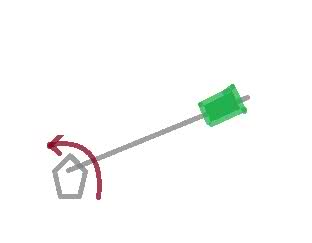
Now, let's take as an example the motion of a block that can slide freely on a frictionless arm that rotates in a horizontal planewith a constant rate over a hinge. Here's a sketch of what I'm talking about:
34quyah.jpg


So if we look into the radial direction of the block's motion, we find that there is no force acting in such a direction and thus accordingly, the block should theoretically not move in the radial direction. Surprisingly, that is not what happens as the block slides away due to its inertia.

Now how come does that happen if there are no radial forces ? Does that mean (according to my initial definition) that I should have accounted for some centrifugal force and thus that my somewhat rough force analysis should be based on a non-inertial frame of reference, ergo that radial/transverse force analysis is not an inertial reference frame ? Or do I have some huge misconception about the issue ?

Thanks in advance
 
Physics news on Phys.org
hey ezadam! :smile:
ezadam said:
So if we look into the radial direction of the block's motion, we find that there is no force acting in such a direction and thus accordingly, the block should theoretically not move in the radial direction. Surprisingly, that is not what happens as the block slides away due to its inertia.

Now how come does that happen if there are no radial forces ? Does that mean (according to my initial definition) that I should have accounted for some centrifugal force and thus that my somewhat rough force analysis should be based on a non-inertial frame of reference, ergo that radial/transverse force analysis is not an inertial reference frame ? Or do I have some huge misconception about the issue ?

you can use either an inertial frame or a rotating frame

in an inertial frame, there is no radial force, so the radial acceleration must be zero, so r'' must be positive …

since radial acceleration = r'' - ω2r :wink:

in a rotating frame, there is a centrifugal force ω2r, so r'' = ω2r
 
Thanks for the reply tiny-tim :)

The fact that in an inertial frame, \ddot{r} is positive is what bothers me ... How can the block, physically speaking, move if there is no force responsible for its radial motion ? I understand your point mathematically but I still have some trouble understanding it intuitively :/

And also, what is the meaning of the block having a zero radial acceleration component while it is still moving radially ? Again, the mathematics of it make sense to me, but its physics is what confuses me the most ... What is the real meaning of radial acceleration ?
 
ezadam said:
And also, what is the meaning of the block having a zero radial acceleration component while it is still moving radially ? Again, the mathematics of it make sense to me, but its physics is what confuses me the most ... What is the real meaning of radial acceleration ?

sorry :redface:, you're going to have to convince yourself on this one …

try drawing velocity vectors :wink:
 
Yeah I somehow pushed myself to understand it :) It's just that it's the first time that in a physics/mechanics course, I am exposed to a such an explicit expression of the effect of inertia on the kinematics of a certain body. Thanks for your help !
 

Similar threads

  • · Replies 18 ·
Replies
18
Views
2K
  • · Replies 114 ·
4
Replies
114
Views
7K
  • · Replies 2 ·
Replies
2
Views
2K
  • · Replies 25 ·
Replies
25
Views
3K
  • · Replies 15 ·
Replies
15
Views
2K
  • · Replies 3 ·
Replies
3
Views
2K
  • · Replies 1 ·
Replies
1
Views
2K
  • · Replies 2 ·
Replies
2
Views
1K
  • · Replies 22 ·
Replies
22
Views
2K
  • · Replies 17 ·
Replies
17
Views
4K