MattRob
- 208
- 29
So, I was curious about this and found more or less what I was looking for here: http://electron9.phys.utk.edu/vectors/3dcoordinates.htm
Except, something is bothering me about those equations. At the very bottom, the equation for Theta in a spherical coordinate system; shouldn't it be
[itex]\theta = {tan^{-1}}( \frac{\sqrt{{x^{2}}+{y^{2}}}}{z})[/itex]
instead of
[itex]\theta = {tan^{-1}}( \frac{z}{\sqrt{{x^{2}}+{y^{2}}}})[/itex]
(The image in question)
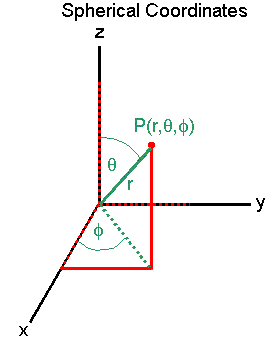
Because [itex]{tan^{-1}}( \frac{opposite}{adjacent}) = \theta[/itex] , and looking at angle [itex]\theta[/itex] , the line opposite of it is exactly equal to [itex]\sqrt{{x^{2}}+{y^{2}}}[/itex] , and the line adjacent to it equal to [itex]z[/itex].
So I'm wondering if I'm in error (and how so if I am) or if the linked page is.
Except, something is bothering me about those equations. At the very bottom, the equation for Theta in a spherical coordinate system; shouldn't it be
[itex]\theta = {tan^{-1}}( \frac{\sqrt{{x^{2}}+{y^{2}}}}{z})[/itex]
instead of
[itex]\theta = {tan^{-1}}( \frac{z}{\sqrt{{x^{2}}+{y^{2}}}})[/itex]
(The image in question)
Because [itex]{tan^{-1}}( \frac{opposite}{adjacent}) = \theta[/itex] , and looking at angle [itex]\theta[/itex] , the line opposite of it is exactly equal to [itex]\sqrt{{x^{2}}+{y^{2}}}[/itex] , and the line adjacent to it equal to [itex]z[/itex].
So I'm wondering if I'm in error (and how so if I am) or if the linked page is.