Is there a basic example that works based on gravitoelectromagnetism?

  • Context: Graduate 
  • Thread starter Thread starter sergioperezf
  • Start date Start date
Click For Summary

Discussion Overview

The discussion revolves around the concept of gravitoelectromagnetism (GEM) and its practical examples or applications. Participants explore the theoretical underpinnings of GEM, its relationship to gravito-magnetism, and potential real-world instances where GEM might be applicable, particularly in experimental contexts.

Discussion Character

  • Exploratory
  • Technical explanation
  • Debate/contested

Main Points Raised

  • Some participants describe GEM as a set of analogies between electromagnetism and relativistic gravitation, specifically relating Maxwell's equations to approximations of the Einstein field equations.
  • Others explain that under certain simplifications, mass density and flow in gravitation can be analogous to charge density and current in electromagnetism, with gravitational fields resembling electrostatic fields and "gravitomagnetic fields" resembling magnetic fields.
  • One participant argues that while gravito-magnetism can be a useful approximation in certain situations, it does not eliminate the need for full general relativity, emphasizing the importance of knowing when the approximation is valid.
  • There is a contention regarding the terminology, with some participants noting that "gravitoelectromagnetism" and "gravitomagnetism" may refer to similar concepts, while others express confusion over the term "gravitoelectromagnetism" itself.
  • Participants mention the Gravity Probe B experiment as a potential application of GEM, noting that while it is referenced in literature, a thorough numerical analysis using GEM has not been widely published.
  • Additional references to related experiments and literature are provided, including discussions on the Lense-Thirring effect and the LARES missions, indicating ongoing research in the field.

Areas of Agreement / Disagreement

Participants express differing views on the terminology and applicability of GEM and gravito-magnetism, with no consensus reached on the utility of GEM in practical examples. The discussion remains unresolved regarding the clarity and usefulness of the concepts presented.

Contextual Notes

Some participants highlight limitations in understanding the conditions under which GEM applies, and there are unresolved questions regarding the definitions and distinctions between gravitoelectromagnetism and gravito-magnetism.
sergioperezf
Messages
1
Reaction score
0
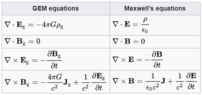
The definition says Gravitoelectromagnetism (GEM), refers to a set of formal analogies between the equations for electromagnetism and relativistic gravitation; specifically: between Maxwell's field equations and an approximation, valid under certain conditions, to the Einstein field equations for general relativity.
But I don't find an useful real example.
 

Attachments

  • 1.png
    1.png
    8 KB · Views: 123
Physics news on Phys.org
Under certain simplifications the Einstein field equations simplify to the same form as Maxwell's equations. When you do the simplification mass density and mass density flow occupy the same place in the maths as charge density and current density in Maxwell's equations, the Newtonian gravitational field acts like the electrostatic field, and a "gravitomagnetic field" acts like the magnetic field.

The correspondence is not precise because you can only have positive mass density where you can have positive or negative charge density. And the equations are only approximations to the full form of the Einstein field equations.

Does that help?
 
Last edited:
  • Like
Likes   Reactions: vanhees71
What @Ibix describes is "gravitomagnetism", which is fairly useless. In some situations it is a good approximation, but this doesn't spare you from the full GR, because you need to know if you are in a situation where this approximation works or does not.

But the OP didn't write "gravitomagnetism". He wrote "gravitoeletromagntism" which I have never heard of,
 
  • Like
Likes   Reactions: vanhees71
(Note: OP is on a 10-day vacation from PF for some other issues.)
 
Could be. I guess we will find out in ten days.
 
  • Like
Likes   Reactions: martinbn
Vanadium 50 said:
the OP didn't write "gravitomagnetism". He wrote "gravitoeletromagntism" which I have never heard of
They're the same thing. What @Ibix posted pretty much matches the description given on the Wikipedia page for "gravitoelectromagnetism". "Gravitomagnetism" is just focusing on the "magnetic" part of "gravitoelectromagnetism" (the "electric" part is just ordinary Newtonian gravity).
 
  • Like
Likes   Reactions: vanhees71 and Ibix
  • Like
Likes   Reactions: vanhees71 and romsofia
  • #10
To add onto pervect's post...
'The 1995-99 measurements of the Lense-Thirring effect using laser-ranged satellites' https://iopscience.iop.org/article/10.1088/0264-9381/17/12/309

'Gravitoelectromagnetism: A Brief Review'
https://arxiv.org/abs/gr-qc/0311030

'Gravity Probe B: Final Results of a Space Experiment to Test General Relativity'
https://arxiv.org/abs/1105.3456

Of course, LARES 2 launched two years ago, which you can find some info here: https://www.lares-mission.com/LARES_2.asp
But, LARES one has a lot of papers out, which you can find here: https://www.lares-mission.com/pubblicazioni.asp

And, some of the ideas behind LARES 1 before it was launched can be found here:
'Towards a One Percent Measurement of Frame Dragging by Spin with Satellite Laser Ranging to LAGEOS, LAGEOS 2 and LARES and GRACE Gravity Models'
https://link.springer.com/article/10.1007/s11214-009-9585-7

And some drama between some physicists in this field 🫢: https://retractionwatch.com/2014/06...sing-fake-names-to-criticize-papers-on-arxiv/
 
  • Like
Likes   Reactions: vanhees71

Similar threads

  • · Replies 8 ·
Replies
8
Views
3K
  • · Replies 3 ·
Replies
3
Views
931
  • · Replies 1 ·
Replies
1
Views
865
  • · Replies 47 ·
2
Replies
47
Views
5K
  • · Replies 10 ·
Replies
10
Views
1K
  • · Replies 12 ·
Replies
12
Views
3K
  • · Replies 50 ·
2
Replies
50
Views
4K
  • · Replies 18 ·
Replies
18
Views
2K
  • · Replies 2 ·
Replies
2
Views
3K
  • · Replies 5 ·
Replies
5
Views
3K