Is Thermal Expansion Fatigue a Concern for Aluminum Alloy Motorcycle Frames?

Click For Summary
SUMMARY

The discussion centers on the impact of thermal expansion fatigue on aluminum alloy motorcycle frames. Participants agree that while aluminum does not have a fatigue limit, the thermal expansion caused by daily temperature variations (approximately 20° to 30°) is unlikely to induce significant microstructural damage. The consensus is that aluminum parts can endure substantial thermal stress, estimated at around 300 MPa, without failing for thousands of years. However, concerns about micro fractures and external factors like corrosion from environmental exposure remain valid.

PREREQUISITES
  • Understanding of aluminum alloy properties and thermal expansion coefficients
  • Knowledge of fatigue limits and microstructural changes in metals
  • Familiarity with stress-relieving processes in metal manufacturing
  • Basic principles of material science related to temperature-induced stress
NEXT STEPS
  • Research the effects of thermal expansion on aluminum alloys in mechanical applications
  • Explore the concept of fatigue limits in various materials, particularly aluminum
  • Learn about industrial stress-relieving techniques for metal components
  • Investigate the impact of environmental factors on the longevity of aluminum structures
USEFUL FOR

Engineers, materials scientists, motorcycle manufacturers, and anyone involved in the design and maintenance of aluminum alloy structures will benefit from this discussion.

Sefi
Messages
4
Reaction score
3
Hello, assuming to keep an aluminum alloy motorcycle frame not in use, still, will the daily temperature variations cause thermal fatigue due to the continuous expansions and retractions or is the force developed by a few degrees of variations not sufficient to create microstructural dislocations?
 
  • Like
Likes   Reactions: 256bits
Engineering news on Phys.org
Welcome to PF.

Are you asking if a motorcycle with an aluminum frame will degrade over time? I don't think I've heard of that before. Can you give us some links to what is causing you to ask this? Thanks.
 
  • Like
Likes   Reactions: 256bits
Hi Berkeman, thanks for the answer, mine was a consideration, from what I read aluminum and aluminum alloys do not have a fatigue limit below which they do not register damage, at each work cycle something in the microstructure is changed. An annual thermal expansion can go from about 0° to 30°, inside even less but there is at least 20° of range. Furthermore, aluminum has a high expansion coefficient, therefore thinking for example of a frame made up of 2 bolted pieces, I imagine that in the points of greatest stress (bolts) these variations can be understood as a work cycle, or perhaps even throughout the frame same. I've always thought that by keeping a car or motorbike only for museum-type display, at least the metal parts wouldn't have been damaged simply by the time.
 
Sefi said:
An annual thermal expansion can go from about 0° to 30°
So what stress is induced on the material if ones takes an annual change in temperature of 30 degrees?

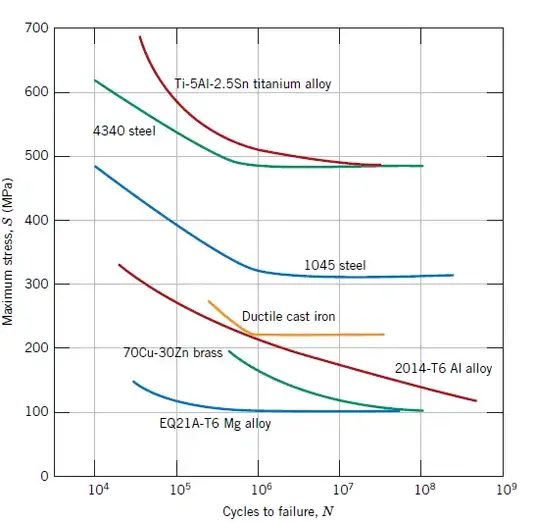
Here is a graph for various materials.
https://material-properties.org/what-is-fatigue-life-s-n-curve-woehler-curve-definition/
S-N-curves-of-different-materials.png

For an induced annual thermal stress of 300MPa or so, your aluminium parts should last 10000 years.
Daily, the parts would still last 30 years or so with that same 300 Mpa induced loading.
You just have to determine how much the stress would actually be from the the change in temperature.
And then one can lie in bed at night worrying if it is something to worry about.

Not to say that some micro fractures would not occur, but the parts would have a difficult time failing.

Sefi said:
keeping a car or motorbike only for museum-type display
Corrosion from sunlight and weathering can wreck havoc on the machine.
 
Understood, it would be interesting to know how much stress is induced daily just due to the sudden change in temperature
 
Sefi said:
Understood, it would be interesting to know how much stress is induced daily just due to the sudden change in temperature
I may be wrong, but I believe that not much stress, if any, is induced by a change of temperature of the whole aluminum alloy motorcycle frame.

The case of a commercial airplane fuselage is different, because the pressurization cycles induce cyclic internal stress for what it is essentially a cylindrical vessel.

As a matter of fact, heating up whole metal parts and assemblies in big ovens, is a common industrial way to reduce internal stress that have been previously created by heat treatment, welding, or other means of manufacturing.

Perhaps your stamped and welded frame went through a thermal stress relieving process in the factory prior to the final assembly of the motorcycle.

Please, see:
https://gearsolutions.com/departments/hot-seat/stress-relief-is-a-key-step-in-parts-manufacturing/#:~:text=Performing a stress-relieving operation,up to 2-3 hours.
 
Last edited:
  • Like
Likes   Reactions: 256bits
Lnewqban said:
As a matter of fact, heating up whole metal parts and assemblies in big ovens, is a common industrial way to reduce internal stress that have been previously created by heat treatment, welding, or other means of manufacturing.
I was going to sat something like that about heating a block of aluminium, but you did convey it better then I would have in regards to a practical scenario.
 
  • Like
Likes   Reactions: Lnewqban
Lnewqban said:
I may be wrong, but I believe that not much stress, if any, is induced by a change of temperature of the whole aluminum alloy motorcycle frame.

The case of a commercial airplane fuselage is different, because the pressurization cycles induce cyclic internal stress for what it is essentially a cylindrical vessel.

As a matter of fact, heating up whole metal parts and assemblies in big ovens, is a common industrial way to reduce internal stress that have been previously created by heat treatment, welding, or other means of manufacturing.

Perhaps your stamped and welded frame went through a thermal stress relieving process in the factory prior to the final assembly of the motorcycle.

Please, see:
https://gearsolutions.com/departments/hot-seat/stress-relief-is-a-key-step-in-parts-manufacturing/#:~:text=Performing a stress-relieving operation,up to 2-3 hours.

Thanks for the answer, yes the frames are indeed heat treated to give strength and release the stress in the welds, but having bolted areas or simply expanding and contracting every day due to the change in ambient temperature does not theoretically produce internal dislocations? For steel we could speak of endurance limit, at least theoretically, but with aluminum as far as I understand every little stress or load modifies the internal microstructure or at least that's what I've read in the various researches conducted. Having said that, I don't understand one thing, how is it possible that there isn't a minimum load limit beyond which there will be no fatigue? I imagine that even in aluminum you must have a certain level of energy to allow the dislocations to overcome obstacles and move each other, taking the concept to extremes, if we were to place a weight of 1 gram on aluminum, we would have to see some effort with patience to wait for years? seems like a bold statement, as an ignorant I guess there must be a certain amount of load per cubic Cm or something like that. Still, thermal expansion is a great force too
 

Similar threads

  • · Replies 1 ·
Replies
1
Views
2K
  • · Replies 2 ·
Replies
2
Views
3K
  • · Replies 13 ·
Replies
13
Views
21K
  • · Replies 2 ·
Replies
2
Views
3K
  • · Replies 4 ·
Replies
4
Views
4K
  • · Replies 13 ·
Replies
13
Views
6K
  • · Replies 1 ·
Replies
1
Views
3K
  • · Replies 24 ·
Replies
24
Views
5K
  • · Replies 12 ·
Replies
12
Views
5K
  • · Replies 5 ·
Replies
5
Views
17K