Is this manipulation "evil" or simply not intuitive due to unfamiliarity?

Click For Summary
SUMMARY

The discussion focuses on the challenges of performing substitutions in integral calculus, particularly for indefinite and definite integrals. Participants emphasize the importance of practice and familiarity with various substitution techniques, especially when dealing with limits. The beta function's limits and the necessity of transforming them correctly are highlighted as critical aspects of solving integrals. Key resources mentioned include "Special Functions" by Askey, Andrews, and Roy, which provides insights into linear fractional transformations.

PREREQUISITES
  • Understanding of integral calculus concepts, particularly substitutions.
  • Familiarity with definite and indefinite integrals.
  • Knowledge of the beta function and its properties.
  • Basic understanding of linear fractional transformations.
NEXT STEPS
  • Study substitution techniques for indefinite integrals in depth.
  • Explore the properties and applications of the beta function.
  • Learn about linear fractional transformations and their role in calculus.
  • Read "Special Functions" by Askey, Andrews, and Roy for advanced insights.
USEFUL FOR

Students and educators in mathematics, particularly those focusing on calculus, integral techniques, and mathematical analysis.

JC2000
Messages
186
Reaction score
16
Homework Statement
Show that :
$$
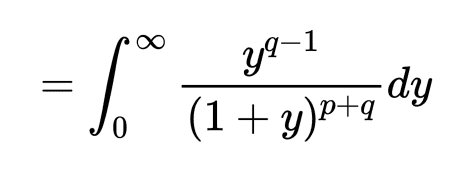
\beta(p, q)=\int_{0}^{\infty} \frac{y^{q-1}}{(1+y)^{p+q}} d y
$$
Relevant Equations
The Beta Function :

$$
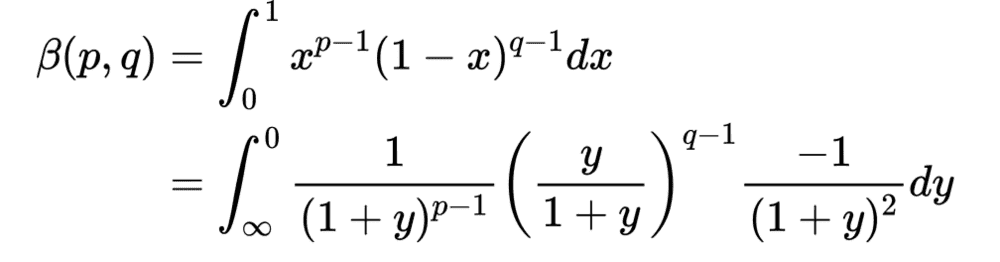
\beta(m, n)=\int_{0}^{1} x^{m-1}(1-x)^{n-1} d x
$$
The solution is as follows :
Screenshot 2020-06-09 at 9.11.35 PM.png

Screenshot 2020-06-09 at 9.12.16 PM.png
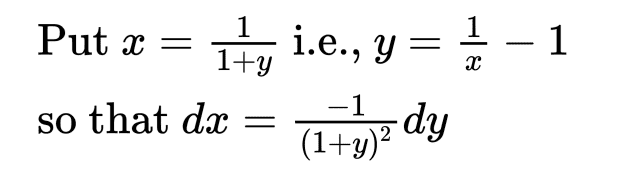
The substitution is what nags me , which is as follows :
Screenshot 2020-06-09 at 9.08.07 PM.png

This substitution "trick" to me seems impossibly difficult to arrive at "logically" without pretty much reverse engineering the problem.
So is this simply a lack of practice/ familiarisation showing ? I feel like I have always struggled with similar manipulations. In the past I think it was through repeatedly encountering a certain peculiar manipulation that it would become second nature for me. Is this how such problems are to be approached? Since it seems to almost be the same as memorising the solution!

Thank you for your insight!
 

Attachments

  • Screenshot 2020-06-09 at 9.07.24 PM.png
    Screenshot 2020-06-09 at 9.07.24 PM.png
    13.7 KB · Views: 193
  • Like
Likes   Reactions: etotheipi
Physics news on Phys.org
Substitutions for indefinite integrals can be tricky and you pretty much have to learn them, however for definite integrals the question gives you a big clue - look at the limits.
 
  • Like
Likes   Reactions: JC2000 and PeroK
pbuk said:
Substitutions for indefinite integrals can be tricky and you pretty much have to learn them, however for definite integrals the question gives you a big clue - look at the limits.

For indefinite integrals do you mean I should start listing the substitutions once they ambush me or is it fine to internalise them by practicing often?

So for this integral since the beta function has limits 0 and 1 while the question has limits 0 and infinity, I must search for a substitution whereby the desired transformation of limits is achieved (?)

Thanks for the input!
 
JC2000 said:
For indefinite integrals do you mean I should start listing the substitutions once they ambush me or is it fine to internalise them by practicing often?
Practice, practice, practice :smile:
JC2000 said:
So for this integral since the beta function has limits 0 and 1 while the question has limits 0 and infinity, I must search for a substitution whereby the desired transformation of limits is achieved (?)
Yes - if you see ## \infty ## on one side of the transformation you know you are looking for a substitution where one limit goes to 1/0, if you see ## \pi ## on one side only you are looking for a trigonometric substitution etc. Don't forget to consider (as in this case) that the transformation might 'swap' the upper and lower limit.
 
  • Like
Likes   Reactions: JC2000
This tip is on pg. 76 of Special Functions by Askey, Andrews, and Roy in the chapter on hypergeometric functions:

There are six linear fractional transformations that will map a set of three points to a permutation of the three points. For example, the set ##\left\{ 0,1,\infty\right\}## will be mapped to itself by the mappings

$$x\rightarrow \, x, \, 1-x, \, \tfrac{1}{x} , \, \tfrac{1}{1-x} , \, 1-\tfrac{1}{x} = \tfrac{x-1}{x} , \, \tfrac{1}{1-\tfrac{1}{x}} = \tfrac{x}{x-1}$$
 
Last edited:
  • Like
Likes   Reactions: etotheipi and JC2000

Similar threads

  • · Replies 7 ·
Replies
7
Views
2K
  • · Replies 179 ·
6
Replies
179
Views
28K
  • · Replies 4 ·
Replies
4
Views
2K
  • · Replies 5 ·
Replies
5
Views
3K
  • · Replies 3 ·
Replies
3
Views
4K
  • · Replies 32 ·
2
Replies
32
Views
7K
  • · Replies 10 ·
Replies
10
Views
6K
  • · Replies 1 ·
Replies
1
Views
2K
Replies
6
Views
4K
  • · Replies 1 ·
Replies
1
Views
3K