Is this possible? (regarding observable and actual size of universe)

  • Context: Graduate 
  • Thread starter Thread starter Kaldanis
  • Start date Start date
  • Tags Tags
    Observable Universe
Click For Summary
SUMMARY

The discussion centers on the nature of the observable universe and the implications of its homogeneity and isotropy. Participants assert that regardless of location, such as a hypothetical "Planet X," observers would perceive a similar cosmic landscape, with the observable universe appearing isotropic and centered around them. The conversation emphasizes that the universe lacks edges or centers, as these concepts contradict the cosmological principle of homogeneity. Furthermore, the expansion of space does not necessitate an external void, as the universe itself is expanding, and the notion of a void is deemed unhelpful in scientific discourse.

PREREQUISITES
  • Understanding of cosmological principles, specifically homogeneity and isotropy.
  • Familiarity with the concept of the observable universe and its limitations.
  • Knowledge of the Big Bang theory and the expansion of space.
  • Basic grasp of topological differences in open and closed universes.
NEXT STEPS
  • Research the implications of homogeneity and isotropy in cosmology.
  • Explore the concept of the observable universe and its boundaries.
  • Study the Big Bang theory and its role in the expansion of the universe.
  • Investigate topological differences in cosmological models, including open and closed universes.
USEFUL FOR

Astronomers, cosmologists, physics students, and anyone interested in understanding the structure and expansion of the universe.

Kaldanis
Messages
106
Reaction score
0
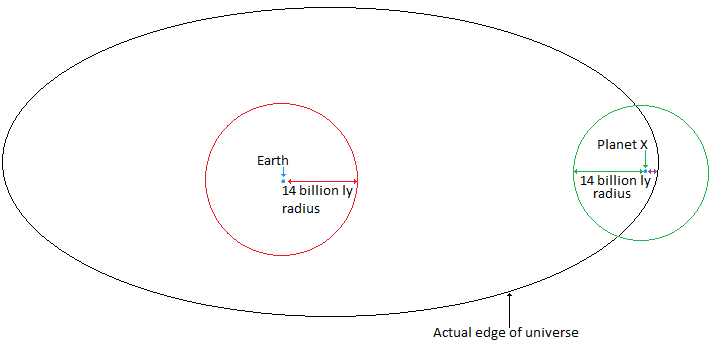
I think the picture explains it better than I can with words. Is it possible that we can only see a small sphere around our planet (red circle around Earth in the picture), but there could be a 'planet x' on the real edge of the universe that can see light from 14 billion light years away in one direction but perhaps only from 1 billion away in another direction? They could essentially see the edge of universe in one direction? (the purple arrow shows this edge they would see.)

Or, everything could be an infinite sphere and so we'd see the 14 billion light year radius no matter where we are in the universe. I'm guessing this is one of those things we will never know?

de2pvl.png
 
Space news on Phys.org
Kaldanis said:
I think the picture explains it better than I can with words. Is it possible that we can only see a small sphere around our planet (red circle around Earth in the picture), but there could be a 'planet x' on the real edge of the universe that can see light from 14 billion light years away in one direction but perhaps only from 1 billion away in another direction? They could essentially see the edge of universe in one direction? (the purple arrow shows this edge they would see.)

Hello,

If we could stand at Planet X at the edge of our Observable Universe, then standing on Planet X we would once again be at the center of our observable Universe!

Remember that the reason we can "see" anything is that the light has had time to reach us. If we were on Planet X we would merely move the center of our observable Universe. The Observable Universe as observed from Planet X would look very similar to what we would observe on Earth.

This is because on large scales space is Homogenous (the same everywhere). As space is homogenous and expansion is not ballistic like an explosion but is an expansion of space, then to discuss "edges" or "centers" would invalidate homogeneity which is a core cosmological principal.

Kaldanis said:
Or, everything could be an infinite sphere and so we'd see the 14 billion light year radius no matter where we are in the universe. I'm guessing this is one of those things we will never know?

this is partially correct. Even if the Universe is finite then there would still be no edge. I think it would benefit you to look up topological differences in open/closed universes and to look further into flat/curved spacetimes. Chances are we will never know if the entire Universe is infinite or just finite and incredibly large - there has been a lower boundary placed on the possible size if infinite, it is much much larger than the OU.

I hope this helps your understanding.
 
I'd like to soften Cosmo Novice's answer a bit:
All you said is true, Kaldanis. Probably we'll never know.
But the universe looks quite homogeneous (or rather: isotropic) as far as we can see, that's why the standard cosmological models all assume absolute homogeneity thoughout the universe - the math is a lot easier then, and it doesn't matter anyway.
So your first scenario is not possible in such a model, as there is no edge anywhere. That's also true for finite universes, they look rather like the surface of a sphere: finite, but without edge.
 
Just to add to Ich and to my previous posts:

Spatially, there are no preferred frames of reference, so no place in the Universe we can point to and say "that is the center" or "that is the egde". However there is a differed sort of edge to the Universe - that is a temporal edge, what this means is wherever we observe from (whether that be Earth or planet X) then we are at the place light has taken the longest to reach, therefore all observers exist at the temporal edge.

Just a bit of thought for food and maybe to help you visualise expansion, I think the core to your question is understanding the nature of expansion.

Hope this helps.
 
Thank you for the replies. I think my problem is I don't completely understand the shape/geometry of space.

I understand that you're saying if I were to go to 'planet x' then I would find myself in a similar situation to being on Earth - surrounded by galaxies in all directions with the furthest appearing to around 14 billion light years away. I'm not questioning the age of the universe, since if the velocity of light is constant then 14bn will always be the most distant light we can see, anywhere. What I'm questioning is how do we know there will always be something 14 billion light years away in that direction?

How do we know it will always look like how it appears from Earth? This seems to be an assumption to me, considering we can't see anything past our current horizon of 14bn ly. Aren't we just assuming that we'd see the same thing if we went there? Is it really not possible that space is expanding in all directions into some kind of void, meaning that maybe there wouldn't be an end to space, but you'd eventually reach a point where there's no more matter head of you?

Kind of like how our galaxy is densely packed with stars, but if you went to the edges of our galaxy you'd eventually reach a point where there's no more stars ahead. You'd just be drifting through the void between galaxies. Could our universe not be like this, where all the galaxies are clumped together and expanding into a void? (who's to say it stops there, there could be clusters of universes separated by huge distances!) If the answer is no, how are we so sure of this considering we are confined to a 14 billion light year radius sphere around Earth?

I hope that made sense.
 
Kaldanis said:
Thank you for the replies. I think my problem is I don't completely understand the shape/geometry of space.

I understand that you're saying if I were to go to 'planet x' then I would find myself in a similar situation to being on Earth - surrounded by galaxies in all directions with the furthest appearing to around 14 billion light years away. I'm not questioning the age of the universe, since if the velocity of light is constant then 14bn will always be the most distant light we can see, anywhere. What I'm questioning is how do we know there will always be something 14 billion light years away in that direction?

It is difficult to understand because the toplogy is dependent on curvature,

The reason we theorise this is because the OU we observer is isotropic. This isotropy must extend beyond our Observable Universe otherwise if beyone our OU was a vastly different matter or energy distribution we would obesrve its effects at the edge of our OU - Such as with the Dark Flow scenario as an example.

Kaldanis said:
How do we know it will always look like how it appears from Earth? This seems to be an assumption to me, considering we can't see anything past our current horizon of 14bn ly. Aren't we just assuming that we'd see the same thing if we went there? Is it really not possible that space is expanding in all directions into some kind of void, meaning that maybe there wouldn't be an end to space, but you'd eventually reach a point where there's no more matter head of you?

Yes it is an assumption but one that corresponds with all of out observations - isotropy is a key feature of modern cosmology and our understanding of large scale structure formation, inflation and expansion all take into account this cosmological principle. Now it is entirely possible that our Observable Universe is actually not isotropic with the rest of the Universe but we must go against all current observations.

You would never reach a point when there was no more matter - matter is expanding along with space. Assuming a matter explosion in space is the wrong way to look at it. Prior to the Big Bang there was no space. The Big Bang was not the creation of matter into a prior existing background, the Big Bang is the rapid expansion of all space/matter after t>planck, the space you are talking about exists as a result of the expansion of space.

Kaldanis said:
Kind of like how our galaxy is densely packed with stars, but if you went to the edges of our galaxy you'd eventually reach a point where there's no more stars ahead. You'd just be drifting through the void between galaxies. Could our universe not be like this, where all the galaxies are clumped together and expanding into a void? (who's to say it stops there, there could be clusters of universes separated by huge distances!) If the answer is no, how are we so sure of this considering we are confined to a 14 billion light year radius sphere around Earth?

I hope that made sense.

The idea of a "void" is not a very useful notion. The only void we can discuss is the vacuum of space, as far as science is concerned the expansion of space - the expansion of the Universe (the expansion of reality) does not require anything to expand into. Essentially what we can say is that the Universe was once much, much, denser and hotter than it is currently and that since the Big Bang the Universe has expanded and cooled.

Hope this helps feel free to post more questions. I am no expert but am sure the experts will chime in if I explain anything incorrectly.

Cosmo
 

Similar threads

  • · Replies 42 ·
2
Replies
42
Views
6K
  • · Replies 17 ·
Replies
17
Views
2K
  • · Replies 103 ·
4
Replies
103
Views
12K
  • · Replies 44 ·
2
Replies
44
Views
6K
  • · Replies 54 ·
2
Replies
54
Views
5K
  • · Replies 8 ·
Replies
8
Views
3K
  • · Replies 11 ·
Replies
11
Views
3K
  • · Replies 20 ·
Replies
20
Views
2K
  • · Replies 23 ·
Replies
23
Views
3K
  • · Replies 15 ·
Replies
15
Views
3K