Is this steel structure stable/ready to build?

Click For Summary

Discussion Overview

The discussion revolves around the stability and readiness for construction of a proposed steel structure intended to provide a rain-proof area for outdoor seating. Participants explore various design considerations, structural integrity, and potential improvements to the initial concept.

Discussion Character

  • Debate/contested
  • Technical explanation
  • Conceptual clarification

Main Points Raised

  • One participant asserts that the initial frame design is unstable and would rotate clockwise under strong wind conditions, suggesting the need for improved ground anchorage.
  • Another participant questions whether the weight of the structure and existing steel beams would prevent rotation, seeking further opinions on the material's ability to withstand bending.
  • A concern is raised about local internal stresses at the anchorage points due to wind, which could lead to concrete cracking or steel yielding, potentially causing structural failure.
  • Suggestions are made to enhance stability, including adding more concrete to the base, adjusting the arch beam's anchorage, and simplifying the strut design.
  • Replacing a steel cable with a steel bar is proposed as a means to strengthen the structure against wind forces.
  • A recommendation is made to reduce the radius of curvature of the arch beam for a stronger and simpler design, with a reference to a well-designed bus shelter as an ideal model.

Areas of Agreement / Disagreement

Participants express differing views on the stability of the current design and propose various modifications. There is no consensus on the best approach or the adequacy of the existing structure, and the discussion remains unresolved.

Contextual Notes

Participants emphasize the importance of having any final design checked by a structural engineer for safety, indicating a recognition of the limitations of their expertise and the potential risks involved.

Pastean
Messages
6
Reaction score
0
Hi,

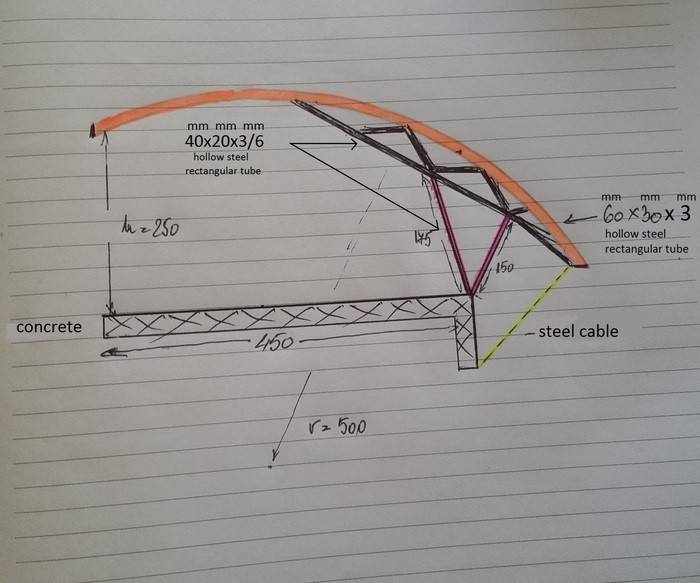
My father has been dedicating a lot of his time to making our soon-to-be home as "rewarding" (I guess) and as nice as possible for when its done. The new side project would be this. It is supposed to be some rain-proof place for a bench/table outside.
There are going to be three (more or less if needed) structures like the one in the picture, parallel to each other, with some sort of material (haven't figured it out yet) to make a nice rain-proof spot for a bench or a table.
33fezjl.jpg

What inspired him:
241ntl2.jpg


My question to you is: does this structure look stable, ready to build? are there any improvements that can be done?
Neither of us work with CAD or software like this and our budget is quite limited for this project, so asking people around is pretty much all the expertise we're going to get.

Thank you.
 
Engineering news on Phys.org
Frame shown in your sketch is unstable . If strong wind came from the left the whole construction would rotate clockwise .

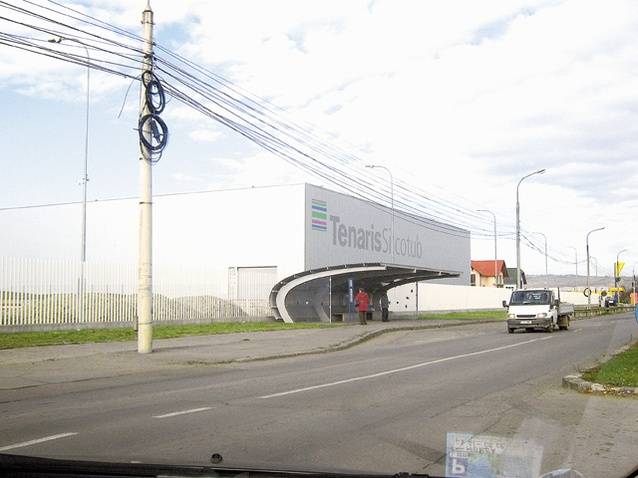
Frame shown in bus stop picture has a rigid frame with effective ground anchorage . You need to modify your frame so as to have similar ground anchorage .

You should have your final design checked by a structural engineer .
 
Wouldn't the weight be enough for it not to rotate? and it is also anchored with those two steel beams (there's no rotating mechanism at the bottom). Also the house sits about 3m to the left of the structure.
This is as far as I can get with the expertise sadly, so any further opinion on what I just said is much appreciated.

So as you have addressed the wind problem, should I assume that the materials could hold the structure as it sits right now? (no bending and such?)
 
The problem with this structure is that near the point where two steel tubes are anchored to the concrete foundation, very large local internal stresses will appear, due to wind from the left. That may have two consequences: (a) local stresses in the concrete would be so high that the concrete may develop cracks, and eventually the anchorage would fail; or (b) normal stresses in the tubes (near the anchorage) may exceed the yield stress for steel; as a result, the tubes would bend, and the whole construction (as mentioned in another comment above) would rotate clockwise (local buckling of the tubes may also occur).
 
Maybe something like this :

Put down some more concrete on the right hand side of base .

Bring the right hand end of the arch beam down to the level of the new concrete and arrange a firm anchorage . Either bury an extension of the beam deep in the concrete or use steel base plates and foundation bolts .

Remove all the struts as drawn . Replace with one simple strut .

Draw that out and we'll see if further work is needed .

I must stress though that whatever design you end up with has to be checked by a structural engineer for safety .
 
Replacing the steel cable by a steel bar would help as well. Don't underestimate wind.
 
You would end up with a stronger and simpler design if you reduced the radius of curvature of the arch beam .

Leave the left end where it is and pull the right hand end over onto the existing concrete base .

Note that the arch beam in that bus shelter is very well designed - if you could get somewhere near the same shape that would be ideal .
 
Last edited:

Similar threads

Replies
5
Views
2K
  • · Replies 2 ·
Replies
2
Views
3K
  • · Replies 6 ·
Replies
6
Views
3K
  • · Replies 96 ·
4
Replies
96
Views
11K
Replies
2
Views
3K
  • · Replies 9 ·
Replies
9
Views
1K
  • · Replies 3 ·
Replies
3
Views
3K
  • · Replies 7 ·
Replies
7
Views
3K
  • · Replies 1 ·
Replies
1
Views
3K
  • · Replies 5 ·
Replies
5
Views
3K