Is this way of steering possible?

Click For Summary

Discussion Overview

The discussion centers around the feasibility of a unique steering mechanism for a square platform with fixed and steerable wheels. Participants explore the mechanics of steering, potential complications, and alternative methods, focusing on theoretical and conceptual aspects of vehicle dynamics.

Discussion Character

  • Exploratory
  • Technical explanation
  • Debate/contested

Main Points Raised

  • One participant proposes a steering mechanism where the left side wheels are fixed and the right side wheels are steerable, questioning its effectiveness.
  • Another participant suggests that using a wheeled skid steer method with four fixed wheels would be less complicated than the proposed design.
  • A participant argues that the configuration of the steerable wheels affects the center of rotation, which could influence turning capabilities, but expresses uncertainty about the effectiveness of the design.
  • Concerns are raised about the stability of the proposed design, with references to how fixed and steerable wheels interact during turns.
  • One participant draws parallels to common wheeled vehicles, suggesting that the proposed setup may lead to instability if not designed correctly.
  • Another participant recommends an alternative configuration involving motors and steering servos that could enhance maneuverability.

Areas of Agreement / Disagreement

Participants express differing opinions on the effectiveness and practicality of the proposed steering mechanism. There is no consensus on whether the design would work well, with multiple competing views presented throughout the discussion.

Contextual Notes

The discussion includes assumptions about weight distribution, friction, and the dynamics of turning, which are not fully resolved. The implications of different wheel configurations on stability and maneuverability are also noted but remain open to interpretation.

drago44
Messages
3
Reaction score
0
TL;DR
Steering platform four wheel robot one side fixed
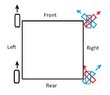
I was wondering... Let's say we have a square platform with 4 wheels at corners placed on dirt and let's have left side wheels fixed straight and right side wheels are steerable so that when rear right goes in then front right goes out, would this way of steering work? What's your thoughts?
 

Attachments

  • steeringQ.jpg
    steeringQ.jpg
    15.8 KB · Views: 105
Engineering news on Phys.org
:welcome:
Do you have some ideas yourself on what problems such a construction might give?
 
I think the most obvious question would be: Why?

At this point using the wheeled skid steer method with four fixed wheels and varying the speed from side to side would be less complicated:

 
  • Like
Likes   Reactions: Rive, russ_watters and Lnewqban
drago44 said:
... would this way of steering work?
No.
Welcome, @drago44 !

Another idea:

lesco-jpg.88795
 
jack action said:
I think the most obvious question would be: Why?

At this point using the wheeled skid steer method with four fixed wheels and varying the speed from side to side would be less complicated:


Great video but in my situation only fixed wheels (on left side) are powered, changing direction of motors has no effect on direction of platform without steerable wheels on the right side...
 
Lnewqban said:
No.
Welcome, @drago44 !

Another idea:

lesco-jpg.88795
Well like this but just rotate all wheels for 90 degrees so whole thing moves "sideways" - that's in question here!
 
drago44 said:
Great video but in my situation only fixed wheels (on left side) are powered, changing direction of motors has no effect on direction of platform without steerable wheels on the right side...
In that case, having the steerable wheels in the blue positions will set the center of rotation somewhere in the middle of the vehicle and it should most likely easily turn right on itself.

If the steerable wheels are still in the blue positions but at a lesser angle, the center of rotation will be to the left of the powered wheels and it might turn left. Especially if there is a lot of weight transfer on the outside wheels. I say might because I intuitively think it will require a lot more skidding from the powered wheels.

Going into the red positions, the effect will be similar to the blue positions, but instead of turning on itself, it will turn about a point to the right of the vehicle. Again, a lot of skidding is asked here. At a low angle, even more skidding is required which makes the right turn more difficult. The weight transfer is all wrong in this condition because the powered wheels are favored such that the vehicle will tend to go straight.

I would expect that only turning on itself would work properly (blue positions), adjusting the power in the proper direction to turn right or left.
 
TL;DR: It'll turn, but not well. The two fixed wheels on one side will act against any turning moment you attempt to apply.

As others have mentioned, having your fixed wheels on a common axis, like on the zero-turn mower, is much easier. Think of a shopping cart, or a wheelchair, and how it's configured. Casters up front, fixed wheels in the back, right? I spent a couple years working as a loader and cart wrangler at a home improvement store and got to understanding their behavior quite well. They're happiest when their center of mass is ahead of the axis on which the fixed wheels rotate. Basically, the axle you'd put the bearings on. That axis, when extended to infinity, is always going to have the point around which the cart/car/vehicle/etc. turns on it. And it will naturally seek to keep that axis behind the center of mass. That's where it's dynamically stable. IF you reverse it, and put the axis of the fixed wheels ahead of the center of mass, like pushing a cart from the nose/front, it's unstable, and will flip around if disturbed by even the slightest amount. Different friction levels in the fixed wheels, a bump, a gust of wind, etc, and it'll gleefully whip around and put the casters forwards.

What you're proposing takes your fixed wheels and puts them on two separate axes. This is going to provide a very strong stabilizing force. Think about how the axles on a big semi truck are set up. Yes, it's mainly for load distribution and reducing footprint pressure, but it also provides some extra stability to have the multiple axles in parallel like that.

If you've got two motors, and two steering servers, which is what I'm understanding your situation is, you'd be much better served by putting both motors at the back, both steering servos at the front, and having a mode where you can basically turn both wheels nose in if you want to turn really sharply, then drive the motors in opposite directions.
 

Similar threads

  • · Replies 9 ·
Replies
9
Views
2K
  • · Replies 15 ·
Replies
15
Views
3K
  • · Replies 8 ·
Replies
8
Views
7K
  • · Replies 4 ·
Replies
4
Views
5K
  • · Replies 9 ·
Replies
9
Views
3K
  • · Replies 8 ·
Replies
8
Views
9K
  • · Replies 9 ·
Replies
9
Views
8K
  • · Replies 3 ·
Replies
3
Views
2K
  • · Replies 9 ·
Replies
9
Views
2K
  • · Replies 24 ·
Replies
24
Views
6K
