Is Your Calculation of Simple Harmonic Motion Accurate?

Join the discussion
Ask a follow-up here, or get your own question answered by working scientists, mathematicians and engineers — people, not an autocomplete.
Real named experts · corrections over time · the nuance an AI answer skips
5 replies · 2K views
Krokodrile
Messages
45
Reaction score
3
Homework Statement
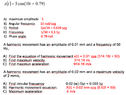
Determinate amplitude, velocity, aceleration, and ecuation of the principal ecuations (more information in the down image)
Relevant Equations
1/T w/2pi
Captura de Pantalla 2021-04-30 a la(s) 1.58.02.png

The first ecuation values i am 99% that is correct. But, in the second and three problem i don't know if my results are ok. The problem number 2 i comprobate with the teacher that te aceleration its correct, so, with this i calculate the velocity.

I use like example the second problem for try resolve the 3rd problem, but causes me much problems.
Any help, please?
 

Attachments
  • Captura de Pantalla 2021-04-30 a la(s) 1.45.29.png
    Captura de Pantalla 2021-04-30 a la(s) 1.45.29.png
    29.7 KB · Views: 262
Physics news on Phys.org
Krokodrile said:
The first ecuation values i am 99% that is correct.
Except D.

Krokodrile said:
The problem number 2 i comprobate with the teacher that te aceleration its correct, so, with this i calculate the velocity.
In a), why the +50?
In B), how did you calculate the velocity?
In C), despite your teacher's confirmation, I get a much smaller value.

Krokodrile said:
I use like example the second problem for try resolve the 3rd problem, but causes me much problems.
I don't understand how you got any of those. Please explain your reasoning.
 
haruspex said:
Except D.In a), why the +50?
In B), how did you calculate the velocity?
In C), despite your teacher's confirmation, I get a much smaller value.I don't understand how you got any of those. Please explain your reasoning.
a) Thats my mistake, i put hz in angle.
b) The velocity: the teacher just give us the ecuation 0.1cos (314.16t+angle), i the formula v= 2pi/w: 2pi/0.02
c) Maybe I am wrong with the value copy, but i sure that say us 914.16 with m/s units.For the 3rd problem I'm on my own with a single "class", i put the values in the ecuation of the best way i can.
For the circular frecuency i used the formula w/2pi.
For the aceleration i try to work the aceleration value with pi
 
b) have you had calculus? taking the derivative of the position x(t) will give you an equation for the velocity. The max amplitude should be apparent from that

c) m/s corresponds to a velocity, not acceleration. similar to (b) above, taking the derivative of v(t) will give you acceleration
 
onatirec said:
b) have you had calculus? taking the derivative of the position x(t) will give you an equation for the velocity. The max amplitude should be apparent from that

c) m/s corresponds to a velocity, not acceleration. similar to (b) above, taking the derivative of v(t) will give you acceleration
Captura de Pantalla 2021-04-30 a la(s) 16.17.55.png
I tried make it better
 

Attachments

  • Captura de Pantalla 2021-04-30 a la(s) 16.16.34.png
    Captura de Pantalla 2021-04-30 a la(s) 16.16.34.png
    16.1 KB · Views: 162
Krokodrile said:
b) The velocity: the teacher just give us the ecuation 0.1cos (314.16t+angle), i the formula v= 2pi/w: 2pi/0.02
##100\pi## r/s is the angular velocity, which is constant. The question is asking for the maximum linear velocity, i.e. the maximum rate of change of x.
See @onatirec's advice above.
Krokodrile said:
c) Maybe I am wrong with the value copy, but i sure that say us 914.16 with m/s units.
The units are wrong for an acceleration, and if we correct the units to ##m/s^2## the number is wildly wrong. I want to know how you calculated it.
It sounds like someone gave you the answer but you wrote it down wrongly, and don't know how to find it for yourself. Is that right?
Krokodrile said:
For the circular frecuency i used the formula w/2pi.
But where does the value of 0.02 r/s for w come from?
Krokodrile said:
For the aceleration i try to work the aceleration value with pi

Here's how this stuff works:
##x(t)=A\sin(\omega t+\phi)##
Differentiate to find the velocity:
##v(t)=\frac{dx}{dt}=A\omega\cos(\omega t+\phi)##
Differentiate again to find the acceleration :
##a(t)=\frac{dv}{dt}=-A\omega^2\sin(\omega t+\phi)##

Do you understand those differentiation steps?
