Jake's questions about integrations

  • Topic:
  • Thread starter Prove It
  • Start date
1 reply · 5K views · last reply
Prove It
Gold Member
MHB
Messages
1,434
Reaction score
20
View attachment 5590

5. To start with, we should work out the x intercepts, they are x = -2 and x = 2. That means your region in the first quadrant will be integrated over $\displaystyle \begin{align*} x \in [0,2] \end{align*}$.

You should note that rotating the function $\displaystyle \begin{align*} y = 4 - x^2 \end{align*}$ about the line $\displaystyle \begin{align*} y = -\frac{1}{2} \end{align*}$ will give the exact same volume as rotating $\displaystyle \begin{align*} y = \frac{9}{2} - x^2 \end{align*}$ around the x axis. We would then subtract the volume of the region bounded by the line $\displaystyle \begin{align*} y = \frac{1}{2} \end{align*}$ rotated about the x axis.

So our required volume is

$\displaystyle \begin{align*} V &= \int_0^2{ \pi\,\left( \frac{9}{2} - x^2 \right) ^2 \,\mathrm{d}x } - \int_0^2{ \pi\,\left( \frac{1}{2} \right) ^2\,\mathrm{d}x } \\ &= \pi \int_0^2{ \left[ \left( \frac{9}{2} - x^2 \right) ^2 - \left( \frac{1}{2} \right) ^2 \right] \,\mathrm{d}x } \\ &= \pi \int_0^2{ \left( \frac{81}{4} - 9\,x^2 + x^4 - \frac{1}{4} \right) \,\mathrm{d}x } \\ &= \pi \int_0^2{ \left( 20 - 9\,x^2 + x^4 \right) \,\mathrm{d}x } \\ &= \pi \,\left[ 20\,x - 3\,x^3 + \frac{x^5}{5} \right] _0^2 \\ &= \pi \,\left[ \left( 20 \cdot 2 - 3 \cdot 2^3 + \frac{2^5}{5} \right) - \left( 20 \cdot 0 - 3 \cdot 0^3 + \frac{0^5}{5} \right) \right] \\ &= \pi \, \left( 40 - 24 + \frac{32}{5} - 0 \right) \\ &= \pi \, \left( 16 + \frac{32}{5} \right) \\ &= \frac{112\,\pi}{5}\,\textrm{units}^3 \\ &\approx 70.371\,68 \, \textrm{units}^3 \end{align*}$I will do the second question when I have a spare moment.
 
Attachments
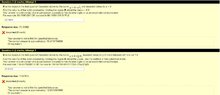
  • Screenshot of two online calculus quiz questions, Question 5 and Question 6, each marked Incorrect, with the student's wrong numerical answers 70.30862 and 11.87915 shown beneath them.
    questions.jpg
    77.7 KB · Views: 117
To evaluate the second volume, you need to imagine the region being made up of a very large number of vertically oriented cylinders. The areas of the curved surfaces of the cylinders together build up to the volume of your solid.

In each cylinder, the radius is the x value, and the height is the y value. So each cylinder has area $\displaystyle \begin{align*} 2\,\pi\,x\,y \end{align*}$, where $\displaystyle \begin{align*} y = 3 + \frac{1}{4}\,\sqrt{x} \end{align*}$ and $\displaystyle \begin{align*} x \in \left[ 1, \frac{3}{2} \right] \end{align*}$. Thus the volume is

$\displaystyle \begin{align*} V &= \int_1^{\frac{3}{2}}{ 2\,\pi\,x\,\left( 3 + \frac{1}{4}\,\sqrt{x} \right) \,\mathrm{d}x } \\ &= 2\,\pi\int_1^{\frac{3}{2}}{ \left( 3\,x + \frac{1}{4}\,x^{\frac{3}{2}} \right) \,\mathrm{d}x } \\ &= 2\,\pi\,\left[ \frac{3\,x^2}{2} + \frac{1}{4}\,\left( \frac{x^{\frac{5}{2}}}{\frac{5}{2}} \right) \right]_1^{\frac{3}{2}} \\ &= 2\,\pi\,\left[ \frac{3\,x^2}{2} + \frac{x^{\frac{5}{2}}}{10} \right] _1^{\frac{3}{2}} \\ &= 2\,\pi\,\left\{ \left[ \frac{3\,\left( \frac{3}{2} \right) ^2}{2} + \frac{\left( \frac{3}{2} \right) ^{\frac{5}{2}}}{10} \right] - \left[ \frac{3\,\left( 1 \right) ^2}{2} + \frac{1^{\frac{5}{2}}}{10} \right] \right\} \\ &= 2\,\pi \,\left( \frac{27}{8} + \frac{9\,\sqrt{6}}{80} - \frac{3}{2} - \frac{1}{10} \right) \\ &= \pi\,\left( \frac{27}{4} + \frac{9\,\sqrt{6}}{40} - 3 - \frac{1}{5} \right) \\ &= \pi \,\left( \frac{270}{40} + \frac{9\,\sqrt{6}}{40} - \frac{120}{40} - \frac{8}{40} \right) \\ &= \frac{\left( 142 + 9\,\sqrt{6} \right)\,\pi }{40}\,\textrm{units}^3 \\ &\approx 12.884\,10\,\textrm{units}^3 \end{align*}$