Kelvin - not the basic, but the derived unit of measurement?

  • Level: High School 
  • Thread starter Thread starter Piotrovskiy Yury
  • Start date Start date
  • Tags Tags
    Kelvin Measurement Unit
Join the discussion
Registration is free. Start your own thread to ask a follow-up.
13 replies · 3K views
Piotrovskiy Yury
Messages
6
Reaction score
0
TL;DR
Kelvin - not the basic, but the derived unit of measurement.
1. Kelvin - not the basic, but the derived unit of measurement?

Modern physics believes that kelvin is the basic unit of measurement of SI (one of seven).
At the same time, in all encyclopedias and textbooks it is written:

T= Θ/k = Θ /1,380649x10е-23

Θ - is the energy of the molecule in joules.
k - is the Boltzmann constant = 1,380649e-23 J / K
T - is the absolute temperature in kelvin.

From the formula it follows that the absolute temperature of kelvin is derived through the joules of kinetic energy of the molecule.
And this means that Kelvin is not the basic unit, but a derived unit.

Another proof that kelvin is not the basic, but a derivative, is a site-converter

Convert kelvin [K] <-> joule [J]

https://www.translatorscafe.com/unit-converter/EN/...

2. In accordance with the fact that kelvin is not the basic unit, it is proposed to legalize, along with the use of the Celsius scale and others, the mandatory parallel use of the energy scale in joules.

That is, in addition to “historically established practice”, habits, inertia of thinking, temperature measurement in degrees, not joules, is unjustified.

In addition, the measurement of temperature in degrees (Celsius, Kelvin, Fahrenheit, etc.) hides, disguises the essence of temperature as a physical phenomenon, complicates its understanding and contributes to the physical illiteracy of the people.

THERMOMETERS WITH JOULE - SCALE:
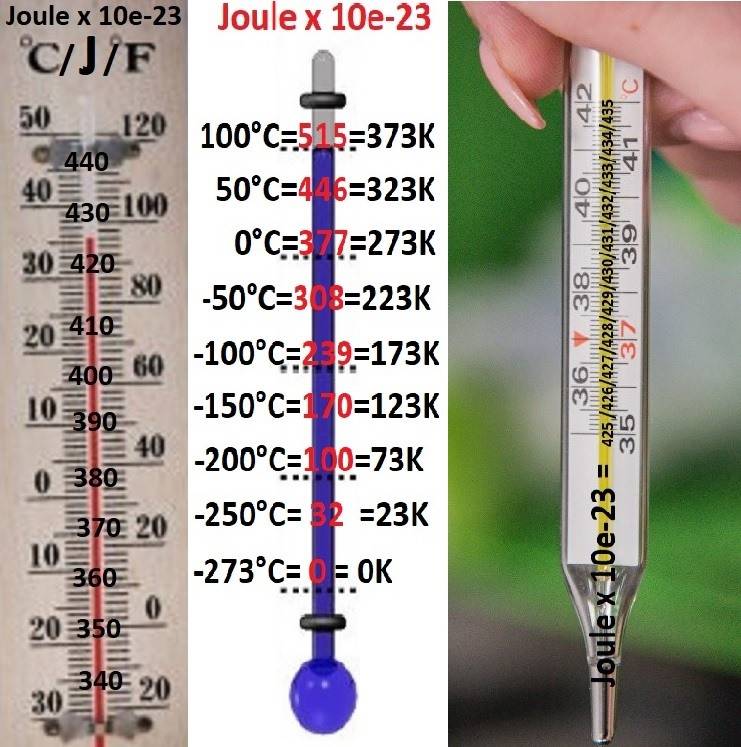
Температура-энергия7   3 2.jpg
 
Physics news on Phys.org
Piotrovskiy Yury said:
Modern physics believes that kelvin is the basic unit of measurement of SI (one of seven).

The choice is a matter of convenience.

From the formula it follows that the absolute temperature of kelvin is derived through the joules of kinetic energy of the molecule.
And this means that Kelvin is not the basic unit, but a derived unit.

You can always make your own choice of what you consider to be fundamental. The choice is a matter of convenience.
 
  • Like
Likes   Reactions: berkeman
A website unit converter does not prove anything. The Joule is still a derived SI unit, even if defined in terms of another unit.
Note that Ampere is a base unit even though it is Coulombs/sec.
I believe the reason was because it was easier to measure amps than Coulombs.
 
You're right. The Joule is still a derived SI unit, but the joule is 1 J = 1 kg m² / s².
So kelvin is equal to 1 kg m² / s².
That is, kelvin is reduced to kg, m, s
 
Piotrovskiy Yury said:
So kelvin is equal to 1 kg m² / s².

That's simply not correct.
 
Piotrovskiy Yury said:
Modern physics believes that kelvin is the basic unit of measurement of SI (one of seven).
It is not a matter of belief, it is a matter of definition. The BIPM committee has defined the K as a base unit. They could have defined another, but they chose to define K.
Piotrovskiy Yury said:
the absolute temperature of kelvin is derived through the joules of kinetic energy of the molecule
This is not correct in general. It is only true for ideal gasses, but other molecules posses vibrational modes which are as much potential energy as kinetic energy.

That said, yes, the SI could have defined the J as a base unit and the K as a derived unit, but they didn’t. They defined it the other way.
 
Vanadium 50 said:
That's simply not correct.
OK. What exactly is “just not correct”?

1. T = Q / k correct?

2. Q = J = kg x m² / s² correct?
 
Dale said:
It is not a matter of belief, it is a matter of definition. The BIPM committee has defined the K as a base unit. They could have defined another, but they chose to define K.This is not correct in general. It is only true for ideal gasses, but other molecules posses vibrational modes which are as much potential energy as kinetic energy.

That said, yes, the SI could have defined the J as a base unit and the K as a derived unit, but they didn’t. They defined it the other way.

I agree. Yesterday it was determined this way, but in a year it will be determined differently.
 
  • Sad
  • Skeptical
Likes   Reactions: davenn, weirdoguy and Motore
Piotrovskiy Yury said:
I agree. Yesterday it was determined this way, but in a year it will be determined differently.
Certainly in a year it *could* be determined differently. I doubt that it *will* be determined differently. The BIPM is a group that is pretty concerned with historical continuity.
 
The SI has been made over right in May this year by fixing all the fundamental constants like ##\hbar##, ##c##, ##e##, and also ##k_{\text{B}}##. It's hard to imagine that there will be major changes in the basic definitions of the SI in the foreseeable future. The only thing which might be still changed is the definition of the second which is still defined via the hyperfine structure transition of Cs. Maybe within a decade there'll be more accurate possibilities be achieved leading to an even more accurate and more robust definition of the second (like the nuclear transition of Thorium).
 
vanhees71 said:
The only thing which might be still changed is the definition of the second which is still defined via the hyperfine structure transition of Cs. Maybe within a decade there'll be more accurate possibilities be achieved leading to an even more accurate and more robust definition of the second (like the nuclear transition of Thorium).
I agree, I think that sort of change is the most likely in the next couple of decades.
 
Piotrovskiy Yury said:
What exactly is “just not correct”?

The 1.
 
Vanadium 50 said:
The 1.
It is not correct?

1. T= Θ/k = Θ /1,380649x10е-23

Θ - is the energy of the molecule in joules.
k - is the Boltzmann constant = 1,380649e-23 J / K
T - is the absolute temperature in kelvin.
 
  • Skeptical
Likes   Reactions: weirdoguy
No, it's not. Besides, what's your point?
 
  • Like
Likes   Reactions: vanhees71