Kinematics question: Stunt driver jumping his car from ramp to ramp

Click For Summary
SUMMARY

The discussion focuses on solving a kinematics problem involving a stunt driver jumping a car from one ramp to another. Participants confirm the use of the equations for horizontal and vertical motion, specifically Vx = 90/3.6 cos 30 and Vy = 90/3.6 sin 30. The key issue identified is the misapplication of the equation s = v_it + 0.5at², leading to incorrect time (t) and distance calculations. The correct approach emphasizes that the time taken for horizontal travel is equal to the time taken for vertical motion, allowing for accurate distance calculations.

PREREQUISITES
  • Understanding of kinematic equations in physics
  • Knowledge of vector components in motion (horizontal and vertical)
  • Familiarity with gravitational acceleration (g = 9.8 m/s²)
  • Basic trigonometry for angle calculations (sine and cosine functions)
NEXT STEPS
  • Study the application of kinematic equations in projectile motion
  • Learn how to calculate time of flight in projectile problems
  • Explore the effects of air resistance on projectile motion
  • Practice solving similar kinematics problems involving ramps and angles
USEFUL FOR

Students studying physics, educators teaching kinematics, and anyone interested in understanding projectile motion and its applications in real-world scenarios.

nicky670
Messages
21
Reaction score
1
Homework Statement
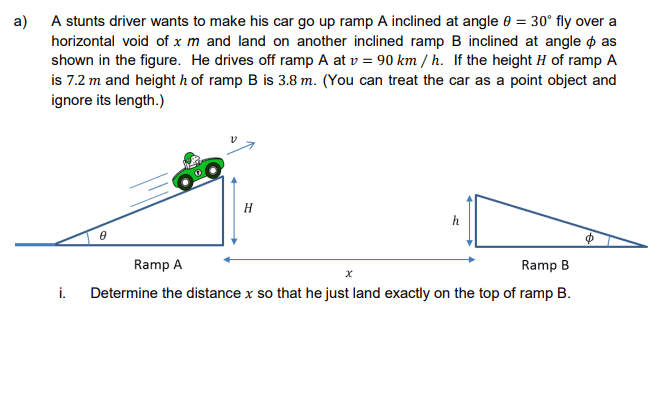
A stunts driver wants to make his car go up ramp A inclined at angle 𝜃 = 30∘
fly over ahorizontal void of 𝑥 m and land on another inclined ramp B inclined at angle 𝜙 as
shown in the figure. He drives off ramp A at 𝑣 = 90 𝑘𝑚 ∕ ℎ. If the height 𝐻 of ramp A
is 7.2 𝑚 and height ℎ of ramp B is 3.8 𝑚. (You can treat the car as a point object and
ignore its length.)
Relevant Equations
s = Vit + 0.5at^2
Do i use the equation above mentioned to solve it? If i do, am i correct to say that Vx = 90/3.6 cos 30 and Vy = 90/3.6 sin30?
phy7.PNG
 
Last edited by a moderator:
Physics news on Phys.org
nicky670 said:
Do i use the equation above mentioned to solve it? If i do, am i correct to say that Vx = 90/3.6 cos 30 and Vy = 90/3.6 sin30?
If you include the appropriate units, yes.
 
haruspex said:
If you include the appropriate units, yes.
okay so i wanted to find the time taken for the car to travel from start point to end point. And if i substitute the into the equation, will be 7.2 = 25sin30t - 0.5(9.8)t^2. But the t that i got is wrong from the answer, and so if i want to find the x distance when i substitute the t inside, i will get the wrong answer. What am i doing wrong?
 
nicky670 said:
7.2 =
Where on the target ramp do you want to land?
 
haruspex said:
Where on the target ramp do you want to land?
On top of ramp B, so i take 3.8?
 
nicky670 said:
On top of ramp B, so i take 3.8?
Maybe... depends what you mean by "take" here. Take something as being 3.8 or take away 3.8?
 
haruspex said:
Maybe... depends what you mean by "take" here. Take something as being 3.8 or take away 3.8?
Make the s in the equation, 3.8
 
nicky670 said:
Make the s in the equation, 3.8
In the equation ##s=v_it+\frac 12 at^2##, what is the definition of s?
 
nicky670 said:
okay so i wanted to find the time taken for the car to travel from start point to end point. And if i substitute the into the equation, will be 7.2 = 25sin30t - 0.5(9.8)t^2. But the t that i got is wrong from the answer, and so if i want to find the x distance when i substitute the t inside, i will get the wrong answer. What am i doing wrong?
Your error is in the application of that equation. :smile:
You will realize it as you respond the question in post #8 above.

“The time taken for the car to travel from start point to end point” horizontally is the same time taken for the car to vertically move up and down.

As the problem allows you to disregard the frictional drag of the air, we could say that the car will rise and fall only under the influence of the constant acceleration of gravity g all the time.

Assuming the same absence of air resistance, you could throw a ball or stone straight upwards at the same ##V_{iy}=12.5~m/s## that you have calculated and it would reach the same height relative to your hand that the car reaches respect to the departure point of ramp A.
You can easily calculate the time taken by the ball (or the car) to reach the peak or its highest point, let’s call it ##t_{up}##.

That ball would take the same amount of seconds in its way down than it took in its way up and it would land in your hand with a downwards velocity of 12.5 m/s.

If instead, the ball misses your hand and lands on a surface located several meters lower than your hand, the taken time to fall from the peak to that surface, as well as the landing velocity would be greater than the at-the-hand values.

Since the vertical up and down heights of the ball (as well as of your car) are not symmetrical, we could say that:

##Total~flight~time~=~t_{up}+t_{down}##

Applying that total flight time to the horizontal movement of the car, you could calculate the x distance between take-off and landing points of your car.
 

Similar threads

  • · Replies 4 ·
Replies
4
Views
2K
  • · Replies 1 ·
Replies
1
Views
2K
  • · Replies 2 ·
Replies
2
Views
17K
  • · Replies 8 ·
Replies
8
Views
3K
Replies
18
Views
3K
  • · Replies 5 ·
Replies
5
Views
2K
  • · Replies 15 ·
Replies
15
Views
3K
  • · Replies 6 ·
Replies
6
Views
2K
  • · Replies 56 ·
2
Replies
56
Views
4K
  • · Replies 2 ·
Replies
2
Views
3K