Kinetic energy of a compound system (atwood machine)

Click For Summary
SUMMARY

The discussion centers on calculating the total kinetic energy of a compound system, specifically an Atwood machine consisting of two connected masses. The key equation referenced is ΔK + ΔU = 0, indicating the conservation of energy within an isolated system. The initial kinetic energy (Ki) is zero, as the system starts from rest. To find the final kinetic energy, one must sum the kinetic energies of the individual masses, treating them as separate entities rather than a single block.

PREREQUISITES
  • Understanding of kinetic energy and potential energy concepts
  • Familiarity with the Atwood machine setup and mechanics
  • Knowledge of conservation of energy principles
  • Basic algebra for summing energies
NEXT STEPS
  • Study the derivation of kinetic energy formulas for connected systems
  • Explore the dynamics of the Atwood machine in detail
  • Learn about energy conservation in isolated systems
  • Investigate the effects of non-connected masses on kinetic energy calculations
USEFUL FOR

Students and educators in physics, mechanical engineers, and anyone interested in understanding the dynamics of systems involving multiple moving parts.

Davyd Sadovskyy
Messages
3
Reaction score
0
A system is defined as two connected masses in an atwood machine and the earth. How do I find total kinetic energy in a system where more than one object is moving (or is only one object actually moving since the two masses are connected with a string? idk)
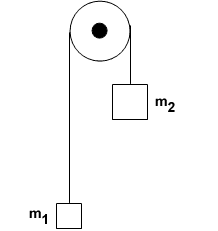
upload_2017-11-3_21-30-10.png


This is an isolated system so... ΔK + ΔU = 0

How do I define energies of a system if there are multiple moving parts, each with its own energy? This is at the core of my confusion. I know that initially, there are no particles in this system with velocity, so Ki must be 0.
These are my questions

1.) How would you define the final kinetic energy? Do you treat the two moving blocks as a singly block instead of 2 separate blocks?

2.) What if a system consisted of 2 non connected blocks. How would you define final kinetic energy then?
 

Attachments

  • upload_2017-11-3_21-30-10.png
    upload_2017-11-3_21-30-10.png
    921 bytes · Views: 1,036
  • upload_2017-11-3_21-58-5.png
    upload_2017-11-3_21-58-5.png
    921 bytes · Views: 688
Physics news on Phys.org
Davyd Sadovskyy said:
How would you define the final kinetic energy?
Energy is additive. Just sum the KEs of the individual masses.
 

Similar threads

Replies
17
Views
2K
Replies
29
Views
3K
Replies
2
Views
1K
Replies
55
Views
6K
  • · Replies 1 ·
Replies
1
Views
1K
  • · Replies 9 ·
Replies
9
Views
2K
  • · Replies 6 ·
Replies
6
Views
2K
Replies
15
Views
2K
  • · Replies 2 ·
Replies
2
Views
3K
  • · Replies 21 ·
Replies
21
Views
5K