Kronecker function products - matrix format

Click For Summary
The discussion revolves around understanding the Kronecker function and its application in matrix equations, particularly in the context of the Cijkl equation. The user seeks clarification on the roles of indices "m" and "n," which are described as free indices that may be summed over, leading to the contraction of the matrix to only involve indices "i" and "j." There is confusion regarding the dimensionality of the matrices involved, with the user noting that typical representations are in 3D, yet their equations involve matrices that do not seem compatible. The conversation emphasizes the need for a deeper understanding of the summation process and the implications of dimensionality on the Kronecker function's application. Overall, the user aims to grasp the underlying concepts rather than just manipulating the equations.
hermish
Messages
10
Reaction score
0
Hi all,
Firstly, I am not sure whether this is the area of the forum to ask this.
I have been learning and researching a completely different topic, and from this I have come across a completely new concept of the Kronecker function. I have done a google search on this to get the intro and general background of how this function works. However, there is a particular problem which I cannot put my seem to get my head around.

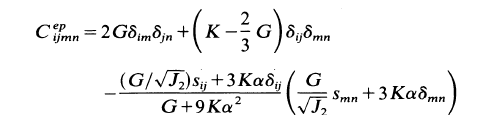
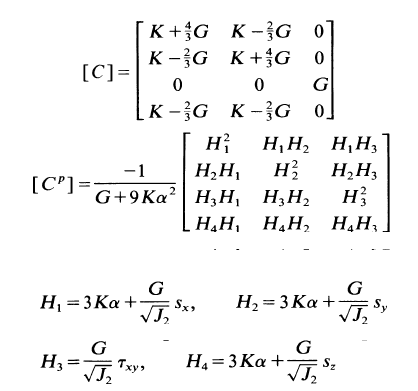
I have included the relevant equations below. I understand these equations EXCEPT for the Kronecker terms.
Cmatrix_zpsx5fauoza.png


Cmatrix_zps5wjnniel.png


From my understanding, the Cijkl equation can be expanded to obtain the C and C^p matrices. I do not fully understand how this process works, because I do not understand how to utilise the Kronecker function.

In this context, I am guessing the i and j in the Kronecker terms represent the entry of the matrix, i.e if i=2, j=1, that means you are looking at the 2nd row and 1st column. And hence, you can go from there to calculate the term that goes into the particular matrix entry.

What I do not understand are the "m" and "n" terms. What are they? What purpose do they serve? Can I just set any number for "m" and "n"

Thanks in advanced for the help.
 
Physics news on Phys.org
The Kronecker symbol delta(i,j) means 1 if i=j and 0 otherwise. If you are working in 3 dimensions then the matrix delta(i,j) is the identity matrix consisting of 1s on the diagonal and zeroes elsewhere.

m and n are free indices. What may be going on is a summation over these indices, hence they disappear and you only have i and j left, so the "contracted" C has only 2 free indices and may be written down as a matrix. Just a guess.
 
davidmoore63@y said:
The Kronecker symbol delta(i,j) means 1 if i=j and 0 otherwise. If you are working in 3 dimensions then the matrix delta(i,j) is the identity matrix consisting of 1s on the diagonal and zeroes elsewhere.

m and n are free indices. What may be going on is a summation over these indices, hence they disappear and you only have i and j left, so the "contracted" C has only 2 free indices and may be written down as a matrix. Just a guess.

Hi
Thanks very much for the response

You have also reminded me about this whole notion of 3 dimensions and 1s sitting on the diagonal that is not sitting well with me. Firstly, in all honesty, I am not even sure whether this whole thing is regarded as 3 dimension or whatever number of dimensions. There doesn't seem to be anything in the equation that suggests we are working in 3 dimensions. Regardless of that, whether it's 3 dimensions, 2 dimensions, 4 dimensions or whatever, the typical format of the Kronecker function is a 3x3 matrix (this appears on every site on google search), in the case here it contains 4 x 3 matrices which are obviously not compatible. However, I am guessing that since a couple of zeroes appear in the third row and third column, this may have something to do with making it compatible with a 3x3 matrix?

Finally, I cannot seem to gather what you mean by a "summation over these indices" and more particularly, "you only have i and j left". I have tried working backwards, and it seems like the terms "m" and "n" need to be something particular for these equations to hold. I am able to expand the equation into a matrix format, however I would like to understand the concepts behind it, because at the moment I am simply just working backwards

Thanks, Nick
 
I was suggesting that perhaps [C] = Sigma (m=1 to 3) Sigma (n=1 to 3) of C(i,j,m,n)
 
Time reversal invariant Hamiltonians must satisfy ##[H,\Theta]=0## where ##\Theta## is time reversal operator. However, in some texts (for example see Many-body Quantum Theory in Condensed Matter Physics an introduction, HENRIK BRUUS and KARSTEN FLENSBERG, Corrected version: 14 January 2016, section 7.1.4) the time reversal invariant condition is introduced as ##H=H^*##. How these two conditions are identical?

Similar threads

  • · Replies 1 ·
Replies
1
Views
1K
  • · Replies 8 ·
Replies
8
Views
4K
  • · Replies 8 ·
Replies
8
Views
9K
  • · Replies 3 ·
Replies
3
Views
1K
  • · Replies 1 ·
Replies
1
Views
1K
  • · Replies 3 ·
Replies
3
Views
2K
  • · Replies 0 ·
Replies
0
Views
1K
  • · Replies 1 ·
Replies
1
Views
1K
  • · Replies 9 ·
Replies
9
Views
2K
  • · Replies 21 ·
Replies
21
Views
3K