Kronecker delta by using creation/annihilation operators

  • Context: Undergrad 
  • Thread starter Thread starter Faust90
  • Start date Start date
  • Tags Tags
    Delta Operators
Click For Summary

Discussion Overview

The discussion revolves around the use of the Kronecker delta in the context of creation and annihilation operators, specifically addressing an expression involving a sum over indices. Participants are exploring the implications of summing over different indices and how it relates to the Kronecker delta identity.

Discussion Character

  • Exploratory, Technical explanation, Debate/contested

Main Points Raised

  • One participant questions the validity of using the Kronecker delta in the expression, noting that the sum is over index ##i## rather than over the positions ##r_i##.
  • Another participant clarifies that the index ##i## in the sum corresponds to the subscript of ##r##, while the other ##i## is the imaginary unit, suggesting that the Kronecker delta simplifies the expression by eliminating the exponential term.
  • A further contribution proposes a hypothetical scenario where all positions ##r_i## are the same, leading to a specific product form, which raises questions about the implications of this assumption.

Areas of Agreement / Disagreement

Participants express differing views on the interpretation of the indices in the sum and the application of the Kronecker delta, indicating that the discussion remains unresolved with competing perspectives.

Contextual Notes

There are limitations regarding the assumptions about the indices and the nature of the positions ##r_i##, which may affect the interpretation of the sum and the application of the Kronecker delta.

Faust90
Messages
19
Reaction score
0
Hey all,

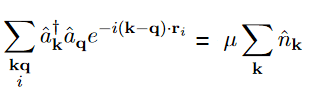
i've found the following expression:
yeKNHjC.png


How do they get that? They somehow used the kronecker delta Sum_k exp(i k (m-n))=delta_mn. But in the expression above, they're summing over i and not over r_i??

Best
 
Physics news on Phys.org
Do you need more background or is the question not precise enough? :-)
 
Hi Faust90

The index ##i## under the sum refers to the subscript ##i## under the ##r##. The other i is the imaginary number. The Kronecker delta gets rid of the exponential and thus the sum on ##i## anyway. Try this website and see if it clears any confusion you are having. http://www.physicspages.com/2014/11/09/discrete-fourier-transforms/
 
Hi Mr-R,

thanks for your answer. Yes, but my problem is that the sum is not running over r_i but over i.
Let's assume the r_i are an set of positions, for example always the same position, i.e. r_i={1,1,1,1,1,1,...}. Then in the end, that's just a product
prod_n=0^\infity e^{i(k-q)}


Similar threads

Replies
0
Views
854
  • · Replies 5 ·
Replies
5
Views
3K
  • · Replies 3 ·
Replies
3
Views
3K
  • · Replies 2 ·
Replies
2
Views
2K
  • · Replies 4 ·
Replies
4
Views
2K
  • · Replies 3 ·
Replies
3
Views
1K
  • · Replies 9 ·
Replies
9
Views
3K
  • · Replies 2 ·
Replies
2
Views
2K
  • · Replies 3 ·
Replies
3
Views
2K
  • · Replies 2 ·
Replies
2
Views
2K