Ladder on rough ground against rough wall

  • Thread starter Thread starter Yoonique
  • Start date Start date
  • Tags Tags
    Ground Wall
Click For Summary

Homework Help Overview

The problem involves a ladder resting against a rough wall and on a rough floor, with a focus on determining the smallest angle between the ladder and the floor. The scenario includes considerations of forces, torques, and friction coefficients at both contact points.

Discussion Character

  • Exploratory, Assumption checking, Problem interpretation

Approaches and Questions Raised

  • Participants discuss the conditions under which the ladder can remain stationary, particularly regarding the static friction at the contact surfaces. Questions arise about whether both friction conditions must be satisfied simultaneously.

Discussion Status

Some participants have provided insights and attempted to clarify the conditions for equilibrium. There is an ongoing exploration of the implications of static friction on the ladder's movement, with a recent resolution of a typographical error in a proposed angle formula.

Contextual Notes

Participants are navigating the complexities of static friction and its role in the stability of the ladder, with some uncertainty around the correct interpretation of the angle formula and its components.

Yoonique
Messages
105
Reaction score
0
1. Homework Statement
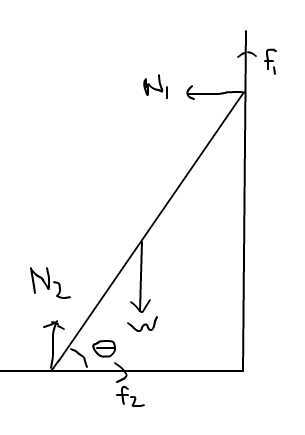
A ladder on the rough floor is leaning against a vertical rough wall. The ladder has length l and mass m. The coefficients of friction are μ for both contact surfaces. What is the smallest angle between the ladder and the floor?

Homework Equations


∑F=ma
∑τ = F⊥ r
fs ≤ μsN

The Attempt at a Solution


[/B]
Snapshot.jpg

∑Fy = 0
N2 + f1 - W = 0

∑Fx = 0
f2 - N1 = 0
f2 = N1

∑τ about the ground = 0
N1lsinθ + f1lcosθ - W(l/2)(cosθ) = 0

For θ to be the smallest angle, what is the condition? Is it f1 = μN1 or f2 = μN2 or both of them need to happen at the same time?
 
Last edited:
Physics news on Phys.org
Can the ladder move if the friction is static at some of the contact surfaces at the ends of the ladder?
 
ehild said:
Can the ladder move if the friction is static at some of the contact surfaces at the ends of the ladder?
I think the ladder can't move if one the friction is static. So both must happen at the same time.
 
Last edited:
Okay, I finally managed to solve it. θ = tan-1[1-μ2/(2u)]. Thanks ehild!
 
Yoonique said:
Okay, I finally managed to solve it. θ = tan-1[1-μ2/(2u)]. Thanks ehild!
Are you sure that ##\theta= \tan^{-1}\left(1 - \frac{ \mu^2 }{2 \mu }\right)## ? Why you do not simplify with μ? Or some parentheses missing? :devil:
 
ehild said:
Are you sure that ##\theta= \tan^{-1}\left(1 - \frac{ \mu^2 }{2 \mu }\right)## ? Why you do not simplify with μ? Or some parentheses missing? :devil:
Oh it is a typo! Should be θ = tan-1[(1-μ2)/(2μ)]. Thanks anyway!
 
Yoonique said:
Oh it is a typo! Should be θ = tan-1[(1-μ2)/(2μ)]. Thanks anyway!
It is correct now. Nice work!
 

Similar threads

  • · Replies 20 ·
Replies
20
Views
2K
Replies
6
Views
3K
  • · Replies 12 ·
Replies
12
Views
2K
Replies
5
Views
3K
  • · Replies 5 ·
Replies
5
Views
3K
  • · Replies 8 ·
Replies
8
Views
4K
  • · Replies 3 ·
Replies
3
Views
5K
  • · Replies 3 ·
Replies
3
Views
2K
Replies
9
Views
2K
  • · Replies 13 ·
Replies
13
Views
3K