diewolke
- 2
- 0
Hello physicsforums community.
I have recently learned about Lagrange multipliers and have been given three problems to solve. Could you guys please go over my work and see if I have the gist of it? One question, a theoretical one, I have no idea how to begin. Any advice regarding this would be welcomed.
Thanks
PS: Please excuse any formatting errors; this is my first post on this forum.
--------------
Question 1a
f:R^2-->R^2, (x,y)-->x^2-y^2, and let S be the circle of radius 1 around the origin.
In two dimensions, the condition that
[tex]\nabla[/tex]f(x,y,z)=[tex]\lambda[/tex][tex]\nabla[/tex]g(x,y,z) at [tex]x_{o}[/tex], that is, [tex]\nabla[/tex]f(x,y,z) and [tex]\nabla[/tex]g(x,y,z) are parallel at [tex]x_{o}[/tex][/tex] is the same as the level curves being tangent at x[tex]_{.}[/tex]. Give the reason why you may conclude that the level curves are tangent at [tex]x_{o}[/tex].
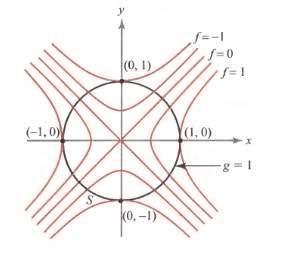
2. f:R^2-->R^2, (x,y)-->x^2-y^2 and
g:R^2-->R^1, (x,y)--> x^2+y^2 (obtained from the statement about S)
3. I simply do not have a clue how to go about this. I know that the gradient of a function is given by the coordinates which are the function's partial derivatives. I also know that the gradient points to the direction of highest increase for a function at a particular point. Regarding level sets, I know that level sets are given by all (x,..x[tex]_{n}[/tex]) such that f(x,..,x[tex]_{n}[/tex])=c, where c is a constant. I am not sure how to utilize this information to produce an answer. Any advice?
---------------
Question 1b
1. Using the Lagrange multiplier method, maximize the function f(x,y,z)=x+z subject to the constraint x^2+y^2+z^2=51
2. [tex]\nabla[/tex]f(x,y,z)=[tex]\lambda[/tex][tex]\nabla[/tex]g(x,y,z)
3.
Having computed the gradients for g and f, listed the partials separately, and using the above equation, I obtained the following system of equations:
1=2x[tex]\lambda[/tex]
0=2y[tex]\lambda[/tex]
1=2z[tex]\lambda[/tex]
Solving for x, y, and z, I obtained
x=1/(2lambda)
y=0 and
z=x=1/(2lambda)
and here is the constraint once more: x^2+y^2+z^2=51
substituting the values of x, y, and z into the above expression,
I get [tex]\lambda[/tex]=+ or - [tex]\frac{1}{\sqrt{102}}[/tex]
using this value to solve for x, y, and z, I get that
x=+ or -[tex]\frac{\sqrt{102}}{2}[/tex]
y=0 and
z=+ or -[tex]\frac{\sqrt{102}}{2}[/tex]
plugging in these values into f(x,y,z)=x+z,
I find that the max must be [tex]\sqrt{102}[/tex]. Is this correct?
----------
I will post the third question shortly.
Thank you again
I have recently learned about Lagrange multipliers and have been given three problems to solve. Could you guys please go over my work and see if I have the gist of it? One question, a theoretical one, I have no idea how to begin. Any advice regarding this would be welcomed.
Thanks
PS: Please excuse any formatting errors; this is my first post on this forum.
--------------
Question 1a
f:R^2-->R^2, (x,y)-->x^2-y^2, and let S be the circle of radius 1 around the origin.
In two dimensions, the condition that
[tex]\nabla[/tex]f(x,y,z)=[tex]\lambda[/tex][tex]\nabla[/tex]g(x,y,z) at [tex]x_{o}[/tex], that is, [tex]\nabla[/tex]f(x,y,z) and [tex]\nabla[/tex]g(x,y,z) are parallel at [tex]x_{o}[/tex][/tex] is the same as the level curves being tangent at x[tex]_{.}[/tex]. Give the reason why you may conclude that the level curves are tangent at [tex]x_{o}[/tex].
2. f:R^2-->R^2, (x,y)-->x^2-y^2 and
g:R^2-->R^1, (x,y)--> x^2+y^2 (obtained from the statement about S)
3. I simply do not have a clue how to go about this. I know that the gradient of a function is given by the coordinates which are the function's partial derivatives. I also know that the gradient points to the direction of highest increase for a function at a particular point. Regarding level sets, I know that level sets are given by all (x,..x[tex]_{n}[/tex]) such that f(x,..,x[tex]_{n}[/tex])=c, where c is a constant. I am not sure how to utilize this information to produce an answer. Any advice?
---------------
Question 1b
1. Using the Lagrange multiplier method, maximize the function f(x,y,z)=x+z subject to the constraint x^2+y^2+z^2=51
2. [tex]\nabla[/tex]f(x,y,z)=[tex]\lambda[/tex][tex]\nabla[/tex]g(x,y,z)
3.
Having computed the gradients for g and f, listed the partials separately, and using the above equation, I obtained the following system of equations:
1=2x[tex]\lambda[/tex]
0=2y[tex]\lambda[/tex]
1=2z[tex]\lambda[/tex]
Solving for x, y, and z, I obtained
x=1/(2lambda)
y=0 and
z=x=1/(2lambda)
and here is the constraint once more: x^2+y^2+z^2=51
substituting the values of x, y, and z into the above expression,
I get [tex]\lambda[/tex]=+ or - [tex]\frac{1}{\sqrt{102}}[/tex]
using this value to solve for x, y, and z, I get that
x=+ or -[tex]\frac{\sqrt{102}}{2}[/tex]
y=0 and
z=+ or -[tex]\frac{\sqrt{102}}{2}[/tex]
plugging in these values into f(x,y,z)=x+z,
I find that the max must be [tex]\sqrt{102}[/tex]. Is this correct?
----------
I will post the third question shortly.
Thank you again