Lagrange multipliers for maximizing Gibbs entropy

1 reply · 3K views · last reply
Sekonda
Messages
201
Reaction score
0
Hey,

Here is the problem:

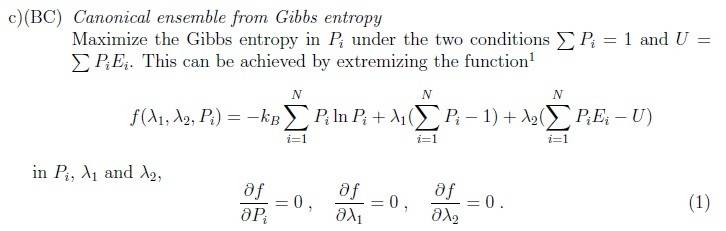
Handwritten-style typeset problem part c) on canonical ensemble from Gibbs entropy: maximize -k_B sum P_i ln P_i subject to sum P_i = 1 and sum P_i E_i = U, via f(λ1, λ2, P_i) with stationarity conditions ∂f/∂P_i = 0, ∂f/∂λ1 = 0, ∂f/∂λ2 = 0, labelled equation (1).


The method by which we solve is by Langrange Multipliers, and so I believe I found the derivative of f with respects to P(i) but I have two quantities I'm sure what they equal:

Summations over i=1 to N : Ʃln(P(i)) and ƩE(i)

Thanks for any help,
S
 
Sekonda said:
The method by which we solve is by Langrange Multipliers, and so I believe I found the derivative of f with respects to P(i) but I have two quantities I'm sure what they equal:

Summations over i=1 to N : Ʃln(P(i)) and ƩE(i)

Thanks for any help,
S

Remember you have N different quantities Pi that you are derivating with respect to. So for example if you have f(x,y) = x ln x + y ln y, then ∂f/∂x = ln x + 1 and likewise for y. There are no mixed terms, and even with a function of N variables, only one term survives the derivative.