Laplace-Runge-Lenz vector problem

  • Context: Graduate 
  • Thread starter Thread starter wantommy
  • Start date Start date
  • Tags Tags
    Vector
Join the discussion
Ask a follow-up here, or get your own question answered by working scientists, mathematicians and engineers — people, not an autocomplete.
Real named experts · corrections over time · the nuance an AI answer skips
2 replies · 3K views
wantommy
Messages
4
Reaction score
0
The vector A is defined as the quantum version of the Laplace-Runge-Lenz vector,

YLRSKU2.jpg


where
hPMi7Th.jpg


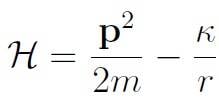
The system Hamiltonian is given by
kP7BCI0.jpg


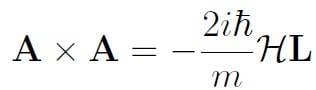
Show that
4ntaIGk.jpg


------------------------------------------------------------------

this problem confuse me for at least 2 years...
i can't derive it :cry:

Can any expert help me?
hope someone can write down specific derivation

Thanks a lot!
 
Physics news on Phys.org
wantommy said:
this problem confuse me for at least 2 years...
i can't derive it :cry:
wantommy, This is an excellent exercise. Even if you can find a complete solution on the web, I encourage you to work it out for yourself. I know of no shortcut, but with a systematic approach it shouldn't take you two years!

Hints: First of all, ditch the cross product notation and write out the components. This problem is about commutators, and the cross product obscures the factor ordering. For example, what you want to show is really

[Ai, Aj] = - 2iħ/m H εijk Lk

Second, build the result up a piece at a time. Start with the commutators that are obvious:

[xi, xj] = 0
[pi, pj] = 0
[pi, xj] = iħ δij

and most importantly,

[Li, Vj] = - i εijk Vk

where V is any vector operator.

Collect intermediate results like [pi, Lj], [xi, Lj] and [Ai, Lj].

Whoops, were you paying attention? :smile: You don't even have to work these out! They're all instances of [Li, Vj].

Finally, make use of well-known identities like

εijk εklm = δil δjm - δim δjl and

[A, BC] = [A,B] C + B [A,C]

Learning how to do a calculation systematically (and learning how to get it right!) is an important part of a physics education.