Large Amplitude Pendulum Equation

  • Context: Graduate 
  • Thread starter Thread starter StevenJacobs990
  • Start date Start date
  • Tags Tags
    Amplitude Pendulum
Click For Summary
SUMMARY

The discussion centers on the equation for large-angle pendulums, specifically the complexities of its infinite series representation. Participants highlight the necessity of elliptic integrals for accurate calculations and speculate on the potential use of Taylor expansions in deriving the series. A pendulum calculator, capable of calculating periods up to theta 14 using the arithmetic mean, is also shared by a user, providing a practical tool for further exploration of the topic.

PREREQUISITES
  • Understanding of large-angle pendulum dynamics
  • Familiarity with elliptic integrals
  • Knowledge of Taylor series expansions
  • Basic skills in using online calculators for pendulum periods
NEXT STEPS
  • Research elliptic integrals and their applications in pendulum motion
  • Explore Taylor series expansions and their role in physics
  • Investigate advanced pendulum calculators and their algorithms
  • Study the mathematical derivation of large amplitude pendulum equations
USEFUL FOR

Students of physics, mathematicians, and engineers interested in pendulum mechanics and those developing tools for calculating pendulum dynamics.

StevenJacobs990
Messages
16
Reaction score
0
The equation for large-angle pendulum can be infinitely long. What is the pattern with the latter numbers in "..."?
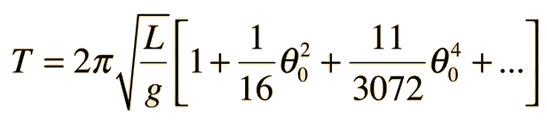
pendl3.gif
 
Physics news on Phys.org
Sorry, your attachment won't open for me.
 
sophiecentaur said:
Does this link help?
Yeah, but what's the pattern that comes after 11/3072 (theta)^4?
 
There is no pattern. That's why you need the elliptic integrals.
 
StevenJacobs990 said:
Yeah, but what's the pattern that comes after 11/3072 (theta)^4?
AS I said before, your attachment is not readable.
 
This is the attachment

pendl3.gif
 
Here is a graphic I made.
Look at equation 3.
pendulum.png
 
pendulum.png
StevenJacobs990
I don't know the equation for generating those numbers in the formula but here is the large amplitude formula carried out to theta 20:
 
  • #10
Honestly, I wouldn't be surprised if this a Taylor expansion of some sort.
 
  • #11
rumborak said:
Honestly, I wouldn't be surprised if this a Taylor expansion of some sort.
. . . .or something else. There are (my Mathematician friends tell me) many equations that can only be solved using a series - Taylor or not so well known ones.
 
  • #12
I originally was writing a pendulum calculator and while researching the Internet, I came across this topic. Anyway, I finished the calculator and it is online: http://www.1728.org/pendulum.htm
It can calculate pendulum periods up to theta 14 and uses the arithmetic mean to calculate exact pendulum periods.
Try it out if you like.
 

Similar threads

  • · Replies 11 ·
Replies
11
Views
2K
  • · Replies 1 ·
Replies
1
Views
1K
  • · Replies 36 ·
2
Replies
36
Views
4K
Replies
11
Views
2K
  • · Replies 10 ·
Replies
10
Views
2K
  • · Replies 1 ·
Replies
1
Views
2K
  • · Replies 7 ·
Replies
7
Views
3K
  • · Replies 11 ·
Replies
11
Views
2K
  • · Replies 8 ·
Replies
8
Views
2K
  • · Replies 3 ·
Replies
3
Views
3K