StevenJacobs990
- 16
- 0
The equation for large-angle pendulum can be infinitely long. What is the pattern with the latter numbers in "..."?
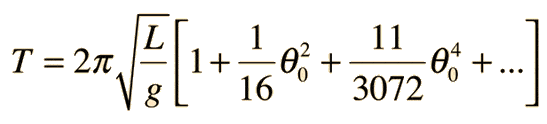
The discussion revolves around the equation for a large-angle pendulum, specifically focusing on the patterns in the coefficients of the series expansion and the potential use of elliptic integrals. Participants explore the mathematical formulation and implications of large amplitude pendulum motion.
Participants do not reach a consensus on the existence of a pattern in the coefficients of the series expansion, with some asserting there is none while others speculate on potential forms of the series.
Participants reference the complexity of the equations involved and the potential need for elliptic integrals, indicating that assumptions about the series may depend on specific mathematical definitions or contexts.
This discussion may be of interest to those studying pendulum dynamics, mathematical series, or anyone developing tools for calculating pendulum motion.
Yeah, but what's the pattern that comes after 11/3072 (theta)^4?sophiecentaur said:Does this link help?
AS I said before, your attachment is not readable.StevenJacobs990 said:Yeah, but what's the pattern that comes after 11/3072 (theta)^4?
. . . .or something else. There are (my Mathematician friends tell me) many equations that can only be solved using a series - Taylor or not so well known ones.rumborak said:Honestly, I wouldn't be surprised if this a Taylor expansion of some sort.