Nauhaie
- 3
- 0
Hi,
I have been taking a classical electrodynamics course, in which we established the classical well-known larmor formula for the radiation of a classically accelerated point charge in vacuum. Then, since the radiated power is a Lorentz invariant, we just assumed that the correct generalization was to replace the classical acceleration with the four-acceleration, and so forth.
This is actually the derivation given on wikipedia:
http://en.wikipedia.org/wiki/Larmor_formula#Relativistic_Generalisation
What I do not understand is WHY we can assume that this power is an invariant in the first place (that is, before I write it in the obviously invariant form, which I cannot do if I do not at first assume it to be invariant).
In both "Greiner, Classical Electrodynamics" and "Jackson, Classical Electrodynamics", it is said that since dE and dt are both fourth components of quadrivectors, then dE/dt is Lorentz invariant.
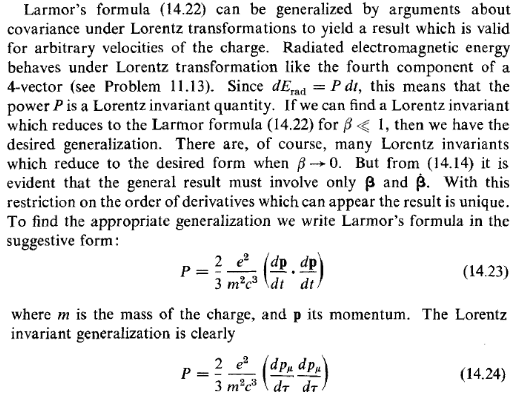
Did I miss something? Do you know of a real derivation of this result?
Thank you very much!
Nauhaie
I have been taking a classical electrodynamics course, in which we established the classical well-known larmor formula for the radiation of a classically accelerated point charge in vacuum. Then, since the radiated power is a Lorentz invariant, we just assumed that the correct generalization was to replace the classical acceleration with the four-acceleration, and so forth.
This is actually the derivation given on wikipedia:
http://en.wikipedia.org/wiki/Larmor_formula#Relativistic_Generalisation
What I do not understand is WHY we can assume that this power is an invariant in the first place (that is, before I write it in the obviously invariant form, which I cannot do if I do not at first assume it to be invariant).
In both "Greiner, Classical Electrodynamics" and "Jackson, Classical Electrodynamics", it is said that since dE and dt are both fourth components of quadrivectors, then dE/dt is Lorentz invariant.
Did I miss something? Do you know of a real derivation of this result?
Thank you very much!
Nauhaie
