Learn Kirchoff's Rules: Solve Circuit With Series and Parallel Combinations

  • Thread starter Thread starter tony873004
  • Start date Start date
  • Tags Tags
    Rules
Click For Summary
SUMMARY

This discussion provides a comprehensive guide to applying Kirchoff's Rules for analyzing electrical circuits with series and parallel combinations. Key steps include identifying equivalent circuits, defining current variables, utilizing symmetry to reduce variables, and formulating junction and loop equations. The discussion clarifies that junction equations represent the conservation of charge at circuit junctions, while loop equations account for the conservation of energy around closed loops. The example illustrates how to label currents and solve for unknowns effectively.

PREREQUISITES
  • Understanding of basic electrical concepts such as voltage, current, and resistance.
  • Familiarity with circuit components like resistors and batteries.
  • Knowledge of algebra for solving simultaneous equations.
  • Basic grasp of series and parallel circuit configurations.
NEXT STEPS
  • Study Kirchoff's Current Law (KCL) and Kirchoff's Voltage Law (KVL) in detail.
  • Learn how to derive and solve simultaneous equations in circuit analysis.
  • Explore the concept of equivalent resistance in series and parallel circuits.
  • Practice solving complex circuits using simulation tools like LTspice or Multisim.
USEFUL FOR

Electrical engineering students, circuit designers, and hobbyists interested in mastering circuit analysis techniques using Kirchoff's Rules.

tony873004
Science Advisor
Gold Member
Messages
1,753
Reaction score
143
Kirchoff's Rules

I can not find a good explanation anywhere for Kirchoff's rules. Googling onlygives me links that don't explain it well, and my textbook's explanation is lacking as well. I'll go over my textbook's description, so hopefully someone here can clarify this for me.

1. Identify any series or parallel combinations and find the simplest equivalent circuit. (easy to do)

2. Define a current variable and choose a positive sense for each variable. The direction you label need not be the actual direction of the current.
WHY? If I get the direction wrong, I'll be adding where I should be subtracting, and that'll give me the wrong answer. Every link says this too, but none of them explain it.

3. Use symmetry if possible to reduce the number of independent variables.
What does this mean? What is an independent variable anyway? What would be an example of a dependent variable?

4. Write junction equations until each current appears in at least one equation.
What is a junction equation? I hate my textbook for using terms it doesn't define. Do they mean I1+I2=I3?

5. Write loop equations until each arm of the circuit occurs in at least one of the loops.
What is a loop equation? Do they mean I=V/R

6. Solve for unknowns
Unknown is how to use Kirchoff's rules

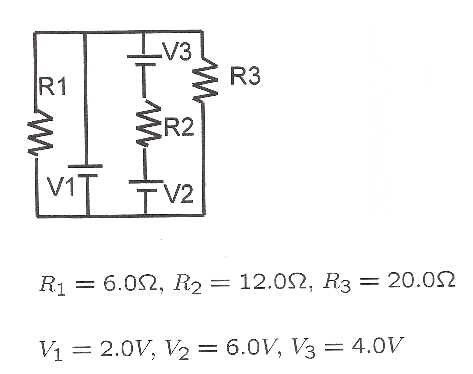
So, for example, how would I do this problem:
kir.GIF

 
Physics news on Phys.org
Hi tony873004,

#2. This is one of the strengths of the Kirchoff approach: you don't need to spend effore ahead of time trying to figure out which way the currents are really going. For example, in the circuit in your diagram we could label the current in all four branches as going upwards. (Of course it's not possible for the currents to really all flow upwards, but that does not matter for the labeling.) Then when we solve the simulataneous equations for the currents, if we get a positive answer then the real current is in the same direction as our labeled current, and a negative answer means the real current is in the opposite direction as our label.

So when I label the current in the leftmost branch as i1 and going upward, after I solve the problem I get i1=(-1/3), which means the real current is flowing downwards (as you might expect).

3. If we change your circuit slightly you can show one way that symmetry can simplify your problem. When we label the currents, we need a current i1 for the leftmost branch (containing R1) and a current i4 for the rightmost branch (containing R3). In your circuit these currents will be different.

However, if R1 had been equal to R3, then you would know that their currents would be the same (since they have the same resistance and are connected to the same points). You could then say that i4=i1 and immediately remove one of the variables so you would have one less to solve for.

4. Yes; you write a junction equation at places where branches come together. Since charge cannot build up at a junction you need

(sum of currents coming into junction)=(sum of currents going out of junction)

where 'coming in' or 'going out' refers to their labelled directions.

5. For the loop equation, you follow a path along the circuit so that you begin and end at the same point, writing down the potential change as you follow the path. Since your final point is the same as your beginning point, then the change in potential must be zero.

So if you start at the bottom of the leftmost loop and go clockwise around that loop, you have:

(change in potential across R1) + (change in potential across V1) = V_f - V_i =0


The potential difference across R1 is i1*R1, and is negative if the direction that you are following the loop is the same direction as the labeled current. The potential difference acroos V1 is given, and is negative if the direction that you are following the loop takes you from the positive terminal to the negative terminal of the battery.

So if i1 is labelled upwards, and we follow the leftmost loop clockwise, we get

- i1*R1 - V1 =0

for the loop equation.
 

Similar threads

  • · Replies 13 ·
Replies
13
Views
1K
  • · Replies 8 ·
Replies
8
Views
2K
  • · Replies 3 ·
Replies
3
Views
2K
  • · Replies 6 ·
Replies
6
Views
3K
  • · Replies 2 ·
Replies
2
Views
2K
  • · Replies 4 ·
Replies
4
Views
2K
  • · Replies 28 ·
Replies
28
Views
2K
  • · Replies 3 ·
Replies
3
Views
2K
  • · Replies 4 ·
Replies
4
Views
2K
  • · Replies 12 ·
Replies
12
Views
2K