Lebesgue Outer Measure .... Carothers, Proposition 16.2 (i) ....

  • Context: Undergrad 
  • Thread starter Thread starter Math Amateur
  • Start date Start date
  • Tags Tags
    Measure
Click For Summary
SUMMARY

The discussion centers on proving Proposition 16.2 (i) from N. L. Carothers' "Real Analysis," specifically regarding the Lebesgue outer measure. Participants emphasize the necessity of demonstrating that if \( \emptyset \neq A \subseteq [0,\infty] \), then \( \inf(A) \geq 0 \). A formal proof is constructed, establishing that the infimum cannot be negative, thus leading to the conclusion that \( m^*(E) \) is non-negative. The participants also explore the range of \( m^*(E) \), confirming it spans from \( 0 \) to \( \infty \) through specific examples.

PREREQUISITES
  • Understanding of Lebesgue outer measure
  • Familiarity with the concept of infimum in real analysis
  • Knowledge of basic properties of intervals in \( \mathbb{R} \)
  • Ability to construct formal mathematical proofs
NEXT STEPS
  • Study the proof techniques used in real analysis, particularly in measure theory
  • Explore the properties of Lebesgue measure and its applications
  • Learn about the implications of the infimum in various mathematical contexts
  • Investigate the relationship between Lebesgue outer measure and Borel sets
USEFUL FOR

Mathematicians, students of real analysis, and anyone interested in understanding measure theory and its foundational proofs.

Math Amateur
Gold Member
MHB
Messages
3,920
Reaction score
48
TL;DR
I need help in order to construct and express a valid, convincing, formal and rigorous proof to Carothers Proposition 16.2 (i) ...
I am reading N. L. Carothers' book: "Real Analysis". ... ...

I am focused on Chapter 16: Lebesgue Measure ... ...

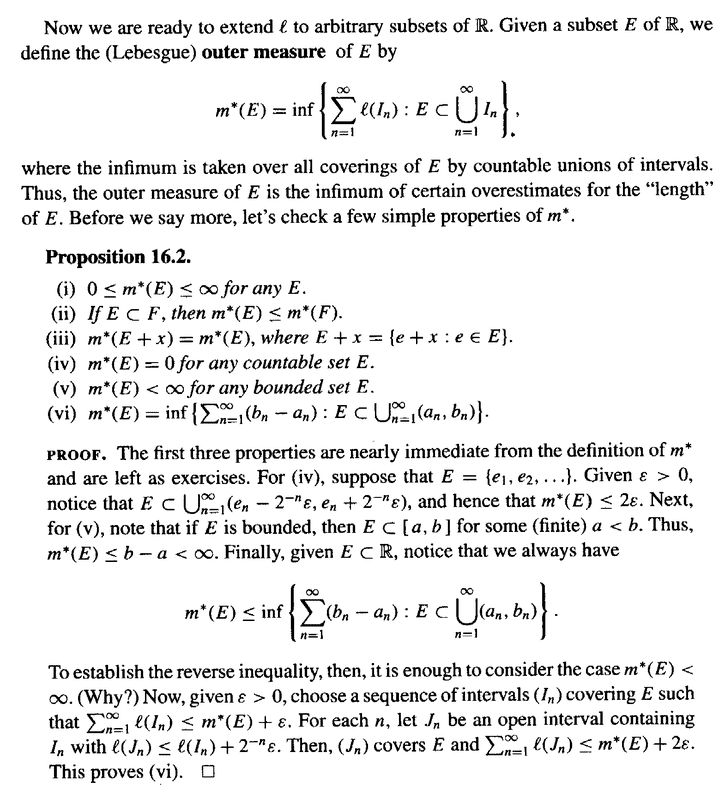
I need help with the proof of Proposition 16.2 part (i) ...

Proposition 16.2 and its proof read as follows:
Carothers - Proposition 16.2 ... .png

Carothers does not prove Proposition 16.2 (i) above ...

Although it seems intuitively obvious, I am unable to construct and express a valid, convincing, formal and rigorous proof of the result ...

Can someone please demonstrate a formal and rigorous proof of Proposition 16.2 (i) above ...

Peter
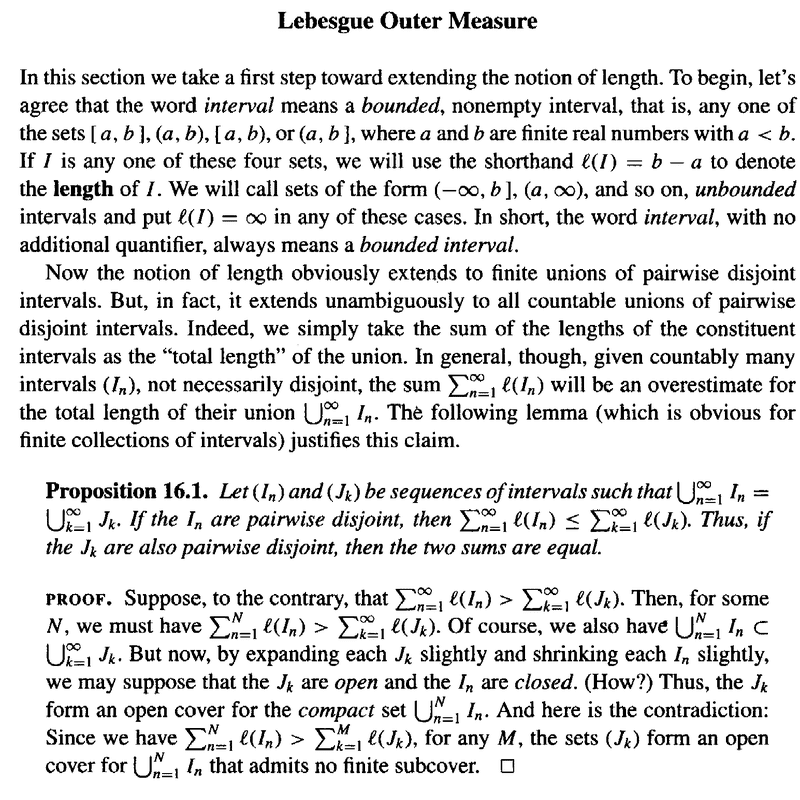
========================================================================================================It may help readers of the above post to have access to Carothers introduction to Lebesgue outer measure ... so I am providing the same as follows:
Carothers - Proposition 16.1 ... .png


Hope that helps ...

Peter
 
Physics news on Phys.org
Math Amateur said:
I am unable to construct and express a valid, convincing, formal and rigorous proof of the result
But you should at least make an attempt.
 
Hint: If ##\emptyset \neq A \subseteq [0,\infty]##, then ##\inf(A)\geq 0##.

I leave the easy proof of this fact to you.
 
  • Like
Likes   Reactions: Math Amateur
Math_QED said:
Hint: If ##\emptyset \neq A \subseteq [0,\infty]##, then ##\inf(A)\geq 0##.

I leave the easy proof of this fact to you.
Thanks for the hint Math_QED ...

We need to prove the following ...

If ##\emptyset \neq A\subseteq [0,\infty]##, then ##\inf(A)\geq 0##

Proof

Assume ##\text{inf} (A) \lt 0##

Then there exists ##x \in A## such that ##\text{inf} (A) \lt x \lt 0## ...

... contradiction as there are no negative numbers in ##A## ...

Therefore ##\inf(A)\geq 0## ...Could also prove this in the same way for ##m^*(E)## ...

This would establish that ##m^*(E) \geq 0## ...

But that would not necessarily mean that ##m^*(E)## ranges from ##0## to ##\infty## ...

So ... how do we proceed from here ...?

PeterEDIT

To prove that ##m^*(E)## ranges from ##0## to ##\infty## ... would it be sufficient to note that

##m^*([a, b]) = m^*((a, b)) = b - a## for ##a, b \in \mathbb{R}## where ##a \lt b##

... and that ##m^*( \emptyset ) = 0## ... and ##m^*( ( 0, \infty ) ) = \infty - 0 = \infty##

Does that complete the proof?

Peter
 
Last edited:
Math Amateur said:
Thanks for the hint Math_QED ...

We need to prove the following ...

If ##\emptyset \neq A\subseteq [0,\infty]##, then ##\inf(A)\geq 0##

Proof

Assume ##\text{inf} (A) \lt 0##

Then there exists ##x \in A## such that ##\text{inf} (A) \lt x \lt 0## ...

... contradiction as there are no negative numbers in ##A## ...

Therefore ##\inf(A)\geq 0## ...Could also prove this in the same way for ##m^*(E)## ...

This would establish that ##m^*(E) \geq 0## ...

But that would not necessarily mean that ##m^*(E)## ranges from ##0## to ##\infty## ...

So ... how do we proceed from here ...?

PeterEDIT

To prove that ##m^*(E)## ranges from ##0## to ##\infty## ... would it be sufficient to note that

##m^*([a, b]) = m^*((a, b)) = b - a## for ##a, b \in \mathbb{R}## where ##a \lt b##

... and that ##m^*( \emptyset ) = 0## ... and ##m^*( ( 0, \infty ) ) = \infty - 0 = \infty##

Does that complete the proof?

Peter

If ##A\subseteq [0,\infty]##, then ##0## is a lower bound of ##A## hence...
 
  • Like
Likes   Reactions: Math Amateur
Math_QED said:
If ##A\subseteq [0,\infty]##, then ##0## is a lower bound of ##A## hence...


Oh ... OK ... then ##m^* (A) \geq 0## ...

But ... does that necessarily prove that ##m^* (A)## ranges from ##0## to ##\infty##?

Peter
 
I'll be very explicit now.

Lemma: Let ##\emptyset \neq A \subseteq [0, \infty]##. Then ##\inf A \in [0, \infty]##.
Proof: ##0## is a lower bound for ##A##, hence by definition of infinum as greatest lower bound ##\inf(A) \geq 0##. ##\quad \square##

Apply the lemma with ##A:= \{\sum_{n=1}^\infty l(I_n): E \subseteq \bigcup_{n=1}^\infty I_n\}##. Then you obtain ##\infty \geq m^*(E)= \inf(A) \geq 0##.
 
  • Like
Likes   Reactions: Math Amateur

Similar threads

  • · Replies 5 ·
Replies
5
Views
2K
  • · Replies 2 ·
Replies
2
Views
1K
  • · Replies 2 ·
Replies
2
Views
1K
Replies
6
Views
2K
  • · Replies 14 ·
Replies
14
Views
3K
  • · Replies 2 ·
Replies
2
Views
2K
  • · Replies 4 ·
Replies
4
Views
2K
  • · Replies 8 ·
Replies
8
Views
2K
Replies
2
Views
2K
  • · Replies 6 ·
Replies
6
Views
2K