Legendre Transformation of Lagrangian density ?

Click For Summary
SUMMARY

The discussion focuses on the Legendre transformation of Lagrangian density to Hamiltonian density in the context of the Dirac Equation within Quantum Electrodynamics (QED). The derivation of Hamiltonian density (H density) from Lagrangian density (L density) is clarified, emphasizing the importance of time derivatives in the transformation. The canonical stress-energy tensor is defined as \(\mathcal{T}^{\mu \nu} = \dfrac{\partial \mathcal{L}}{\partial \partial_\mu \phi_j} \partial^\nu \phi_j - g^{\mu \nu} \mathcal{L}\), leading to the Hamiltonian density \(\mathcal{H} = \mathcal{T}^{tt} =\dfrac{\partial \mathcal{L}}{\partial \partial_t \phi_j} \partial^t \phi_j - g^{tt} \mathcal{L}\). The discussion concludes that the Hamiltonian, derived from the Hamiltonian density, remains constant over time.

PREREQUISITES
  • Understanding of Quantum Electrodynamics (QED)
  • Familiarity with the Dirac Equation
  • Knowledge of Lagrangian and Hamiltonian mechanics
  • Basic concepts of tensor calculus and metric tensors
NEXT STEPS
  • Study the De Donder-Weyl theory in detail
  • Learn about the derivation and application of canonical stress-energy tensors
  • Explore the implications of Hamiltonian mechanics in field theory
  • Investigate the role of time derivatives in Lagrangian and Hamiltonian formulations
USEFUL FOR

Physicists, particularly those specializing in theoretical physics, quantum mechanics, and field theory, as well as students studying advanced topics in QED and Hamiltonian dynamics.

DOTDO
Messages
8
Reaction score
2
Hi

I began to study the basics of QED.

Now I am studying Lagrangian and Hamiltonian densities of Dirac Equation.

I'll call them L density and H density for convenience :)Anyway, the derivation of the H density from L density using Legendre transformation confuses me :(

I thought because parameters of them are space-time components, it should be


bandicam 2015-05-03 11-13-28-477.jpg

But I found that this is related to the De Doner - Weyl Theory,

and the H density used in textbook is
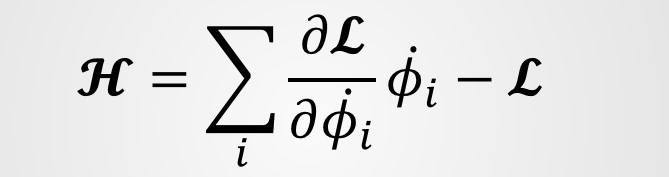
bandicam 2015-05-03 11-13-34-326.jpg

where the dot represents time derivative.So, my question is,

why we consider Legendre transformation on only time derivative of phi ?

Is it just 'defined' to consider energy of the system?

Then what does the covariant H density defined in the De Donder - Weyl theory mean?
 
Physics news on Phys.org
From the lagrangian density \mathcal{L}, you can define the canonical stress-energy tensor \mathcal{T} as follows:

\mathcal{T}^{\mu \nu} = \dfrac{\partial \mathcal{L}}{\partial \partial_\mu \phi_j} \partial^\nu \phi_j - g^{\mu \nu} \mathcal{L}

This is a conserved current in the first index:

\partial_\mu \mathcal{T}^{\mu \nu} = 0

Then you can define a hamiltonian density \mathcal{H} in terms of \mathcal{T}:

\mathcal{H} = \mathcal{T}^{tt} =\dfrac{\partial \mathcal{L}}{\partial \partial_t \phi_j} \partial^t \phi_j - g^{tt} \mathcal{L}

This is the same as the expression in the textbook, if you're using the metric where g^{tt} = +1 and defining \dot{\phi_j} = \partial_t \phi_j

The hamiltonian is the integral of the hamiltonian density over all space:

H = \int d^3 x \mathcal{H}

It's the hamiltonian, not the hamiltonian density, that is constant:

\dfrac{d}{dt} H = 0
 

Similar threads

  • · Replies 3 ·
Replies
3
Views
3K
  • · Replies 1 ·
Replies
1
Views
2K
  • · Replies 3 ·
Replies
3
Views
3K
  • · Replies 1 ·
Replies
1
Views
1K
  • · Replies 18 ·
Replies
18
Views
8K
  • · Replies 6 ·
Replies
6
Views
3K
  • · Replies 5 ·
Replies
5
Views
2K
Replies
3
Views
1K
  • · Replies 2 ·
Replies
2
Views
3K
  • · Replies 31 ·
2
Replies
31
Views
5K