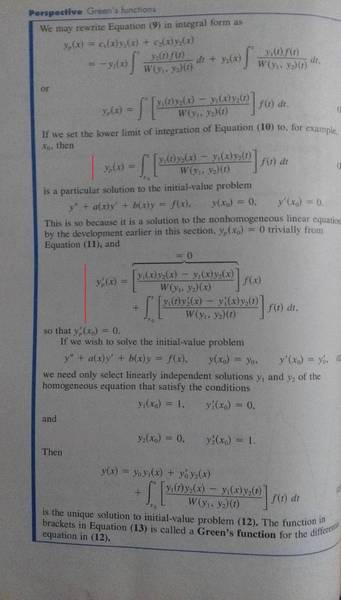
It is because they differentiate with respect to ##x## and there are at least three occurrences of ##x## in the formula that is being integrated: one as an upper integration limit, and two as function arguments in the integrand. There may be up to two more, being the ##y_1,y_2## in the denominator of the integrand. The excerpt does not make clear whether they also depend on ##x##, so I will assume they do not, although they could, since there is a ##y_1(x)## and ##y_2(x)## in the numerator.
Let the function ##A:\mathbb R^2\to\mathbb R## be an antiderivative (indefinite integral) of the integrand with respect to ##t##, ie ##\frac{\partial }{\partial t}A(t,x)=a(t,x)## where ##a(t,x)## is the integrand.
Then the definite integral is
$$A(x,x)-A(x_0,x)$$
Differentiating this wrt ##x## and using the total differential rule gives
\begin{align*}
\frac d{dx}\left(A(x,x)-A(x_0,x)\right)
&=D_1A(x,x)\frac{dx}{dx} + D_2A(x,x)\frac{dx}{dx}
-D_1A(x_0,x)\frac{dx_0}{dx}-D_2A(x_0,x)\frac{dx}{dx}\\
&=D_1A(x,x)\cdot 1 + D_2A(x,x)\cdot 1
-D_1A(x_0,x)\cdot 0-D_2A(x_0,x)\cdot 1\\
&=D_1A(x,x) + D_2A(x,x)-D_2A(x_0,x)
\end{align*}
where ##D_kA## indicates the partial derivative of function ##A## wrt its ##k##th argument.
This is equal to
\begin{align*}
a(x,x) + D_u\bigg(A(x,u)-A(x_0,u)\bigg)\bigg|_{u=x}
&=
a(x,x) + D_u \int_{x_0}^x a(t,u)dt\bigg|_{u=x}
\end{align*}
where ##D_u## indicates
partial differentiation wrt the variable ##u##
In the second term we can, given certain mild assumptions, move the differentiation operator inside the integral sign to obtain:
\begin{align*}
a(x,x) + \int_{x_0}^x D_ua(t,u)dt\bigg|_{u=x}
=a(x,x) + \int_{x_0}^x D_xa(t,x)dt
\end{align*}
EDIT: Which is a derivation of the Leibniz integration rule referenced in the above post, which appeared on my screen when I posted this.
 )