Lenz's Law applied to a non-circuit conductor?

Click For Summary
SUMMARY

The discussion focuses on the application of Lenz's Law to a 20km long conductor swung through Earth's magnetic field, which generated a 3500V potential difference. Although there is no conventional current in the wire, the momentary movement of charge during separation behaves like a current, inducing a magnetic field. Lenz's Law applies to this scenario, as the induced magnetic field opposes the change in the external magnetic field. The energy for charge separation is derived from the kinetic energy of the satellite, and momentary currents do radiate power electromagnetically.

PREREQUISITES
  • Understanding of Lenz's Law and its implications in electromagnetism
  • Familiarity with electromagnetic induction principles
  • Knowledge of Lorentz force and its effects on charge carriers
  • Basic concepts of electric potential and charge separation
NEXT STEPS
  • Study the principles of electromagnetic induction in detail
  • Explore the mathematical formulation of Lenz's Law and its applications
  • Investigate the Lorentz force and its role in charge movement within conductors
  • Examine the relationship between kinetic energy and electromagnetic phenomena in moving conductors
USEFUL FOR

Physics students, electrical engineers, and anyone interested in the practical applications of electromagnetism and Lenz's Law in real-world scenarios.

kostoglotov
Messages
231
Reaction score
6
I was reading through my College Physics text, and it talked about how NASA once swung a 20km long conductor through the Earth's magnetic field and setup a 3500V potential difference along the wire.
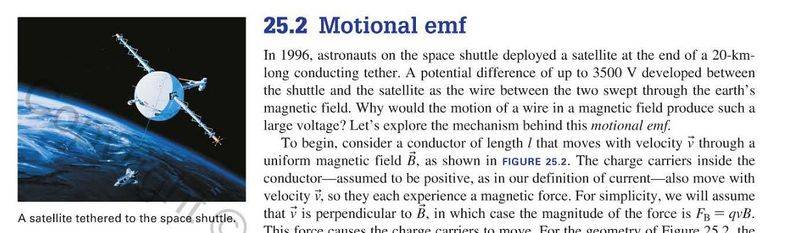
k35c12a.jpg


I understand that there's no conventional current in that wire, it's not a circuit. But for a brief moment, in the instants that the charge was separating, wouldn't this momentary movement of charge behave briefly like a current? And if so, wouldn't that momentarily setup it's own magnetic field? Would Lenz's law about the direction of the current somehow conform to what was happening during the separation of charge here? (the momentarily induced magnetic field would simultaneously oppose, add to, be orthogonal to, etc the Earth's field) Does Lenz's law only apply to circuit with an effective area experiencing a changing magnetic flux?

Presumably work was done by the shuttle to achieve separation of the charge in the wire. Was no net power dissipated by the (briefly) induced magnetic field?
 
Physics news on Phys.org
Lenz's law does not apply here because there is not a changing B field. There is no natural B-flux to even consider in this problem. The voltage produced in the wire is due to the magentic (Lorentz) force separating the charges in the the wire. This does cause a current momentarily. You can imagine that the circuit actually is closed and that the ends of the wire form a capacitor. So as the wire is dragged through the magnetic field, the ends of the wire will build up a charge difference until an equilibrium is reached between the static charge forces and the magnetic forces.

If you consider the geometry, you should find that in fact as current moves along the wire, on one side of the wire, the magnetic field will be enhanced, and the other side it will be weakened. It seems to me that it happens that he side of the wire in the direction the wire is moving will have a positive change in the B along the relevant direction, and the other side of the wire will have less B in that direction.

The energy required for the separation of charges was taken from the kinetic energy of the satellites. And yes, the momentary currents would radiate some power electromagnetically.
 

Similar threads

  • · Replies 6 ·
Replies
6
Views
6K
  • · Replies 9 ·
Replies
9
Views
2K
  • · Replies 1 ·
Replies
1
Views
1K
  • · Replies 2 ·
Replies
2
Views
3K
  • · Replies 9 ·
Replies
9
Views
4K
  • · Replies 4 ·
Replies
4
Views
1K
  • · Replies 2 ·
Replies
2
Views
1K
  • · Replies 10 ·
Replies
10
Views
4K
  • · Replies 2 ·
Replies
2
Views
2K
  • · Replies 4 ·
Replies
4
Views
2K