Leonardo’s Perpetual Motion Machines

Click For Summary
SUMMARY

Leonardo da Vinci's designs for perpetual motion machines, while fascinating, do not function as intended due to the laws of physics. The discussion highlights that Leonardo acknowledged the impossibility of perpetual motion by referencing Newton's Third Law of Motion, which states that for every action, there is an equal and opposite reaction. The machines are marketed as art pieces rather than functional devices, and the conversation also touches on the historical context of these ideas, including the influence of Zeno's paradox.

PREREQUISITES
  • Understanding of Newton's Third Law of Motion
  • Familiarity with the concept of perpetual motion
  • Knowledge of Zeno's paradox
  • Awareness of Renaissance scientific thought
NEXT STEPS
  • Research the historical context of Newton's laws and their predecessors
  • Explore the implications of Zeno's paradox in modern physics
  • Investigate other historical attempts at creating perpetual motion machines
  • Examine the artistic representation of scientific concepts in Renaissance art
USEFUL FOR

Historians, physics enthusiasts, art historians, and anyone interested in the intersection of science and art during the Renaissance period.
dkotschessaa
Messages
1,063
Reaction score
763
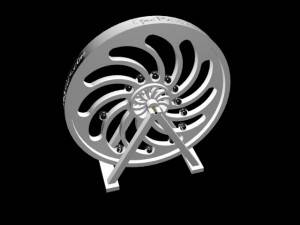
Obviously they don't work, perpetually, but they're really cool anyway:

http://www.leonardodavincisinventions.com/mechanical-inventions/leonardo-perpetual-motion-machine/

perpetual-motion-leonardo-da-vinci-3a-300x225.jpg
 
  • Like
Likes   Reactions: fresh_42
Physics news on Phys.org
Ban and lock in 3, 2, 1...
 
FYI, the site makes no claims for the machines to work, and simply sells them as art pieces.
 
Borek said:
Ban and lock in 3, 2, 1...
0.5, 0.25, 0.125, wait for it, wait for it...
 
  • Like
Likes   Reactions: fresh_42, Bystander and dkotschessaa
Leonardo decided against investigating perpetual motion any further after he wrote (in mirror writing) beside the designs – “for every action there is an opposite and equal reaction” (the machines will not work). That quote is also Isaac Newtons Third Law of Motion, 200 years before Newton was born!
Now, this is very interesting. Newton ascribed the discovery of the third law to his contemporaries in the Royal Society. He wasn't aware anyone had realized it or voiced it before them. That being the case, it is intriguing to see Leonardo had written it down as far back as the Renaissance. I am now curious to know if there's any record of it before Leonardo anywhere.
 
berkeman said:
0.5, 0.25, 0.125, wait for it, wait for it...
The very first thing that came to mind upon seeing this was Zeno's paradox. I wonder what sort of person this makes me...
 

Similar threads

  • · Replies 9 ·
Replies
9
Views
1K
  • · Replies 9 ·
Replies
9
Views
1K
  • · Replies 4 ·
Replies
4
Views
5K
  • · Replies 2 ·
Replies
2
Views
2K
  • · Replies 35 ·
2
Replies
35
Views
6K
  • · Replies 6 ·
Replies
6
Views
1K
  • · Replies 9 ·
Replies
9
Views
2K
  • Sticky
  • · Replies 31 ·
2
Replies
31
Views
15K
  • · Replies 9 ·
Replies
9
Views
3K
  • · Replies 16 ·
Replies
16
Views
9K