LHC High L pp run ends for 2023

Click For Summary
SUMMARY

The LHC's high luminosity proton run for 2023 has concluded due to a bellows failure near IP8 (LHCb), which has since been replaced. The sector is currently cooling, with beam operations expected to resume around September 11. The remainder of the year will focus on low luminosity special proton running and heavy ion collisions, specifically PbPb. This incident underscores potential weaknesses in the LHC's design, particularly the limited number of cryogenic sectors and the need for improved vacuum quality.

PREREQUISITES
  • Understanding of LHC operations and terminology
  • Knowledge of cryogenic systems in particle accelerators
  • Familiarity with high-energy physics and beam dynamics
  • Awareness of the implications of luminosity in particle collisions
NEXT STEPS
  • Research the design and function of bellows in superconducting magnets
  • Explore the impact of cryogenic sector limitations on particle accelerator performance
  • Study the effects of vacuum quality on beam stability and performance
  • Investigate the operational challenges faced during heavy ion collisions at the LHC
USEFUL FOR

Particle physicists, accelerator engineers, and researchers involved in high-energy physics experiments will benefit from this discussion, particularly those focused on LHC operations and performance optimization.

Vanadium 50
Staff Emeritus
Science Advisor
Education Advisor
Gold Member
Dearly Missed
Messages
35,004
Reaction score
21,705
TL;DR
Due to bellows failure, the high luminosity pp running at the LHC has ended for 2023.
A bellows failed at the LHC near IP8 (LHCb). It has been replaced and the sector is cooling. Beam is expected on or near September 11. There will not be enough time to return to high luminosity pp running, so the run plan for the rest of the year is low luminosity special pp running and heavy ions, which I believe will be PbPb.
 
  • Like
  • Informative
  • Sad
Likes   Reactions: Astronuc, ohwilleke, George Jones and 3 others
Physics news on Phys.org
What is a 'bellows' in this context?
 
  • Like
Likes   Reactions: vanhees71
Expansion joints between superconducting magnets.
 
  • Like
  • Informative
Likes   Reactions: berkeman, vanhees71 and Drakkith
Drakkith said:
What is a 'bellows' in this context?
The sound of scientists annoyed by the interruption of their data.
 
  • Haha
  • Like
Likes   Reactions: Astronuc, ohwilleke, George Jones and 3 others
Like some kind of expensive Rube Goldberg machine, this was ultimately caused by a tree falling over some 50 km away.

Here's an official write-up (albeit no mention of the tree):
https://home.cern/news/news/acceler...-inner-triplet-magnet-causes-small-leak-major

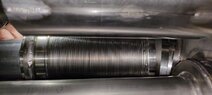
Here is the damaged bellows before being replaced. There was a crack in a weld only 1.6 mm in length. It is just about visible in the centre of the zoomed-in picture.

leak_found2.jpgleak_found3.jpg
 
  • Like
Likes   Reactions: ohwilleke, vanhees71, mfb and 3 others
  • Like
Likes   Reactions: ohwilleke, vanhees71 and Ibix
Drakkith said:
What is a 'bellows' i
The nosy doctor in I Dream of Jeannie.
 
  • Like
Likes   Reactions: Astronuc
This incident highlights area where, while I wouldn't call them weak spots exactly, places where if we had to do it over we might try and improve.

One is that there are only 8 cryogenic sectors (the Tevatron, 4x smaller had 6) so amy cryo problem is a big cryo problem.

Another is that the vacuum quality requires running beam through the machine for a while to "clear out the crud". This is probably not helped by the first point.

It;s a great machine, and it's done a lot of science, don't get me wrong - but like all one of a kind devices, we know more about what would have worked better after we've used it.
 
  • Like
Likes   Reactions: ohwilleke, vanhees71 and Drakkith
The news this summer from the LHC has not been good. On July 17 a tree fell on two high-voltage power lines, causing beams to dump, magnets to quench, and damage (a helium leak) to occur in the cryogenics for an inner triplet magnet. See here for more details. Fixing this required warming up a sector of the ring, with the later cooldown a slow process. According to this status report today at the EPS-HEP2023 conference in Hamburg, there will be an ion run in October, but the proton run is now over for the year, with integrated luminosity only 31.4 inverse fb (target for the year was 75).

From Not Even Wrong.
 
  • Wow
  • Sad
Likes   Reactions: pinball1970 and .Scott
  • #11
Great, so there will be Pb-Pb collisions this year as planned :-))))!!!!
 
  • #12
The answer to that is "maybe". Additional Pb-Pb running beyond what is scheduled is competing with low beam current proton runs, e.g. van der Meer scans and the like. The run plan they are coming up with now may be altered later in the year as we know more.
 
  • Like
  • Informative
Likes   Reactions: vanhees71 and ohwilleke

Similar threads

  • · Replies 0 ·
Replies
0
Views
2K