LHCb observes 5 new particles (excited hadrons)

  • Context: Undergrad 
  • Thread starter Thread starter mfb
  • Start date Start date
  • Tags Tags
    Cern Lhcb Particles
Click For Summary
SUMMARY

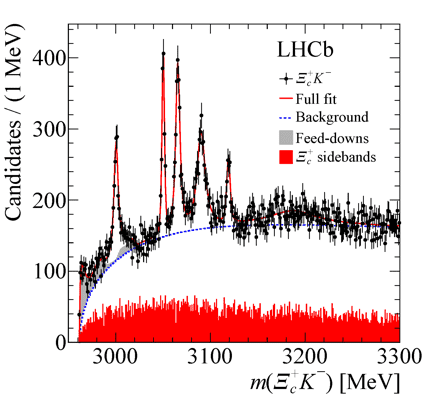
The LHCb collaboration has observed five new excited hadrons, specifically excited states of the baryon ##\Omega_c^0##, with significant decay peaks to ##\Xi_c^+ K^-##, reaching about 20 sigma significance. The findings include a potential broad sixth state around 3200 MeV. These discoveries enhance the understanding of Quantum Chromodynamics (QCD) at low energies, although they do not contribute to Beyond Standard Model (BSM) physics. The mass differences of the new states exhibit uncertainties between 0.15 MeV and 0.9 MeV, with a conservative estimate of ~2% uncertainty on mass differences.

PREREQUISITES
  • Understanding of Quantum Chromodynamics (QCD)
  • Familiarity with baryon spectroscopy and excited states
  • Knowledge of particle decay processes and significance levels
  • Experience with statistical and systematic uncertainty analysis in particle physics
NEXT STEPS
  • Research the implications of excited baryon states on QCD at low energies
  • Explore the quark model for charmed baryons and negative parity states
  • Study the statistical methods for analyzing particle mass uncertainties
  • Investigate the role of LHCb in discovering new particles and its impact on particle physics
USEFUL FOR

Particle physicists, researchers in baryon spectroscopy, and anyone interested in the latest discoveries in hadron physics and QCD.

Messages
37,404
Reaction score
14,238
Plain old standard model baryons, but 5 at the same time, and with crystal clear peaks in the decay to ##\Xi_c^+ K^-##. Each peak in the figure is a particle never seen before, and the significances of those peaks are about 20 sigma (10 sigma for the 5th one). A broad 6th state might hide around 3200 MeV.

Based on the quark content (charm strange strange), all those particles are excited ##\Omega_c^0## states. The ground state and one excited state have been known before.

News at the LHCb website
Publication at arXiv
OmegaFig2_s.png
 
  • Like
Likes   Reactions: BiGyElLoWhAt, Amrator, Dr. Courtney and 9 others
Physics news on Phys.org
Can the excited hadrons be used to constrain BSM models or similar in any useful way, or is it mainly just dotting the i's?
 
It can help to understand QCD at low energies better. The predictions for excited states are often quite inaccurate. No BSM physics.

Here is an example for excited charmonium states. See the mass vs. JPC diagram: Yellow are predicted and discovered states, nearly all are below the threshold to decay to two charmed mesons. Grey are predicted but undiscovered states - most predicted states at higher energies have not been found. Red are discovered but unpredicted states which don't fit in the predicted pattern. And finally there are the tetraquarks in purple which also don't fit in.
 
  • Like
Likes   Reactions: Dr. Courtney and Lord Crc
From a low-energy QCD perspective, this is very interesting: these particles are protons, but with every light quark replaced by a heavy one. That let's one separate effects due to quark mass and effects not due to quark mass. For this, the mass differences are more important than the absolute masses, and I would hope LHCb would make these public soon.
 
  • Like
Likes   Reactions: Dr. Courtney
You get a conservative uncertainty if you assume that both statistical and systematic uncertainty are uncorrelated, and treat the uncertainty from the ##\Xi## mass as fully correlated (because it is, obviously). The uncertainties on the masses are between 0.15 MeV and 0.9 MeV, the mass differences are between 15 and 120 MeV. A ~2% uncertainty on the mass differences with conservative assumptions. Is that too large?
 
interesting again... I envy LHCb a little (it always discovers something- of course not 100% revolutionary)...
 
  • Like
Likes   Reactions: Dr. Courtney
mfb said:
Is that too large?

I don't do that kind of physics, but those who do tell me that they want the errors as small as possible. How much can they do with a 2% error that they couldn't do with a 3% error? Hard to tell. That said, it should be relatively easy for LHCb to do this: instead of m1..m5 being the fit variables, fot m1, (m2-m1), (m3-m2), etc. and repropagate the systematics.
 
  • Like
Likes   Reactions: Dr. Courtney
it is really interesting discovery. I am doing the quark model for charmed baryon. it enriches the charmed baryon spectroscopy.
According model, we expect those states are negative parity states (L=1). I hope I can get a good result soon.
 
  • Like
Likes   Reactions: mfb

Similar threads

Replies
7
Views
2K
  • · Replies 6 ·
Replies
6
Views
5K
  • · Replies 4 ·
Replies
4
Views
3K
  • · Replies 41 ·
2
Replies
41
Views
9K
  • · Replies 49 ·
2
Replies
49
Views
12K
  • · Replies 10 ·
Replies
10
Views
4K
  • · Replies 1 ·
Replies
1
Views
1K
  • · Replies 1 ·
Replies
1
Views
2K
  • · Replies 11 ·
Replies
11
Views
3K
  • · Replies 0 ·
Replies
0
Views
4K