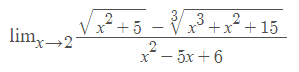
L'Hopital's Rule: Solving Homework Statement

Click For Summary
The discussion centers on the application of L'Hopital's Rule to a limit problem, where the user initially arrives at a solution of -30/-27, while the expected answer is -(2/27). It is pointed out that the user made an error in calculating the derivative of the function (x^3 + x^2 + 15)^(1/3), which led to the incorrect result. The correct derivative of √(x^2 + 5) is also provided for clarity. Ultimately, the consensus is that the user's answer is incorrect, and they should re-evaluate their derivatives to arrive at the correct limit.
akaliuseheal
Messages
53
Reaction score
8
Homework Statement
Capture.PNG

Can I use L'Hopital's rule here. What I get as a solution is -30/-27 while in the notebook,
without using the L'Hopital's rule the answer is -(2/27)

The attempt at a solution
The derivatives i get are:
x/(x2+5)½
(3x2+2x)/3(x3+x2+15)⅓
2x-5

½ and ⅓ are there because it's easier for me to write it here on this forum like that instead of sqrt.

So..
limx→2( ( x/(x2+5)½ - (3x2+2x)/3(x3+x2+15)⅓ ) / 2x-5 )
Image:
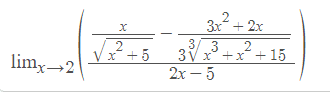
Capture1.PNG

x = 2 ⇒ -30/-27 (1.11)

Could't find software online to verify the solution (symbolab gave no answer) so here I am.
But symbolab did gave me the same answer as I got when I entered the expression from the second image.
 

Attachments

  • Capture.PNG
    Capture.PNG
    1.4 KB · Views: 798
  • Capture1.PNG
    Capture1.PNG
    1.9 KB · Views: 442
Physics news on Phys.org
Firstly, please use Latex to write equations. The link to the Latex help is: https://www.physicsforums.com/help/latexhelp/

Now, derivative of ##\sqrt{x^2+5}## is ##\dfrac{1}{2} \dfrac{2x}{\sqrt{x^2+5}}##.

The other derivatives are correct.

Put these in. Your answer should come.
 
Wrichik Basu said:
Firstly, please use Latex to write equations. The link to the Latex help is: https://www.physicsforums.com/help/latexhelp/

Now, derivative of ##\sqrt{x^2+5}## is ##\dfrac{1}{2} \dfrac{2x}{\sqrt{x^2+5}}##.

The other derivatives are correct.

Put these in. Your answer should come.

If you look at what you got and then what I got, you will see that those two are the same.
 
akaliuseheal said:
If you look at what you got and then what I got, you will see that those two are the same.

You calculated the other derivative incorrectly. See my post.
 
Question: A clock's minute hand has length 4 and its hour hand has length 3. What is the distance between the tips at the moment when it is increasing most rapidly?(Putnam Exam Question) Answer: Making assumption that both the hands moves at constant angular velocities, the answer is ## \sqrt{7} .## But don't you think this assumption is somewhat doubtful and wrong?

Similar threads

Replies
1
Views
1K
  • · Replies 1 ·
Replies
1
Views
2K
  • · Replies 9 ·
Replies
9
Views
2K
Replies
4
Views
2K
  • · Replies 5 ·
Replies
5
Views
2K
  • · Replies 21 ·
Replies
21
Views
7K
Replies
4
Views
2K
  • · Replies 10 ·
Replies
10
Views
2K
  • · Replies 8 ·
Replies
8
Views
2K
  • · Replies 23 ·
Replies
23
Views
2K