Lifting 40 lbs with garage door opener

  • Thread starter Thread starter trickyrick0465
  • Start date Start date
  • Tags Tags
    Lifting
Click For Summary
SUMMARY

The discussion centers on using a garage door opener to lift a 40 lb load, with participants highlighting the limitations of the opener's lifting capacity, which is around 27 lbs without spring assistance. Suggestions include using a smaller chain drive sprocket and implementing a pulley system to effectively halve the load on the opener. Participants recommend considering a counterweight to reduce the strain on the opener and explore alternatives like linear actuators for better control. The conversation emphasizes the importance of design considerations, such as noise and safety mechanisms, when modifying existing equipment.

PREREQUISITES
  • Understanding of garage door opener mechanics
  • Knowledge of pulley systems and counterweights
  • Familiarity with linear actuators and their specifications
  • Basic principles of mechanical advantage and load management
NEXT STEPS
  • Research the specifications and installation of linear actuators, specifically the 12V DC 110 lb model.
  • Learn about pulley systems and how to calculate mechanical advantage for lifting loads.
  • Investigate safety mechanisms for motorized systems, including torque-limiting clutches and safety sensors.
  • Explore designs for counterweight systems in lifting applications, particularly in home automation.
USEFUL FOR

DIY enthusiasts, engineers, and anyone interested in automating lifting mechanisms for home projects, particularly those involving garage door openers and linear actuators.

trickyrick0465
Messages
9
Reaction score
3
I have a garage door opener I want to use to lift 40lbs. I've read that without the spring assist it could manage 27lbs max lifting power. If I played around with the sprocket that's going on the shaft attached to the 40lbs say double or triple the diameter that's whats on the opener would that work.
 
Engineering news on Phys.org
Maybe, I guess. It's not really clear to me what your design is though. Maybe a sketch or a detailed description would get you useful answers.

“Give me a firm place to stand and a lever and I can move the Earth.” - Archimedes
 
To lift more weight, you need a smaller chain drive sprocket. That would create other problems. The sprocket is already about as small as will fit in the space available. And the bearing supporting that sprocket is the cheapest bearing that barely lasts long enough. Pulling harder shortens the life of that bearing.

A better approach is to use a pulley to lift your load. Like this:
Pulley.jpg

Then the opener only has to pull 20 lbs to lift the 40 lb load.
 
  • Like
Likes   Reactions: Spinnor and Lnewqban
Can you devise a counterweight to tension the chain in lieu of the spring?
 
This is what I had in mind the sprocket on the garage door opener would turn a sprocket welded to a shaft that would have the 40lb weight on it.
IMG_20230108_0001.jpg
 
You will likely only get so many turns of the sprocket on the opener. They are made to lift only so far. Gearing it down may not give you the travel you want.
 
My old doors are quite different, with a chain driven linear actuator overhead and linear countersprings. So my design would be different.
 
The chain is a loop. I'm going to rewire the limit switches it only needs to travel about 20 inches. I'm lifting a tv into a box that's in the Attic so I can have a hideaway tv in the bedroom ceiling
Averagesupernova said:
You will likely only get so many turns of the sprocket on the opener. They are made to lift only so far. Gearing it down may not give you the travel you want.
 
So I'm guessing you want the convenience of a remote control and motor mechanism all in one package? I would shy away from that myself. That's just me. I would use a small linear actuator and code up something to control it that can communicate with Bluetooth. Use it with your phone.
 
  • Informative
Likes   Reactions: berkeman
  • #11
Do you have free space in the attic? There is no reason you could not counterweight the TV so that only a few ounces of external force would be required for any motion.
 
  • Like
Likes   Reactions: Nik_2213 and gmax137
  • #12
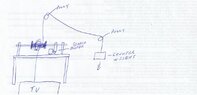
I wanted to keep everything inside the top of the box I was going to insulate it as I'm in the north. I guess I could have one cable coming through a small hole in the top. Do you think this would be ok (see attached) the cable comes through the box and raps 3 or 4 times around a reel or spool and then to the counterweight? The motor drives the shaft the reel is on. Or would it be better to have counterweight directly onto TV (weight)
 

Attachments

  • TV@.jpg
    TV@.jpg
    28.2 KB · Views: 146
  • #13
Do you really need motorized operation? If you have room for a counterweight, just make the counterweight the same weight as the TV. Then a one finger push will move it up, and a one finger pull will bring it down. Friction will keep it wherever you leave it - up or down. If you really need remote operation, a stick to push it up and a string to pull it down.
 
  • Like
Likes   Reactions: berkeman and jack action
  • #14
No your right in your case I would not but there's something for saying "OK Google turn off TV" and the TV retracts up into the ceiling.
 
  • #15
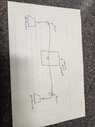
If I did it this way can I assume that there would be no weight on the garage door opener
 

Attachments

  • pullies.jpg
    pullies.jpg
    40.6 KB · Views: 174
  • Like
Likes   Reactions: Lnewqban
  • #16
trickyrick0465 said:
No your right in your case I would not but there's something for saying "OK Google turn off TV" and the TV retracts up into the ceiling.
A counterweight would still be useful - it would take a lot of load off the motor, only having to get the weights moving, not actually lift dead weight. You get two birds with one stone.
 
  • Like
Likes   Reactions: Lnewqban
  • #17
trickyrick0465 said:
If I did it this way can I assume that there would be no weight on the garage door opener
Right, the opener deals only with the friction in the system. Very similar to the "sash weights" in windows.
 
  • #18
gmax137 said:
Very similar to the "sash weights" in windows.
As well as a properly set up garage door with opener.
 
  • #19
I hate to be such a downer but have you thought about the noise a garage door opener will make? Unless you string a cable/rope to the far end of an attached garage to remote mount the opener or something I think you will have more noise than you want when it operates. More than I would care to have anyway
 
  • Informative
Likes   Reactions: DaveC426913
  • #20
Averagesupernova said:
As well as a properly set up garage door with opener.
Very true!
 
  • #21
Also most openers are far more powerful than you require. Tell your cat not to sleep un the TV.
 
  • Haha
Likes   Reactions: Averagesupernova
  • #22
Perhaps look at how powered 'vanishing' loft-access ladders work ?

Snag with powered whatsits such as car windows is the necessity for safety sensors and systems, torque-limiting clutch etc to be sure, to be sure: Due Care, Please ??

There's the other approach that uses single or double 'cantilever' diamond, like a big car-jack. Think inverted access platform. Mechanism provides discreet stability for hoisting TV's frame. The 'worm' drive-thread provides a lot of final torque, decoupling system from eg geared brushless motor...

I've seen similar for pop-up projection screens, cantilevers replacing legacy single or double telescopic rams...
 

Similar threads

  • · Replies 2 ·
Replies
2
Views
2K
  • · Replies 7 ·
Replies
7
Views
5K
Replies
3
Views
2K
  • · Replies 6 ·
Replies
6
Views
4K
  • · Replies 2 ·
Replies
2
Views
1K
  • · Replies 2 ·
Replies
2
Views
2K
  • · Replies 7 ·
Replies
7
Views
3K
  • · Replies 4 ·
Replies
4
Views
8K
Replies
3
Views
2K
  • · Replies 8 ·
Replies
8
Views
5K