Limit as x approaches a: (x+2)^5/3 - (a+2)^5/3 / (x-a) | Limit Laws

  • Thread starter Thread starter fishspawned
  • Start date Start date
  • Tags Tags
    Figure Limit
Click For Summary

Homework Help Overview

The problem involves finding the limit as x approaches a of the expression [(x+2)^(5/3) - (a+2)^(5/3)] / (x-a), which relates to limit laws and potentially derivatives.

Discussion Character

  • Exploratory, Assumption checking, Problem interpretation

Approaches and Questions Raised

  • Participants discuss the possibility of using derivatives to evaluate the limit, with some expressing a desire to avoid differentiation. There are questions about the implications of the power of 5/3 and how it complicates the problem. Others suggest alternative approaches, including substitutions and properties of exponential functions.

Discussion Status

Participants are exploring various methods to approach the limit, with some suggesting that differentiation may be the most straightforward method. There is recognition of the challenges posed by the non-integer exponent, and some participants are sharing insights and potential substitutions that could aid in the analysis.

Contextual Notes

There is a noted restriction against using derivatives directly, as the problem is presented before the introduction of differentiation concepts. This constraint is influencing the approaches being considered.

fishspawned
Messages
66
Reaction score
16

Homework Statement


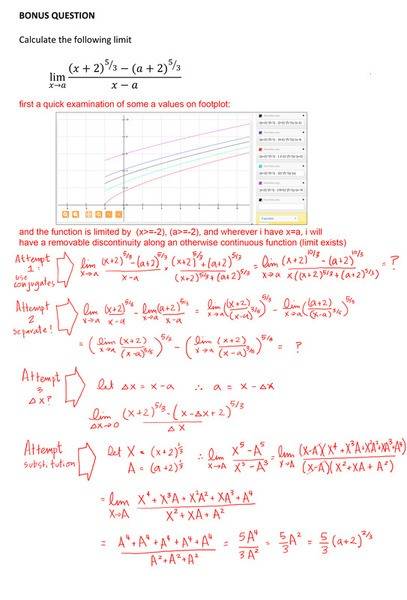
the limit x->a of [(x+2)^5/3 - (a+2)^5/3] / (x-a)

Homework Equations


limit laws

The Attempt at a Solution


CALCULUS%20CHAPTER%202%20TEST%2001%20Limits-8_zps15cgn22c.jpg
[/B]
 
Physics news on Phys.org
Does the formula in the third attempt remind you on something?
 
it looks like I'm trying to get a derivative. I am trying to do this without working using any derivatives and for some reason the power of 5/3 is completely messing with my head and i do not know how to proceed. i am still getting a 0/0 situation.
 
Well, differentiation seems to be the shortest way. Otherwise you probably will have to follow the paths the differentiating formulas are proven. The power ##\frac{1}{3}## is the difficulty here, for you cannot expand it easily. Why do you want to restrict yourself, once you already have the formula for the first derivative?
 
The restriction is due to the question is apparently brought up before any derivatives are introduced. So apparently this is do-able without using straight up differentiation. Yes, the 1/3 is killing me. and i have no idea how to approach it.
 
I've just looked up how ##\frac{d}{dx} x^{\alpha}=\alpha x^{\alpha-1}## is proven for non-integer values ##\alpha##.
It's done by the chain rule and ##x^\alpha = \exp(\alpha \ln x)##. Perhaps this might help and you may use properties of the exponential function. Another substitution ##y=x+2## should decrease writing work.
 
Set ##X=(x+2)^{1/3}## ##A=(a+2)^{1/3}## then the it becomes ##\lim_{X\rightarrow A}{\frac{X^5-A^5}{X^3-A^3}}## . Hope I am right here and this helps.
 
  • Like
Likes   Reactions: fresh_42
DELTA:
this seems to take care of it - provided you know how to expand a sum of powers to a high level - had to look it up to be honest:

so revised sheet:
CALCULUS%20CHAPTER%202%20TEST%2001%20Limits-82_zpshpcpjng5.jpg
 
  • Like
Likes   Reactions: Delta2 and fresh_42
fishspawned said:
DELTA:
this seems to take care of it - provided you know how to expand a sum of powers to a high level - had to look it up to be honest:

so revised sheet:
CALCULUS%20CHAPTER%202%20TEST%2001%20Limits-82_zpshpcpjng5.jpg
Correct result.
 

Similar threads

  • · Replies 2 ·
Replies
2
Views
1K
  • · Replies 9 ·
Replies
9
Views
2K
  • · Replies 8 ·
Replies
8
Views
2K
  • · Replies 4 ·
Replies
4
Views
1K
  • · Replies 15 ·
Replies
15
Views
2K
  • · Replies 26 ·
Replies
26
Views
3K
Replies
16
Views
3K
  • · Replies 10 ·
Replies
10
Views
2K
  • · Replies 20 ·
Replies
20
Views
3K
  • · Replies 12 ·
Replies
12
Views
4K