Limit of a rational function with a constant c

Join the discussion
Ask a follow-up here, or get your own question answered by working scientists, mathematicians and engineers — people, not an autocomplete.
Real named experts · corrections over time · the nuance an AI answer skips
8 replies · 1K views
member 731016
Homework Statement
Please see below
Relevant Equations
Please see below
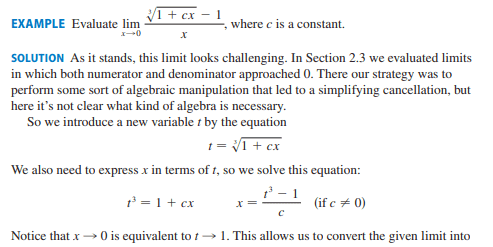
For this problem,
1676430951483.png

Did they get ## x## approaches one is equivalent to ##t## approaches zero because ##t ∝ (x)^{1/3} + 1##?

Many thanks!
 
Last edited by a moderator:
Physics news on Phys.org
" Notice that x ##\rightarrow##0 is equivalent to t ##\rightarrow## 1 ", it says. The given formula becomes
[tex]\lim_{t \rightarrow 1} \frac{c(t-1)}{t^3-1}[/tex]
 
Reply
  • Like
Likes   Reactions: member 731016
anuttarasammyak said:
" Notice that x ##\rightarrow##0 is equivalent to t ##\rightarrow## 1 ", it says. The given formula becomes
[tex]\lim_{t \rightarrow 1} \frac{c(t-1)}{t^3-1}[/tex]
Thank you for your reply @anuttarasammyak !

Sorry, I have updated the question after I realized my mistake. Is my reasoning correct though?

Many thanks!
 
[tex]\lim_{x\rightarrow 0}t=\lim_{x\rightarrow 0} \sqrt[3]{1+cx}=1[/tex]
[tex]\lim_{t\rightarrow 1}x=\lim_{t\rightarrow 1}\frac{t^3-1}{c}=0[/tex]
 
Reply
  • Like
Likes   Reactions: member 731016
Callumnc1 said:
Homework Statement:: Please see below
Relevant Equations:: Please see below

For this problem,
View attachment 322282
Did they get ## x## approaches one is equivalent to ##t## approaches zero because ##t ∝ (x)^{1/3} + 1##?

Many thanks!
I would say it's more like:

As ##x\to 0##, it's clear that ##\displaystyle \root 3 \of{1+cx \,} \to 1##, so ##t\to 1## .
 
Last edited:
Reply
  • Like
Likes   Reactions: member 731016
anuttarasammyak said:
[tex]\lim_{x\rightarrow 0}t=\lim_{x\rightarrow 0} \sqrt[3]{1+cx}=1[/tex]
[tex]\lim_{t\rightarrow 1}x=\lim_{t\rightarrow 1}\frac{t^3-1}{c}=0[/tex]
Thank you for your reply @anuttarasammyak !
 
SammyS said:
I would say it's more like:

As ##x\to 0##, it's clear that ##\root 3 \of{1+cx \,} \to 1##, so ##t\to 1## .
Thank you @SammyS , I see now!
 
Callumnc1 said:
Is my reasoning correct though?
It looks like you're thinking ##\sqrt[3]{1+cx} = \sqrt[3]{1} + \sqrt[3]{cx}##. That's clearly wrong. You can't distribute the root across the addition.

Also, as far as notation goes, ##\propto## means "proportional to", so saying that ##t \propto 1 + x^{1/3}## means that ##t = k(1+x^{1/3})## for some constant ##k##, which you probably didn't mean.
 
Reply
  • Like
Likes   Reactions: member 731016 and PeroK
vela said:
It looks like you're thinking ##\sqrt[3]{1+cx} = \sqrt[3]{1} + \sqrt[3]{cx}##. That's clearly wrong. You can't distribute the root across the addition.

Also, as far as notation goes, ##\propto## means "proportional to", so saying that ##t \propto 1 + x^{1/3}## means that ##t = k(1+x^{1/3})## for some constant ##k##, which you probably didn't mean.
Thank you for your reply @vela!

That is good you mentioned the notation, I didn't realize I could not do that!