Linear Algebra: Solving a system with free variables

Click For Summary

Homework Help Overview

The discussion revolves around solving a system of linear equations involving free variables, specifically using an augmented matrix and exploring the implications of the parametric vector form. Participants are trying to understand the role of the variable "s" in their solutions.

Discussion Character

  • Exploratory, Assumption checking, Problem interpretation

Approaches and Questions Raised

  • Participants discuss setting up an augmented matrix and attempting to solve for variables. There are questions about the meaning of "s" in the context of the parametric vector form and how to properly reduce the matrix to find relationships between the variables.

Discussion Status

Some participants have provided guidance on row reducing the matrix and interpreting the results, while others express confusion about their attempts and the implications of their findings. There is an ongoing exploration of how to express variables in terms of free variables.

Contextual Notes

Participants note the presence of free variables and the challenge of understanding the relationships between them, as well as the lack of clarity regarding certain terms and their application in the problem.

Ryry013
Messages
2
Reaction score
0
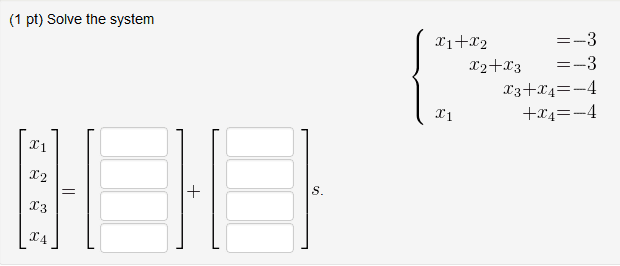
Here is a picture of the problem.
95a5184073482d018c453a322f0bf325.png
Can anyone give me some hints on the problem? I've looked in my textbook, but I don't know what "s" means. I found stuff on the parametric vector form, and it gives me the equation x = su + tv, but I don't see any "t"'s in this problem.

I first tried setting up an augmented matrix with

[ 1 1 0 0 | -3 ]
[ 0 1 1 0 | -3 ]
[ 0 0 1 1 | -4 ]
[ 1 0 0 1 | -4 ]

And I solved for the four variables, like:
x1 = -3 - x2
x2 = -3 - x3
x3 = -4 - x4
x4 = -4 - x1

And now I'm stumped. I didn't think these would do anything, but setting the first and second rows equal to each other, and the third and fourth rows equal to each other simply gets x1 - x3 = 0 for both of them.

I didn't think this would do anything either, but I tried also back substituting the x1 equation into the x4 equation, and then the x2 equation into x4, and so on, and that ended up with x4 = x4.
 
Physics news on Phys.org
edit: never my idea didn't work
 
Chas3down said:
edit: never my idea didn't work

Thanks for the try though.
 
Ryry013 said:
Here is a picture of the problem.
95a5184073482d018c453a322f0bf325.png
Can anyone give me some hints on the problem? I've looked in my textbook, but I don't know what "s" means. I found stuff on the parametric vector form, and it gives me the equation x = su + tv, but I don't see any "t"'s in this problem.

I first tried setting up an augmented matrix with

[ 1 1 0 0 | -3 ]
[ 0 1 1 0 | -3 ]
[ 0 0 1 1 | -4 ]
[ 1 0 0 1 | -4 ]

And I solved for the four variables, like:
x1 = -3 - x2
x2 = -3 - x3
x3 = -4 - x4
x4 = -4 - x1
It looks like you didn't actually do anything with your augmented matrix. Use row reduction to get the matrix in reduced row echelon form. When it's completely reduced you can solve for x1, x2, and x3 in terms of x4. Your solution will look like a vector + a parameter (that's s) times another vector.
Ryry013 said:
And now I'm stumped. I didn't think these would do anything, but setting the first and second rows equal to each other, and the third and fourth rows equal to each other simply gets x1 - x3 = 0 for both of them.

I didn't think this would do anything either, but I tried also back substituting the x1 equation into the x4 equation, and then the x2 equation into x4, and so on, and that ended up with x4 = x4.
 
I agree with Mark44. When I row reduce the augmented matrix, I get all "0"s in the last row, non-zero values in the third column and fourth columns.
Something like this:
\begin{bmatrix} 1 & 0 & 0 & a_1 & b_1 \\ 0 & 1 & 0 & a_2 & b_2 \\ 0 & 0 & 1 & a_3 & b_3 \\ 0 & 0 & 0 & 0 & 0\end{bmatrix}
(with, of course, specific numbers for the "a"s and "b"s but I wanted to leave that fun to you!)

That is equivalent to the equation x_1+ a_1x_4= b_1, x_2+ a_2x_4= b_4, and x_3+ a_3x_4= b_4 which can be solved as "a_i equals a number plus a multiple of x_4".
 

Similar threads

  • · Replies 5 ·
Replies
5
Views
3K
  • · Replies 9 ·
Replies
9
Views
3K
Replies
2
Views
2K
  • · Replies 2 ·
Replies
2
Views
3K
Replies
10
Views
3K
Replies
4
Views
2K
  • · Replies 15 ·
Replies
15
Views
2K
Replies
7
Views
2K
  • · Replies 2 ·
Replies
2
Views
3K
  • · Replies 3 ·
Replies
3
Views
2K