Undergrad Linear combinations of atomic orbitals

Click For Summary
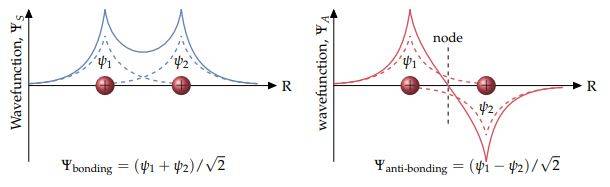
The discussion centers on the linear combinations of atomic orbitals (LCAO) method used to approximate molecular orbitals, specifically for the hydrogen molecular ion H2+. It highlights that the bonding and anti-bonding orbitals arise from summing two 1s orbitals, with the anti-bonding orbital featuring one negative wavefunction due to the nature of the linear combination. This negative component reflects the anti-symmetric nature of the wavefunction, which is essential for maintaining the overall properties of the molecular orbital. The choice of basis for these combinations can vary, but the symmetric and antisymmetric combinations provide a clear approximation of the molecular orbitals. Understanding these concepts is crucial for grasping the behavior of covalent bonds in molecular chemistry.
Avardia
Messages
6
Reaction score
0
So I've been looking at covalent bonds and come across the approx you can do of the molecular orbital for ##H^+_2## by just summing two 1s orbitals, the method is called the linear combinations of atomic orbitals, and you get what is below which I believe is exact in this case since the 1s orbital is all there is. And the orbital is just the wavefunction of electron.
241690


So one is the bonding and the other is anti-bonding orbital. My question is why in the anti-bonding orbital do we have one of the summed 1s wavefunctions as negative?
 
Physics news on Phys.org
Avardia said:
My question is why in the anti-bonding orbital do we have one of the summed 1s wavefunctions as negative?
You don't have to. You're essentially doing a change of basis from the atomic orbitals to the molecular orbitals, so you can choose any two combinations of hydrogen 1s orbitals, as long as the combinations are linearly independent. It so happens that the fully symmetric and fully antisymmetric linear combinations of atomic orbitals closely approximate the bonding and antibonding molecular orbitals. You could choose a different basis, but you'd have much more complicated looking functions for your molecular orbitals.
 
  • Like
Likes DrClaude
Thread 'Unexpected irregular reflection signal from a high-finesse cavity'
I am observing an irregular, aperiodic noise pattern in the reflection signal of a high-finesse optical cavity (finesse ≈ 20,000). The cavity is normally operated using a standard Pound–Drever–Hall (PDH) locking configuration, where an EOM provides phase modulation. The signals shown in the attached figures were recorded with the modulation turned off. Under these conditions, when scanning the laser frequency across a cavity resonance, I expected to observe a simple reflection dip. Instead...

Similar threads

  • · Replies 2 ·
Replies
2
Views
656
  • · Replies 4 ·
Replies
4
Views
4K
  • · Replies 3 ·
Replies
3
Views
2K
  • · Replies 1 ·
Replies
1
Views
2K
  • · Replies 4 ·
Replies
4
Views
3K
Replies
5
Views
2K
Replies
4
Views
5K
Replies
2
Views
5K
  • · Replies 4 ·
Replies
4
Views
2K
  • · Replies 6 ·
Replies
6
Views
2K