Locus of Incentre Problem: Find Ellipse

  • Context:
  • Thread starter Thread starter Saitama
  • Start date Start date
Join the discussion
Ask a follow-up here, or get your own question answered by working scientists, mathematicians and engineers — people, not an autocomplete.
Real named experts · corrections over time · the nuance an AI answer skips
3 replies · 7K views
Saitama
Messages
4,244
Reaction score
93
Problem:
Given the base of a triangle and sum of its sides, then the locus of the centre of its incircle is:

A)straight line
B)circle
C)ellipse
D)hyperbola

Attempt:
Since the given answer is ellipse, I tried showing that the sum of the distances of incentre from the end points of base is constant.

The side lengths opposite to vertex A, B and C are a, b and c respectively. As per the question, a (base) and a+b+c is given. The distance IB is $r/\sin(B/2)$ and IC is $r/\sin(C/2)$, where $r$ is the radius of incircle. Hence,

$$IB+IC=r\left(\frac{1}{\sin(B/2)}+\frac{1}{\sin(C/2)}\right)\,\,\,\, (*)$$
I use the following formulas:
$$r=\frac{\Delta}{s}=\sqrt{\frac{(s-a)(s-b)(s-c)}{s}}$$
$$\sin\left(\frac{B}{2}\right)=\sqrt{\frac{(s-a)(s-c)}{ac}}$$
$$\sin\left(\frac{C}{2}\right)=\sqrt{\frac{(s-a)(s-b)}{ab}}$$
Substituting in (*) and simplifying,
$$IB+IC=\sqrt{\frac{a}{s}}\left(\sqrt{c(s-b)}+\sqrt{b(s-c)}\right)$$
The terms outside the parentheses is constant, I am unable to prove that the terms inside the parentheses are a constant too. :(

Any help is appreciated. Thanks!
 

Attachments

  • triangle.png
    triangle.png
    4.1 KB · Views: 164
Mathematics news on Phys.org
This is an interesting problem. The points $B$ and $C$ are fixed, and the triangle $ABC$ has a constant perimeter. So the point $A$ must lie on an ellipse with foci at $B$ and $C$. The incentre $I$ also lies on an ellipse, but the foci of that ellipse are not at $B$ and $C$, so you should not expect $\overline{IB} + \overline{IC}$ to be constant.

The only way I can solve the problem is to use coordinate geometry. Let $A$ be the point $(a\cos\theta,b\sin\theta)$, so that $$\frac{x^2}{a^2} + \frac{y^2}{b^2} = 1$$ is the ellipse on which $A$ lies. Then $B$ and $C$ are the foci of that ellipse, with coordinates $B = (-ae,0)$, $C = (ae,0)$, where $e$ is the eccentricity of the ellipse, given by $b^2 = a^2(1-e^2)$. The lengths of the sides of the triangle are $\overline{BC} = 2ae$, $\overline{CA} = a(1-e\cos\theta)$, $\overline{AB} = a(1+e\cos\theta)$.

I then used a very useful formula for the coordinates of the incentre that I found here. In words, it says that you take the coordinates of the three vertices of the triangle, multiply each of them by the length of the opposite side, add them, and finally divide by the perimeter of the triangle. I leave you to apply that formula to our triangle here. I found that it gives $I = \Bigl(ae\cos\theta, \dfrac{be\sin\theta}{1+e}\Bigr).$ Thus $I$ lies on the ellipse $$\frac{x^2}{a^2e^2} + \frac{(1+e)^2y^2}{b^2e^2} = 1$$, which passes through the points $B$ and $C$ (and so certainly does not have its foci at those points).
 
Like Opalg, I found this problem interesting and find a coordinate geometry approach to be the most straightforward.

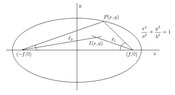
I decided to orient the fixed base of the triangle along the $x$-axis whose center is at the origin, and let its length be $2f$. From the definition of an ellipse, we know the locus of the movable vertex is an ellipse, which I describe by:

$$\frac{x^2}{a^2}+\frac{y^2}{b^2}=1$$

Please refer to the following diagram:

View attachment 1857

Point $P$ is an arbitrary point on the ellipse, and point $I$ is the associated incenter. It is the intersection of the two angle bisectors $\ell_1$ and $\ell_2$.

Let's parametrize point $P$ as follows:

$$x(t)=t$$

$$y(t)=\frac{b}{a}\sqrt{a^2-t^2}$$

where $$-a\le t\le a$$

While we are only considering the top half of the ellipse here, a similar argument could be used for the bottom half.

For these two lines, we know they pass through the foci of the ellipse, so we need to determine their slopes.

For line $\ell_1$, let's first look at the slope of the line through the points:

$$\left(t,\frac{b}{a}\sqrt{a^2-t^2} \right)$$ and $$(f,0)$$

It's angle of inclination is therefore:

$$\theta_1=\tan^{-1}\left(\frac{b\sqrt{a^2-t^2}}{a(t-f)} \right)$$ where $$t\ne f$$

And so the angle of inclination of $\ell_1$ is:

$$\frac{\theta_1}{2}=\frac{1}{2}\tan^{-1}\left(\frac{b\sqrt{a^2-t^2}}{a(t-f)} \right)$$

Hence, the slope of $\ell_1$ is found using a half-angle identity for tangent:

$$m_1=\frac{\sin\left(\tan^{-1}\left(\dfrac{b\sqrt{a^2-t^2}}{a(t-f)} \right) \right)}{1+\cos\left(\tan^{-1}\left(\dfrac{b\sqrt{a^2-t^2}}{a(t-f)} \right) \right)}$$

Using the fact that $$f^2=a^2-b^2$$ we find:

$$m_1=-\frac{b}{a+f}\sqrt{\frac{a+t}{a-t}}$$

Armed now with the slope and the point through which it passes, line $\ell_1$ is given by (using the point-slope formula):

$$y=\frac{b}{a+f}\sqrt{\frac{a+t}{a-t}}(f-x)$$

For line $\ell_2$, let's first look at the slope of the line through the points:

$$\left(t,\frac{b}{a}\sqrt{a^2-t^2} \right)$$ and $$(-f,0)$$

It's angle of inclination is therefore:

$$\theta_2=\tan^{-1}\left(\frac{b\sqrt{a^2-t^2}}{a(t+f)} \right)$$ where $$t\ne -f$$

And so the angle of inclination of $\ell_2$ is:

$$\frac{\theta_2}{2}=\frac{1}{2}\tan^{-1}\left(\frac{b\sqrt{a^2-t^2}}{a(t+f)} \right)$$

Hence, the slope of $\ell_2$ is found using a half-angle identity for tangent:

$$m_2=\frac{\sin\left(\tan^{-1}\left(\dfrac{b\sqrt{a^2-t^2}}{a(t+f)} \right) \right)}{1+\cos\left(\tan^{-1}\left(\dfrac{b\sqrt{a^2-t^2}}{a(t+f)} \right) \right)}$$

Using the fact that $$f^2=a^2-b^2$$ we find:

$$m_2=\frac{b}{a+f}\sqrt{\frac{a-t}{a+t}}$$

Armed now with the slope and the point through which it passes, line $\ell_2$ is given by (using the point-slope formula):

$$y=\frac{b}{a+f}\sqrt{\frac{a-t}{a+t}}(x+f)$$

Equating the two lines, and solving for $x$, we find:

$$=\frac{b}{a+f}\sqrt{\frac{a+t}{a-t}}(f-x)=\frac{b}{a+f}\sqrt{\frac{a-t}{a+t}}(x+f)$$

$$(a+t)(f-x)=(a-t)(x+f)$$

$$af-ax+ft-tx=ax+af-tx-ft$$

$$ft=ax\implies x=\frac{f}{a}t\implies y=\frac{b}{a+f}\sqrt{f^2-x^2}$$

Squaring this value for $y$, (which gives us the bottom half) we obtain the locus for $I$:

$$\frac{x^2}{f^2}+\frac{y^2}{\left(\dfrac{bf}{a+f} \right)^2}=1$$

which is clearly an ellipse.
 

Attachments

  • pranav.jpg
    pranav.jpg
    11.9 KB · Views: 144
Hi Opalg and MarkFL! :)

Thank you both for your helpful solutions. I prefer to stay with parametric coordinates used by Opalg. :P

It was very silly of me to consider B and C as the foci. :o

About that incentre formula, it is also in my course and I need to memorise that (Doh).

Thank you once again.