Logo - Help the turtle escape the room

  • Context:
  • Thread starter Thread starter Yankel
  • Start date Start date
  • Tags Tags
    Escape
Join the discussion
Ask a follow-up here, or get your own question answered by working scientists, mathematicians and engineers — people, not an autocomplete.
Real named experts · corrections over time · the nuance an AI answer skips
1 reply · 2K views
Yankel
Messages
390
Reaction score
0
Hello all,

I have a question, would like to have your opinion on the matter.

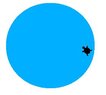
In the Logo programming language, I draw a red blue circle and put a turtle in it. I have specified that the turtle will move forward constantly, but, when approaching a white background (the page's background), it will turn right by 135 degrees. As a result, every time the turtle comes to exit the circle, it turns around and moved forward another way, staying in the circle. In this way the turtle never escapes the circle.

The question is: Is there a starting position (for the turtle itself and/or his head) that will allow him to escape?

Thank you !

View attachment 7237
 

Attachments

  • turtle.JPG
    turtle.JPG
    4.3 KB · Views: 137
Physics news on Phys.org
Yankel said:
Hello all,

I have a question, would like to have your opinion on the matter.

In the Logo programming language, I draw a red blue circle and put a turtle in it. I have specified that the turtle will move forward constantly, but, when approaching a white background (the page's background), it will turn right by 135 degrees. As a result, every time the turtle comes to exit the circle, it turns around and moved forward another way, staying in the circle. In this way the turtle never escapes the circle.

The question is: Is there a starting position (for the turtle itself and/or his head) that will allow him to escape?

Thank you !

Without loss of generality we can assume that the turtle escapes at the top.

\begin{tikzpicture}[>=stealth,shorten >=2pt,,shorten <=2pt]
\fill[cyan!50] circle (2);
\draw[help lines] (-3,-3) grid (3,3);
\draw circle (2);
\fill (0,2) circle (0.07);
\draw (2,0) -- (-1,3);
\draw[->, thick] (2,0) -- (0,2);
\draw[->, thick] (0,2) -- (2,2);
\draw[->] (0,2) +(62.5:0.7) node {$135^\circ$} +(135:1) arc (135:0:1);
\fill (0,0) circle (0.07);
\draw[<->] (0,0) -- node[below, xshift=4] {\small$\frac 12\sqrt 2$} (1,1);
\end{tikzpicture}

If the turtle starts somewhere on the first vector, or in the area that's above it, and moves to the top, it will escape.
And it's not possible to escape in 2 hits or more.

More generally, if the turtle is within distance $\frac 12 \sqrt 2$ of the center, it cannot escape.
And otherwise, it can escape, but only if it is directed at a point where the given angle is $135^\circ$ or less.