Discussion Overview
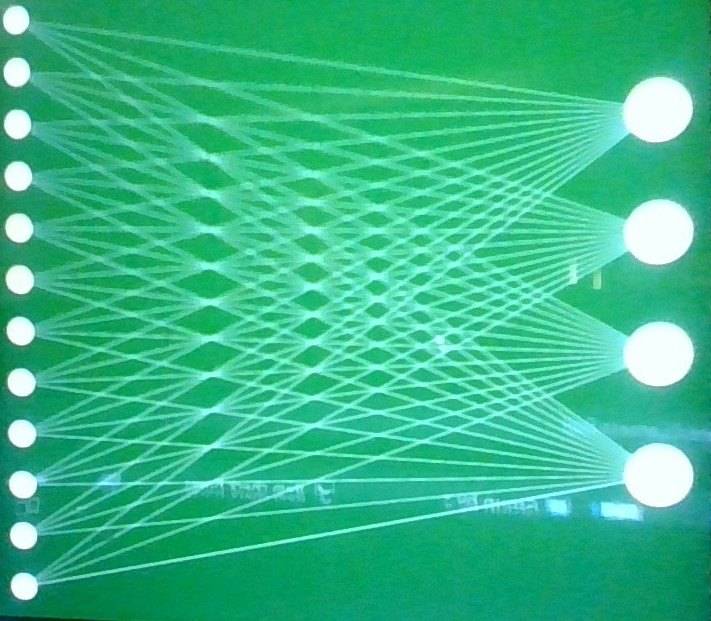
The discussion revolves around finding a formula to determine the number of possible connections between two sets of objects, specifically focusing on a scenario with 12 objects on one side and 4 on the other. Participants explore various interpretations of the problem, including the implications of bipartite graphs and the counting of unique configurations.
Discussion Character
- Exploratory
- Technical explanation
- Debate/contested
- Mathematical reasoning
Main Points Raised
- One participant proposes that the number of connection possibilities for each node on the left is the number of subsets of the nodes on the right, leading to a formula of ##\text{left-nodes}^{(2^\text{right-nodes})}##.
- Another participant corrects an earlier claim, suggesting the formula should be ##(2^{\text{right-nodes}})^{\text{left-nodes}}##, resulting in ##2^{48}## possible configurations.
- Some participants discuss the implications of isomorphic configurations in bipartite graphs, noting that while there are many configurations, some may be isomorphic, complicating the counting of unique arrangements.
- There is a suggestion that the question may need clarification, as some participants express uncertainty about the interpretation of the problem.
- One participant emphasizes the practical application of labeling connections in network configurations, relating it to the discussion of isomorphic graphs.
- Another participant reiterates the need for a formula that generalizes the number of connections based on the number of objects on each side, suggesting a formula of the form ##z=2^{(x \times y)}##.
Areas of Agreement / Disagreement
Participants express varying interpretations of the problem, with some agreeing on the general approach to counting configurations while others highlight the complexities introduced by isomorphism. The discussion remains unresolved regarding the exact formula and its implications.
Contextual Notes
Participants note that the counting of configurations may depend on whether the vertices are distinguishable or indistinguishable, which affects the total number of unique arrangements. The discussion also touches on the complexity of isomorphic configurations as the number of nodes increases.
Who May Find This Useful
This discussion may be of interest to those studying combinatorial mathematics, graph theory, or anyone involved in network design and configuration.